Original title: Hal Finney: Bitcoin’s Digital Pioneer
Original author: Token Dispatch and Thejaswini M A
Original compilation: Block unicorn
Foreword
“Running Bitcoin,” the tweet read. Simple and unadorned, it contained only a few words and was posted on January 11, 2009. Behind this brief message was Hal Finney, who became the first recipient of a Bitcoin transaction in history: just a day later, Satoshi Nakamoto sent him 10 BTC directly. While the debate over Satoshi’s identity rages on, one fact is indisputable: without Hal Finney, Bitcoin might have remained an obscure white paper rather than the financial revolution we know today.
Although he passed away in 2014 due to amyotrophic lateral sclerosis (ALS), his legacy continues to shape the evolution of cryptocurrency. From his early work on privacy software to his final contributions completed through eye-tracking technology after becoming physically paralyzed, Finney’s life seems to be a blueprint of the cyberpunk values embedded in Bitcoin’s DNA.
From Keling to Crypto Punk
Harold Thomas Finney II was born on May 4, 1956, in Coalinga, California, showing an early talent for mathematics and computing. After earning an engineering degree from the California Institute of Technology in 1979, he began his career in the video game industry. At Mattel Electronics, Finney developed several notable console games, including “Adventure” “Armored Assault” and “Space Attack.” Finney’s career trajectory and the development of digital currency itself cannot be separated from the backdrop of the cypherpunk movement that emerged in the late 1980s and early 1990s.

Cypherpunks are a loose collective of privacy advocates, cryptographers, and libertarian technologists who believe that strong cryptography can protect civil liberties from government intrusion and reshape society. The foundational text of the movement, Timothy May’s “Crypto Anarchist Manifesto,” claims that cryptographic technology will fundamentally change the nature of government regulation and taxation. Finney found his ideological home among these digital revolutionaries. Established in 1992, the Cypherpunk mailing list became an important platform for discussing revolutionary ideas about privacy, anonymity, and freedom in the digital age.
In the early 1990s, Finney joined PGP Inc. and collaborated with cryptography pioneer Phil Zimmermann to develop “Pretty Good Privacy” (PGP), an encryption software designed to protect email communications from surveillance. This was not only a technical endeavor but also a form of political activism, as the U.S. government classified strong encryption technology as munitions, restricting its export and subjecting it to the same regulations as weapons. Finney operated two of the earliest cryptography-based anonymous remailer systems, allowing people to send emails without revealing their identities. This was radical technology in the early 1990s, embodying the motto of the cypherpunks: “Cypherpunks write code.”
Digital Cash Experiment
Finney’s natural concern for privacy led him to develop an interest in digital currency. For cypherpunks, this connection is obvious: in an increasingly monitored world, financial privacy represents one of the last frontiers of personal freedom. This interest is not unique. Cypherpunks like David Chaum, Adam Back, Wei Dai, and Nick Szabo proposed various digital cash systems in the 1990s. Finney closely studied their work and engaged in extensive correspondence with Wei Dai and Szabo.
In 2004, Finney created his own digital currency system called Reusable Proof of Work (RPOW). Based on Adam Back’s Hashcash concept, RPOW aims to solve the “double spending problem” through a unique method: tokens that can only be used once, preventing the same digital currency from being used multiple times. The system creates RPOW tokens by allowing clients to provide a proof of work string of a given difficulty (signed by their private key). The tokens are then registered on the server to that signing key. Users can transfer tokens by signing a transfer order to another public key, and the server will update the registration accordingly.
To address security issues, RPOW utilized the IBM 4758 secure cryptographic co-processor, making the server more trustworthy than traditional systems. Although RPOW was never widely adopted, it represented a key step towards Bitcoin, showcasing Finney’s profound understanding of how to create digital scarcity. When a mysterious figure named Satoshi Nakamoto published a white paper titled “Bitcoin: A Peer-to-Peer Electronic Cash System” to a cryptography mailing list in October 2008, most readers dismissed it. This was because cryptographers had seen too many grand plans from “clueless newcomers” before.
But Hal Finney saw something different.
The First User of Bitcoin
“I believe I was the first person to run Bitcoin aside from Satoshi Nakamoto,” Finney later recalled. “I mined the 70th block and I was the recipient of the first Bitcoin transaction when Satoshi sent me ten Bitcoins as a test.” This transaction in January 2009—10 BTC sent from Satoshi to Finney—has become legendary in cryptocurrency lore, marking the transition of Bitcoin from theory to an actual operating system.

In response to the Bitcoin white paper, Finney wrote:
“Bitcoin seems to be a very promising idea. I also believe that a form of token that cannot be forged, if its production rate is predictable and not influenced by corrupt parties, could have potential value.” In the following days, Finney communicated with Satoshi Nakamoto via email, reporting vulnerabilities and suggesting fixes. Unlike many cryptographers, he recognized the potential of Bitcoin early on.
His enthusiasm is not blind optimism. In a now widely known post from 2009, he wrote: “Think about how to reduce the carbon emissions brought by the widespread implementation of Bitcoin.” This indicates that he had already begun to consider the environmental impact of cryptocurrency mining. According to his rough calculations, each Bitcoin could be worth 10 million dollars. At that time, Bitcoin was worth only a few cents, and this prediction seemed absurd. Today, with Bitcoin prices hovering around 100,000 dollars, this prediction appears increasingly prescient.
Tragic Diagnosis and Lasting Legacy
The year 2009 was both a victory and a tragedy for Finney. While exploring the potential of Bitcoin, he received devastating news: he had amyotrophic lateral sclerosis (ALS), the same disease that plagued Stephen Hawking. ALS leads to the degeneration of motor neurons, ultimately causing patients to be unable to walk, speak, or breathe independently. Typically, the time from diagnosis to death ranges from two to five years.

However, even in the last few years of his life when his body was gradually failing, Finney’s mind remained sharp and his spirit undeterred. He continued to contribute to the development of Bitcoin and learned to use eye-tracking software for programming during his paralysis. According to his own estimates, his programming speed was about 50 times slower than before he fell ill.
Finnie even developed software that allowed him to control a mechanical wheelchair through eye movements—this demonstrated his innovative problem-solving ability even in the face of severe physical limitations. On August 28, 2014, 58-year-old Hal Finney passed away due to complications from ALS. According to his wishes, his body was cryogenically frozen at the Alcor Life Extension Foundation in Arizona, marking his final optimistic expression of technology’s potential to overcome human limitations.
Connection with Satoshi Nakamoto
When discussing Hal Finney, it is inevitable to involve speculation about whether he could be Satoshi Nakamoto. Finney lived in Temple City, California, and his neighbor was a Japanese-American named Dorian Nakamoto. Some have speculated that Finney might have borrowed his neighbor’s name as a pseudonym. He possessed technical skills, philosophical positions, and a writing style consistent with those of Satoshi Nakamoto. Nakamoto disappeared from the public eye in April 2011, which coincides roughly with the deterioration of Finney’s health. Finney has always denied being Satoshi Nakamoto, and evidence suggests that they are different individuals.
Moreover, the Bitcoin private keys controlled by Satoshi Nakamoto have not been used since his disappearance, and it seems unlikely that this situation would occur if Finney could access those keys. Finney’s wife, Fran, has put forth a compelling rebuttal, as she has consistently claimed that her husband is not Satoshi Nakamoto. Given Finney’s candor about his involvement in Bitcoin activities and his deteriorating health, he seems to have no reason to continue such deception. Whether or not he is Satoshi Nakamoto, Finney’s contributions to Bitcoin and cryptocurrency are significant in their own right.
Since the passing of Finnie, his legacy has continued in the cryptocurrency space through various forms of tribute. His wife, Fran Finney, founded the annual “Bitcoin Run Challenge” aimed at raising funds for amyotrophic lateral sclerosis (ALS) research, taking inspiration from Finney’s iconic tweet in 2009. The event invites participants to complete any distance by running, walking, or rolling while raising funds for the ALS Association.
“The Bitcoin Challenge” has become an important event in the cryptocurrency community calendar. In 2023, the challenge raised over $50,000 for ALS research, and the 2024 event exceeded this figure, highlighting the ongoing respect for Finney. Fran also took over Hal’s Twitter account, allowing his memory to live on by sharing stories and responding to the cryptocurrency community’s ongoing gratitude.
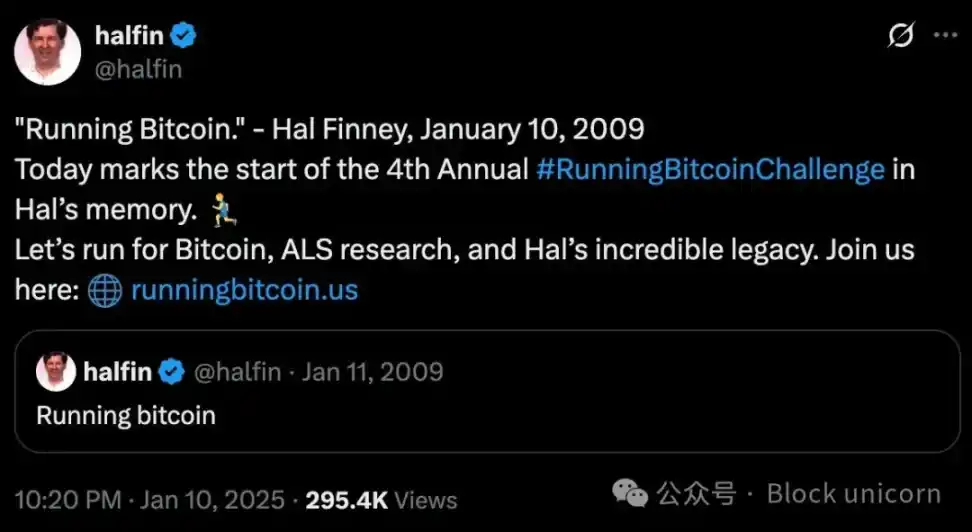
The approval date by the U.S. Securities and Exchange Commission for the first Bitcoin spot exchange-traded fund (ETF) coincides exactly with the date of Finney’s historic tweet 15 years later, which is January 11, 2024.
Our Viewpoint
For many in the cryptocurrency space, Finney represents an ideal: a talented technologist who combines technical expertise with ethical principles, remaining optimistic despite personal tragedy, and views technology as a tool for achieving human freedom. While Satoshi Nakamoto remains shrouded in mystery, Finney serves as the human face of Bitcoin, reminding us that behind the code and cryptography, cryptocurrency is ultimately about people and their yearning for a better world.
The story of Hal Finney forces us to confront some unsettling questions: What do we truly value in the world of cryptocurrency? While the cryptocurrency industry celebrates wealth creation and technological disruption, Finney’s legacy challenges us to think about a more fundamental question: What are all these innovations really for? A movement that originally sought to protect individual freedom through mathematics has sometimes evolved into a form similar to the financial system it sought to replace—centralized, extractive, and often opaque.
Finney’s approach to technology seems simple: to build tools that expand human freedom. Not freedom as an abstract political concept, but actual, everyday freedom—communicating without surveillance, trading without permission, and retaining ownership of one’s digital identity. His life demonstrates the power of personal integrity in technology development. Unlike many who compromise their principles for market demands, Finney maintained an astonishing consistency between his values and his work. From PGP to RPOW to Bitcoin, each project represents another step towards the same goal: enhancing individual autonomy through cryptography.
The industry should ask itself: Does the system we have built align with Hal Finney’s understanding and help advance the vision of cyberpunk? Or have we lost sight of the original revolutionary direction in our pursuit of the next price surge?
Original link
:


