HappyMinerUncle

vip
Age 1 Yıl
Peak Tier 2
No content yet
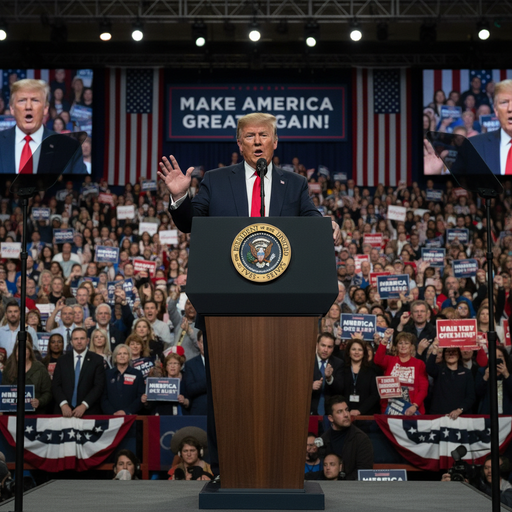
An interesting paradox has been unfolding in U.S. markets over the past few months. Stock indices are rising, while the political approval rating of the country’s top person is falling. It sounds strange, but that’s exactly what we’re seeing right now.
Based on the latest polls by Economist and YouGov, the approval situation is becoming increasingly tense. Trump’s rating has fallen to 37%, while disapproval has reached 57%. This means a net rating of minus twenty percent—a new low during his second term. The figures speak for themselves.
Even more telling is that a split is beginning even with
View Original
  • Reward
  • Comment
  • Repost
  • Share
When I first started understanding trading, one thing struck me: everything on the chart looks chaotic, but in reality, there’s a clear logic behind it. Large players leave traces of their actions, and if you know where to look, you can understand how they think.
Here’s what I mean. Order blocks and imbalances are like fingerprints of big capital in the market. An order block is a zone where big money placed their orders, and these areas often become the start of a significant price movement. When you see the price sharply reverse in the opposite direction, it usually means something happened
View Original
  • Reward
  • Comment
  • Repost
  • Share
I noticed an interesting pattern on the Dogecoin chart. Since October 2023, the price has been developing within an upward megaphone, which looks like a classic accumulation phase against the backdrop of the entire altcoin market. This resembles a pattern called the Livermore cylinder—the very trading template that Jesse Livermore came up with a century ago. Interestingly, its principles still work extremely well on modern assets.
I applied the Livermore cylinder to the Dogecoin megaphone, and although it’s not a perfect match, the main characteristics fit quite well. Clear bullish and bearish
DOGE1,5%
View Original
  • Reward
  • Comment
  • Repost
  • Share
I noticed that Robert Kiyosaki has been increasingly outspoken lately about the state of the global economy. His warnings sound almost like alarms: markets are in a historic bubble, and a crash is inevitable. But what is he so concerned about? Let’s figure it out.
According to Kiyosaki, the main problem is government debt, which has already become an unbearable burden, especially for the U.S. government. Governments cannot pay it off honestly, so they choose the easiest way: printing money. But printing money does not create wealth — it creates inflation. And now the dollar is gradually losing
View Original
  • Reward
  • Comment
  • Repost
  • Share
I've noticed that many newcomers to crypto don't understand what scalping is and why some traders consistently make money from it. Let's figure out what this strategy is all about and whether you can make a profit from it.
Scalping is trading on minimal price movements within seconds or a few minutes. Imagine: you buy Bitcoin at 69,200 and sell at 69,205. The profit is tiny, but if you make dozens of such trades a day, it adds up to a significant income. It sounds simple, but in reality, it requires speed, focus, and composure.
What should you understand about scalping? First, speed is everyth
BTC3,51%
ETH3,98%
View Original
  • Reward
  • Comment
  • Repost
  • Share
I've noticed that Solana has been drawing more and more attention lately—not only as a blockchain, but also as a platform for passive income. SOL staking is indeed one of the more profitable options on the market.
How does it work in practice? You send your SOL to a validator, which is responsible for confirming transactions in the network. In return, you receive rewards in the form of new coins. The key is that you don’t lose control over your funds—you can withdraw them at any time. Unstaking will take a couple of days, but that’s normal.
Now, about earnings. The average annual yield stays i
SOL2,43%
View Original
  • Reward
  • Comment
  • Repost
  • Share
Recently, I noticed that many people in the crypto community use CAGR to evaluate their investments, but it's often misunderstood. Let's clarify what it actually is and why it matters.
CAGR stands for Compound Annual Growth Rate — one of the most reliable ways to assess how your investments performed over a certain period. Unlike simple percentage gains, CAGR accounts for the effect of compound interest, meaning profits grow on themselves year after year.
Why is this important? Because if you see an investment that has doubled in two years, it doesn't mean it grows by 50% per year. CAGR gives
View Original
  • Reward
  • Comment
  • Repost
  • Share
Honestly, every time the market starts to rise, everyone is looking for the same thing — that very cheap cryptocurrency that can deliver 100x or even 1000x. And I understand why it’s so attractive. If a coin costs $0.004, it only needs to reach $4 to give 1000x. Compare this with a coin at $100 — it would have to reach $100k per coin, which is practically impossible.
But here’s the catch: not every cheap cryptocurrency is a gold mine. Most of them just disappear. So if you’re looking for a truly promising project, you need to look at specific things.
First, utility. The cheapest cryptocurren
View Original
  • Reward
  • Comment
  • Repost
  • Share
It's interesting to see how the landscape of global wealth has changed at the beginning of this year. Tech giants now dominate the lists in a completely different way than before, and the gap between the leaders is simply astronomical.
Elon Musk remains the richest person in the world with a net worth of around $726 billion — a record in modern history. No one has accumulated such personal wealth before. SpaceX’s valuation continues to rise, Starlink is expanding, Tesla keeps growing, and his influence in artificial intelligence and neurotechnology is increasing. This is not just money — it’s
View Original
  • Reward
  • Comment
  • Repost
  • Share
Recently, I noticed that many people confuse the terms bull and bear markets, even though these are fundamental concepts for any trader. Let's clarify what a bull market is — a phenomenon that defines the overall character of trading in cryptocurrencies.
A bull market is a condition where asset prices rise consistently and steadily over weeks, months, or even years. In cryptocurrencies, such periods are often accompanied by a wave of optimism and increasing demand for assets. Bitcoin is currently trading around $67,300 with a slight gain during the day, but remember, this does not guarantee co
BTC3,51%
ETH3,98%
SOL2,43%
View Original
  • Reward
  • Comment
  • Repost
  • Share
I've noticed that many people get confused about order blocks, even though they are quite an important tool for market analysis. Let's figure out what they actually are and how they work.
An order block is essentially a zone on the chart where major players—banks, institutions, market makers—concentrate their orders. When a large number of big orders accumulate in one place, it creates significant pressure on the price, causing it to move sharply. These zones usually form before an impulse: the last candle before a strong move, which goes against the main trend.
There are several types, and th
View Original
  • Reward
  • Comment
  • Repost
  • Share
I've noticed that many newcomers to crypto overlook one of the most useful patterns for trading. It's about the pennant—a figure that helps catch the continuation of a trend when others are still uncertain.
In trading, a pennant is essentially a consolidation that appears after a sharp price movement. Imagine: the price suddenly surges or drops (this is the flagpole), then begins trading within a narrow range, forming a small triangle. Usually, this occurs somewhere in the middle of a trend, signaling the start of the second half of the movement.
What's interesting is that a pennant forms quit
View Original
  • Reward
  • Comment
  • Repost
  • Share
I want to share an interesting observation about technical analysis. Recently, I noticed that many traders underestimate the power of simple chart patterns, especially when it comes to trend reversals. One of the most reliable is the double bottom pattern, and here’s why it deserves your attention.
The double bottom pattern is based on a simple idea: the price falls, reaches a low, bounces up, and then falls again roughly to the same level but does not break it. This signals that the (sellers) are losing strength, and the (buyers) are starting to take control. Looking at the chart, the structu
BTC3,51%
BNB2,44%
TRB1,7%
View Original
  • Reward
  • Comment
  • Repost
  • Share
It is interesting to trace which countries were part of the Ottoman Empire throughout its history. It is one of the largest empires in terms of territorial extent.
In Europe, Ottoman rule was particularly long-lasting. Turkey was under their control for 623 years, Bulgaria for 515 years, North Macedonia for 542 years. Greece experienced their influence for 370 to 520 years depending on the region. Serbia for 419 years, Montenegro for 399 years, Bosnia and Herzegovina for 415 years. Even Croatia was partially conquered for 147 years, Kosovo for 524 years. Interestingly, Romania was divided: Wal
View Original
  • Reward
  • Comment
  • Repost
  • Share
I recently came across statistics about the poorest countries in the world based on GDP per capita for 2025. The picture is quite grim, to be honest. South Sudan leads in poverty with only $251 per person. Yemen, Burundi, the Central African Republic, and Malawi are all below $600. Interestingly, most of the world's poorest countries are concentrated in Africa, although there are exceptions like Myanmar, Nepal, and East Timor. Looking at the entire list, it's clear that even among the 50 poorest countries, India only makes it to the end — $2,878. The average for these 50 nations is around $1,
View Original
  • Reward
  • Comment
  • Repost
  • Share
I've noticed that the crypto market is increasingly discussing rare candlestick patterns that can provide good entry signals. One of them is the Dragon pattern, and honestly, when I first heard the name, I thought it was just a marketing gimmick. But then I started to look into it and understood why experienced traders pay attention to it.
The Dragon pattern is an interesting candlestick formation that resembles a double bottom in structure but has its own features. The idea is simple: you see two low points, with an upward line between them (called the neckline), and then the price moves up a
View Original
  • Reward
  • Comment
  • Repost
  • Share
Honestly, when I was just starting to get into crypto, utility tokens seemed to me like the most confusing thing. And then I realized—it’s simply the key to the ecosystem.
Think of it this way: a utility token is not just a digital asset; it’s a ticket to the club. When you hold it, you get access to services, functions, and opportunities within a blockchain platform that are not available to regular users. This could be a discount on fees, the ability to vote, earning rewards through staking, or simply paying for transactions within the network.
Take Ethereum—it’s a classic example. ETH is us
ETH3,98%
LINK4,15%
UNI1,74%
View Original
  • Reward
  • Comment
  • Repost
  • Share
By the way, I noticed that many newcomers still get confused about what a bear market is and why it happens in the first place. Honestly, that's normal. Let’s clarify it without unnecessary fluff.
A bear market in crypto is when prices drop 20% or more from recent highs. It sounds simple, but it’s not just a decline. It’s a whole period when market sentiment turns gloomy, investors panic, and sell more than they buy. It can last weeks, months, or even years. The complete opposite of a bull market, where everyone is optimistic and buying assets.
So, what causes these bear periods? There are sev
View Original
  • Reward
  • Comment
  • Repost
  • Share
I've noticed that many newcomers to crypto don't understand one simple thing: the market is controlled by big players, and if you trade against their logic, you just drain your deposit. That's why I started delving into smart money trading.
The essence is that large capital (whales, banks, hedge funds, institutional investors) always act against crowd expectations. They play on the emotions of retail traders, create false signals, manipulate the price in their favor. And this is not theory — it’s the reality of every trading day.
When I studied smart money trading in more detail, I understood
View Original
  • Reward
  • Comment
  • Repost
  • Share
  • Pin