BTC_POWER_LA

vip
Age 2.1 Yıl
Peak Tier 0
No content yet
From @Snz_BTC. We went through this like 1000x.
BTC0,79%
  • Reward
  • Comment
  • Repost
  • Share
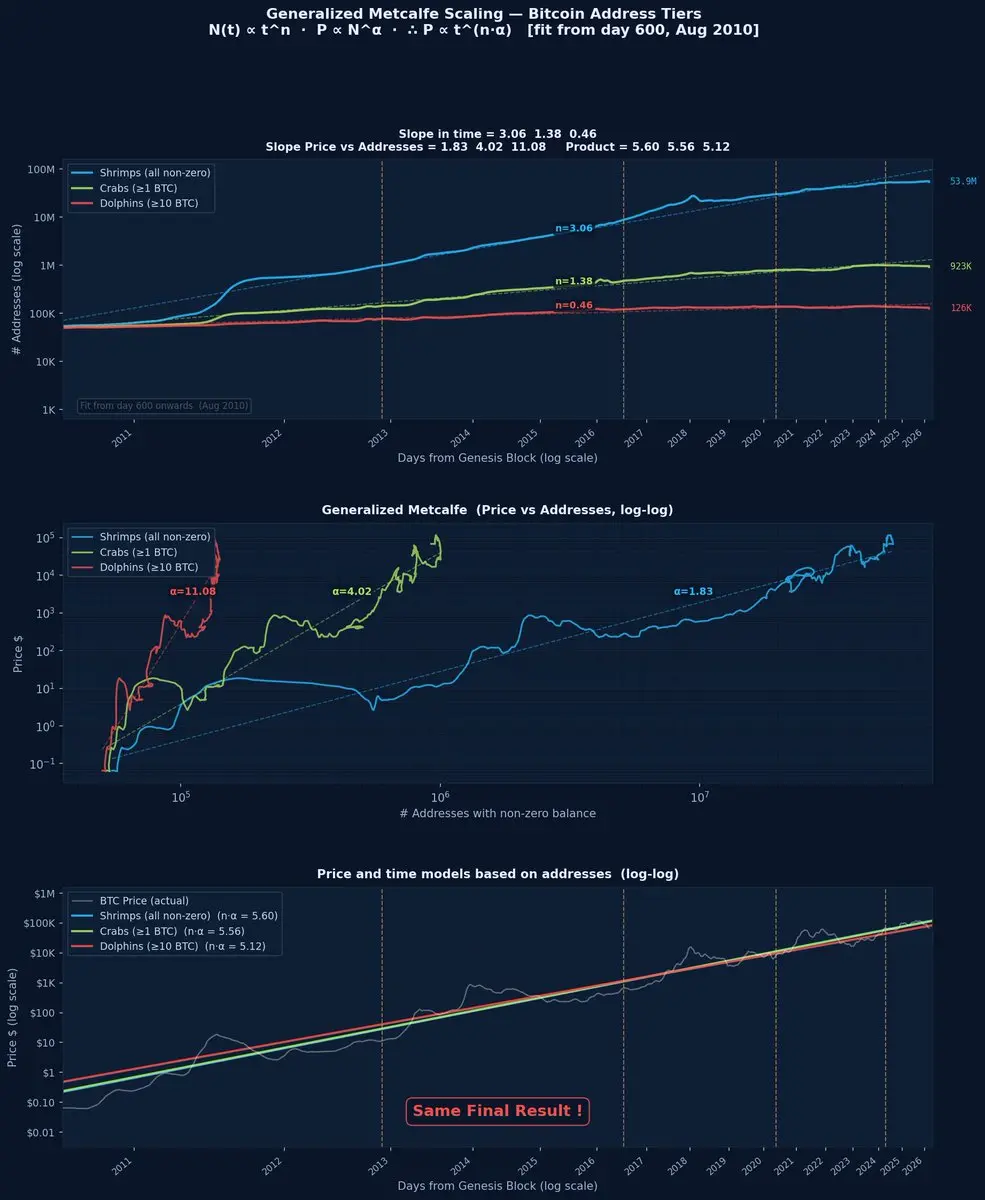
The power law emerges even when we use addresses with different wallet balances.
This is another signature of scale invariance.
Three address tiers were constructed:
•Shrimps = total non-zero balance addresses (the full dataset)
•Crabs = addresses holding ≥1 BTC = (1–10 BTC) + (10–100 BTC)
•Dolphins = addresses holding ≥10 BTC = (10–100 BTC) only
________________________________________
Panel 1 — N(t) vs time, log-log
Each tier is plotted as log₁₀(addresses) vs log₁₀(t_days). An OLS linear regression on these log-transformed values gives the power law exponent n for each tier — the slope of
BTC0,79%
post-image
  • Reward
  • Comment
  • Repost
  • Share
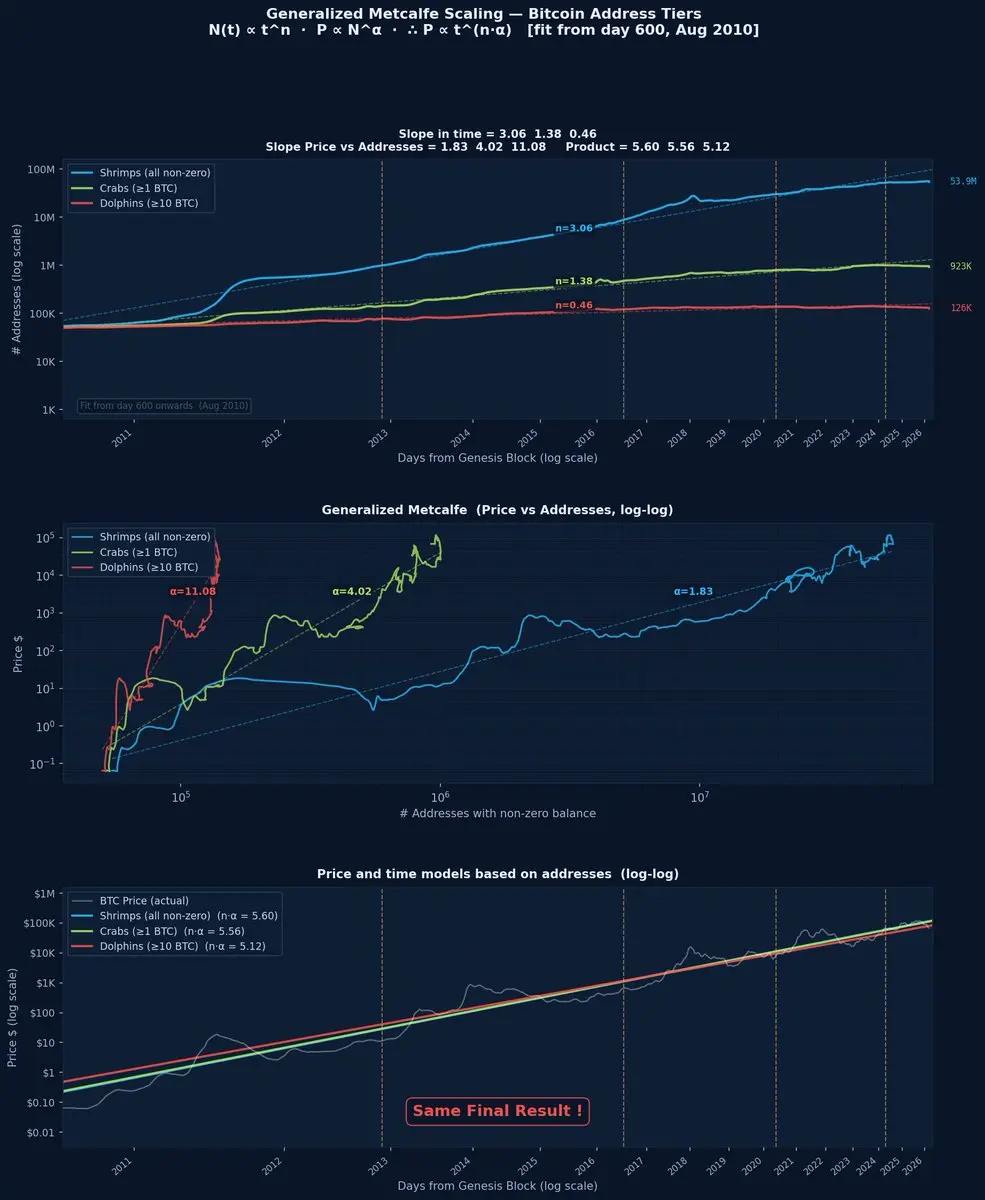
The power law emerges even when we use addresses with different wallet balances.
This is another signature of scale invariance.
Three address tiers were constructed:
•Shrimps = total non-zero balance addresses (the full dataset)
•Crabs = addresses holding ≥1 BTC = (1–10 BTC) + (10–100 BTC)
•Dolphins = addresses holding ≥10 BTC = (10–100 BTC) only
________________________________________
Panel 1 — N(t) vs time, log-log
Each tier is plotted as log₁₀(addresses) vs log₁₀(t_days). An OLS linear regression on these log-transformed values gives the power law exponent n for each tier — the slope of
BTC0,79%
post-image
  • Reward
  • Comment
  • Repost
  • Share
If we have so much noise in the system how do we know that Bitcoin follows a power law and it is scale invariant?
The answer is that noise and signal operate at different timescales, and the tests that establish the power law are specifically designed to separate them.
The residual noise of ±0.30 dex and the cycle-to-cycle variation in β of ±0.57 are both real. But they are oscillations around a stable attractor, not evidence that the attractor does not exist.
Think of it this way: a pendulum has a well-defined equilibrium position even though it is never at rest at that position. The amplit
BTC0,79%
  • Reward
  • Comment
  • Repost
  • Share
The PlanC saga continues
View Original
  • Reward
  • Comment
  • Repost
  • Share
Some other insights in why I fight fakes like PlanC so much:
Someone learning primarily through AI conversations acquires a particular kind of fluency.
They can engage with technical concepts, reproduce the vocabulary, generate plausible-sounding elaborations, and even identify methodological variations like the WLS reweighting — because AI is very good at explaining "here are alternative ways to estimate this." What they typically do not acquire is the deeper intuition that comes from having worked through problems from first principles, made mistakes that took months to understand, or built
  • Reward
  • Comment
  • Repost
  • Share
I love AI.
About PlanC "fixing the power law":
The current episode — claiming to "fix" the power law by pointing to a Δβ of 2.6% — follows the same template but in reverse. Instead of presenting the same thing as something new, he is presenting a minor methodological variant as a structural correction. The rhetorical structure in both cases is identical: establish distance from the original framework, claim novelty or superiority, and position the rebranded or adjusted version as one's own intellectual contribution. The scientific content in both cases is thin — the quantile model is the powe
  • Reward
  • Comment
  • Repost
  • Share
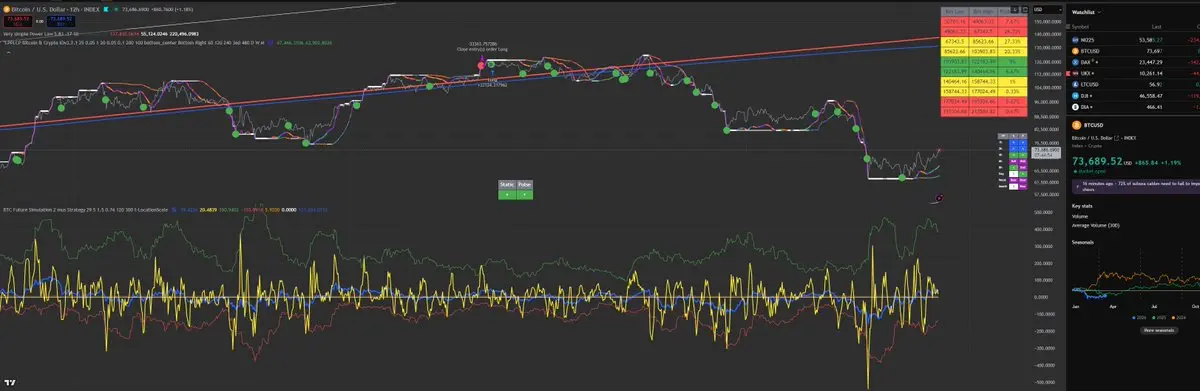
Bitcoin looking good. Leaving the local bottom and moving upward. All the indicators show local upswing. Local slopes on the up and up.
BTC0,79%
post-image
  • Reward
  • 1
  • Repost
  • Share
ThebeginningofLifevip:
Do your own research ( DYOR ) 🤓
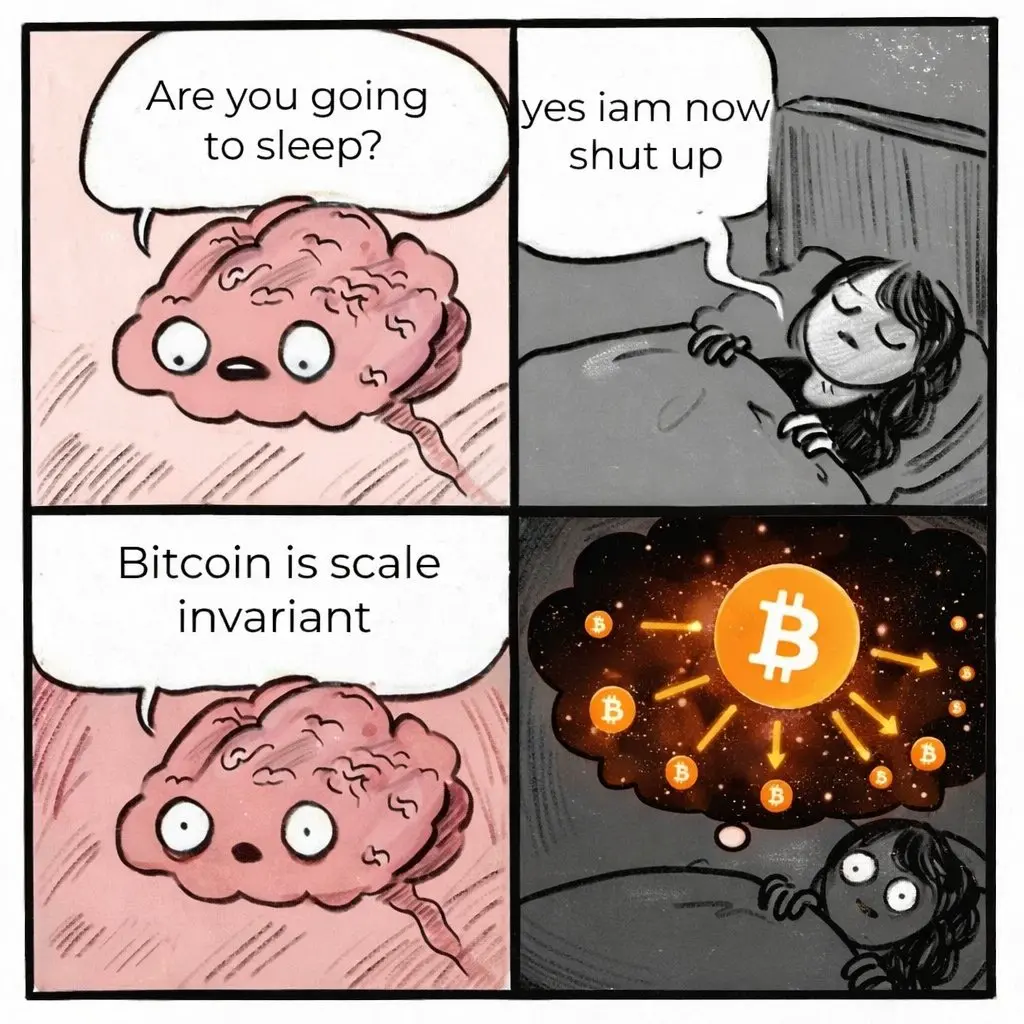
Me on an average night.
post-image
  • Reward
  • Comment
  • Repost
  • Share
I’m reading and re-reading my book The Physics of Bitcoin, and I’m really happy with how it turned out. It introduces many powerful ideas—from scale-invariant systems so common in nature, to network theory, to concepts like self-organized criticality.
You can read it straight through, or use it as a reference guide to better understand why Bitcoin behaves so differently from any other asset.
BTC0,79%
  • Reward
  • Comment
  • Repost
  • Share
Further test to check the stability of the power law using Bayesian analysis. No structural break. This one of the strongest and rigorous tests you can perform.
  • Reward
  • Comment
  • Repost
  • Share
My interview with Andrei Jikh lead to probably the best produced video on the power law.
  • Reward
  • Comment
  • Repost
  • Share
My interview with Andrei Jikh produced probably the best produced video on the power law.
  • Reward
  • Comment
  • Repost
  • Share
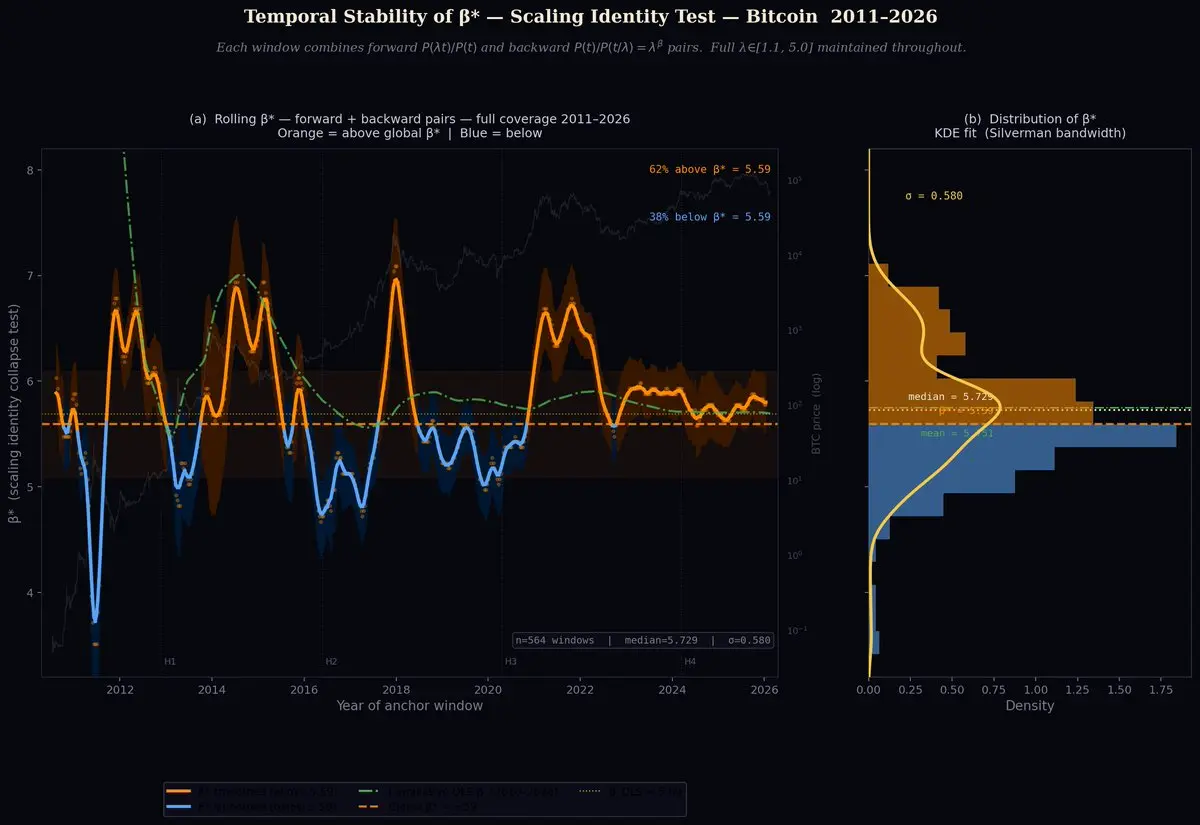
Stability of the power law exponent over time using several methods, regression and scale invariance.
post-image
  • Reward
  • Comment
  • Repost
  • Share
How stable is the exponent of the power law. Very stable. It simply oscillates around an average value.
  • Reward
  • Comment
  • Repost
  • Share
This graph goes even in more depth on how stable Bitcoin dynamical behavior is.
The left panel shows how the scaling equation holds as a function of shifts in times. Theoretically it should be a power law and it is.
It even shows the error bars that are symmetric and relative small given the incredible Bitcoin volatility.
This is how truly measure how stable the Bitcoin power law is.
BTC0,79%
  • Reward
  • Comment
  • Repost
  • Share
I emphasized so much that the power law is not a curve fitting exercise as some pseudo-analysts claim. It is about scaling laws and consistency of behavior of Bitcoin.
What scaling means?
In physics, scaling means that a system looks the same — statistically or structurally — when you zoom in or out by any factor. More precisely, a relationship is scale-invariant if multiplying the independent variable by any constant λ changes the dependent variable by a predictable power of λ, with no preferred scale breaking the symmetry.
Formally: a function f(x) obeys scaling if
f(λx) = λ^β · f(x) for al
BTC0,79%
post-image
  • Reward
  • Comment
  • Repost
  • Share
This is an extension of the scaling test I discussed previously. In this version, we average the deviations along the scaling law and examine how they behave across different time scales. Specifically, we plot the logarithm of returns against the logarithm of the change in time, which can be interpreted as a kind of temporal frequency.
The result is striking: Bitcoin preserves the same statistical behavior across many different time scales. In other words, the system remains self-similar under temporal rescaling. Over more than 16 years of data, Bitcoin’s time dynamics have remained remarkably
BTC0,79%
  • Reward
  • Comment
  • Repost
  • Share
Fantastic commentary by Italian comedian asking what is the real difference between the Iranian theocracy and the American one (to us this is a super weird scene). "The world is in a competition about how has the longest god". Use your imagination what the innuendo is here.
post-image
  • Reward
  • Comment
  • Repost
  • Share
Projections but in a log-log graph.
  • Reward
  • Comment
  • Repost
  • Share
  • Pin