February 26 News: The U.S. Senate Democrats recently held a meeting focused on advancing legislation for the cryptocurrency market structure, with key attention on the CLARITY Act and its feasibility for implementation in 2026. The bill aims to clarify the regulatory roles of the U.S. Securities and Exchange Commission (SEC) and the Commodity Futures Trading Commission (CFTC), establishing a clearer compliance framework for digital asset platforms, stablecoin issuers, and the DeFi ecosystem. It is seen as a significant milestone in U.S. crypto regulation policy.
Currently, the White House’s policy coordination deadline of March 1 is approaching. The rules on stablecoin yields have become a major point of contention between the two parties. Democrats favor strengthening investor protection, limiting potential financial risks, and emphasizing anti-money laundering and banking regulation compatibility; Republicans and the crypto industry, on the other hand, support a regulatory environment that encourages technological innovation to maintain U.S. leadership in blockchain and artificial intelligence.
Meanwhile, senior executives from venture capital firm a16z, Marc Andreessen and Chris Dixon, briefed Senate Republicans on policies, highlighting the importance of the U.S. Senate crypto bill in maintaining America’s leadership in crypto asset regulation, AI innovation, and digital financial infrastructure. Collin McCune, head of government affairs at a16z, noted that the meeting focused on the future direction of crypto market structure legislation and AI strategic coordination.
At the industry level, whether stablecoins should be allowed to offer interest or yields remains a contentious issue. Industry representatives like Brian Armstrong questioned proposals to restrict yields, arguing that such restrictions could weaken the market competitiveness of USD stablecoins and impact the development pace of the U.S. digital asset ecosystem. Meanwhile, the Office of the Comptroller of the Currency (OCC) proposed a framework that allows stablecoin issuance but limits yield distribution, further intensifying policy disagreements between banks and crypto firms.
Additionally, the Senate is coordinating key provisions on tokenized asset regulation, DeFi compliance frameworks, and CFTC spot market rules, causing legislative progress to stall temporarily. Although the Agriculture Committee’s push for related regulatory details is seen as a positive sign, the bill still requires broader support from Democrats to proceed to a full vote.
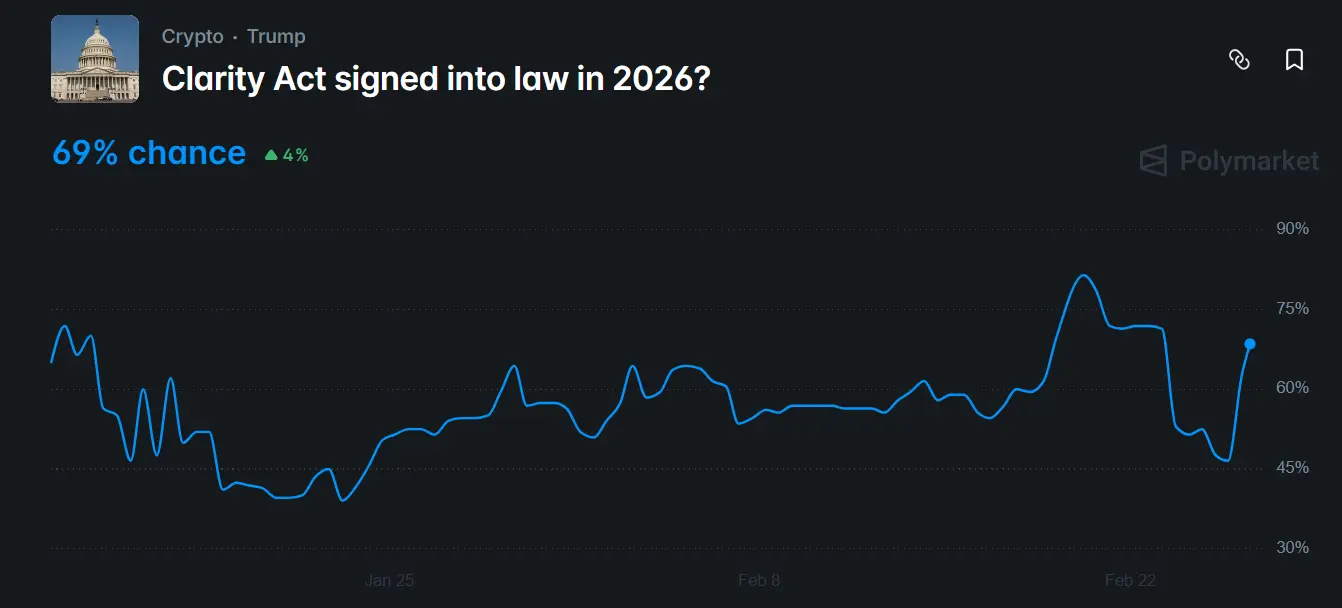 (Source: Polymarket)
Market prediction platforms show that after Trump’s speech on national issues, the probability of the CLARITY Act being signed into law by 2026 dropped to 47%. However, with the progress of Democratic meetings and increased policy lobbying, this probability has rebounded to 69%. This change reflects growing market expectations that U.S. crypto regulation will become clearer, stablecoin policies will be implemented, and the digital asset compliance framework will accelerate formation.
Disclaimer: The information on this page may come from third parties and does not represent the views or opinions of Gate. The content displayed on this page is for reference only and does not constitute any financial, investment, or legal advice. Gate does not guarantee the accuracy or completeness of the information and shall not be liable for any losses arising from the use of this information. Virtual asset investments carry high risks and are subject to significant price volatility. You may lose all of your invested principal. Please fully understand the relevant risks and make prudent decisions based on your own financial situation and risk tolerance. For details, please refer to
Disclaimer.
Related Articles
USD1 supply grew by $1.1 billion from the end of January, with the Solana chain growing by $720 million
Gate News reported on March 27 that, according to Yu Jin monitoring, the supply of the USD1 stablecoin has increased from $3.3 billion to $4.4 billion since certain CEX-related activities began at the end of January, an increase of $1.1 billion. The main growth came from the Solana chain, where its supply increased from $160 million to $880 million, an increase of $720 million. The remaining $380 million increment is distributed across the BNB Chain and the Ethereum network. Currently, USD1 is mainly distributed on the aforementioned three blockchains.
GateNews10m ago
Today's top 100 tokens by market cap: M up 4.28%, SIREN down 52.59%
On March 27, among the top 100 cryptocurrencies by market capitalization, MemeCore had the largest increase at 4.28%, while Siren had the largest decrease at 52.59%. Other tokens with increases and decreases include Canton, PAX Gold, Tether Gold, and others.
GateNews10m ago
In the past 24 hours, the entire network experienced liquidations of $498 million, with long positions accounting for 88.7%.
According to CoinGlass data, on March 27th, the total amount of liquidations in the cryptocurrency market reached $498 million in the past 24 hours, with long positions being dominant. BTC and ETH saw liquidations of $209 million and $136 million respectively, affecting a total of 126,417 people. The largest single liquidation amounted to $6.3388 million.
GateNews40m ago
Shibarium Transactions Hit Multiweek High, Up 1,451% in Four Days - U.Today
Shibarium, Shiba Inu's layer-2 solution, has seen a significant 1451% increase in daily transactions over four days, attributed mainly to technical upgrades rather than organic user growth. Most activity includes automated operations rather than genuine economic engagement.
UToday1h ago
Anthropic’s massive 'Claude Mythos' leak sends software names — and crypto — sharply lower
Anthropic is testing a new AI model, reportedly more capable than its previous releases, termed "Claude Mythos." The leak of internal documents highlighted potential cybersecurity risks and hints at the development of a new model tier called "Capybara."
CoinDesk2h ago
CoinDesk 20 performance update: AAVE drops 3.2% as nearly all constituents decline
CoinDesk Indices reports a daily market update for the CoinDesk 20 Index, which is trading at 1912.59, down 2.4%. Among its assets, BCH and CRO are leaders with slight gains, while APT and AAVE are lagging with notable losses.
CoinDesk2h ago


