Strong ETF inflows into Bitcoin and Ethereum point to renewed institutional buying and improving risk appetite.
U.S. spot Bitcoin exchange-traded funds saw a sharp pickup in inflows on Tuesday, marking the strongest daily demand since early October. Experts believe the trend signals a return of institutional buyers after a period of slow activity. Bitcoin and Ethereum prices rose as capital flowed back into ETFs tied to the two largest digital assets.
Bitcoin ETFs See $753.7M Inflows as Institutional Buying Returns
According to data from SoSoValue, U.S. spot Bitcoin ETFs posted $753.7 million in net inflows on Tuesday, the highest daily figure since October 7. Buying activity centered on major issuers, led by Fidelity, whose FBTC fund attracted $351.36 million. Bitwise followed with $159.42 million into BITB, while BlackRock added $126.27 million through IBIT.
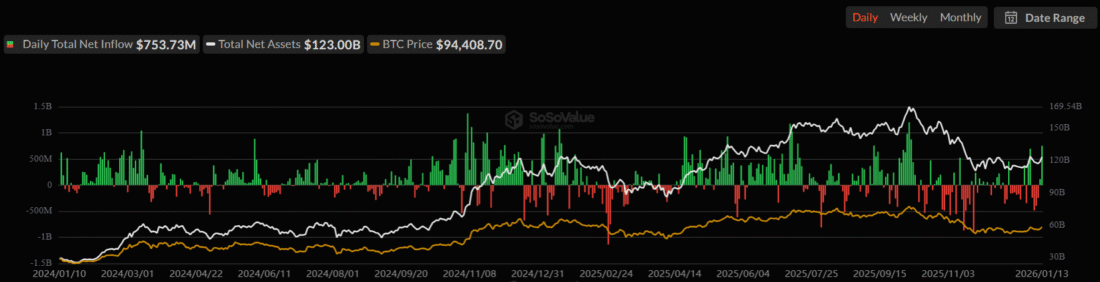
Image Source: SoSoValue
Additional inflows came from ARKB with $84.88 million. Smaller amounts went into Grayscale’s Bitcoin trust at $18.80 million, VanEck’s HODL with $10 million, and WisdomTree’s BTCW with $2.99 million.
Several other spot Bitcoin funds reported flat flows during the session, suggesting inflows were concentrated rather than broad-based.
As of press time, BTC is hovering near $95,084 after climbing over 3.25% over the past day. The OG coin posted 16/30 green trading days, pointing to steady upward pressure alongside ETF demand.
Institutional Buying Lifts Ethereum ETFs, Adds $130 Million in One Day
Nick Ruck, director at LVRG Research, said renewed inflows show investors reallocating capital after a period of caution late last year. He described current conditions as a reset following last quarter’s pullback, with institutional buyers returning as risk appetite improves.
Several factors stood out behind the renewed inflows:
- Strong ETF demand absorbed the available Bitcoin supply beyond daily miner output
- Improved inflation data raised expectations for future interest rate cuts.
- Progress on U.S. crypto legislation reduced regulatory uncertainty.
- Spot market buying, rather than heavy leverage, drove recent price moves.
Like Bitcoin, Ethereum-based investment products pulled in $130 million in net inflows across five funds. BlackRock’s ETHA led with $53.31 million, followed by Grayscale’s Ethereum fund at $35.42 million.
Bitwise’s ETHW brought in $22.96 million, while Fidelity’s FETH added $14.38 million. Grayscale’s ETHE posted a smaller $3.93 million, with other funds reporting no changes.
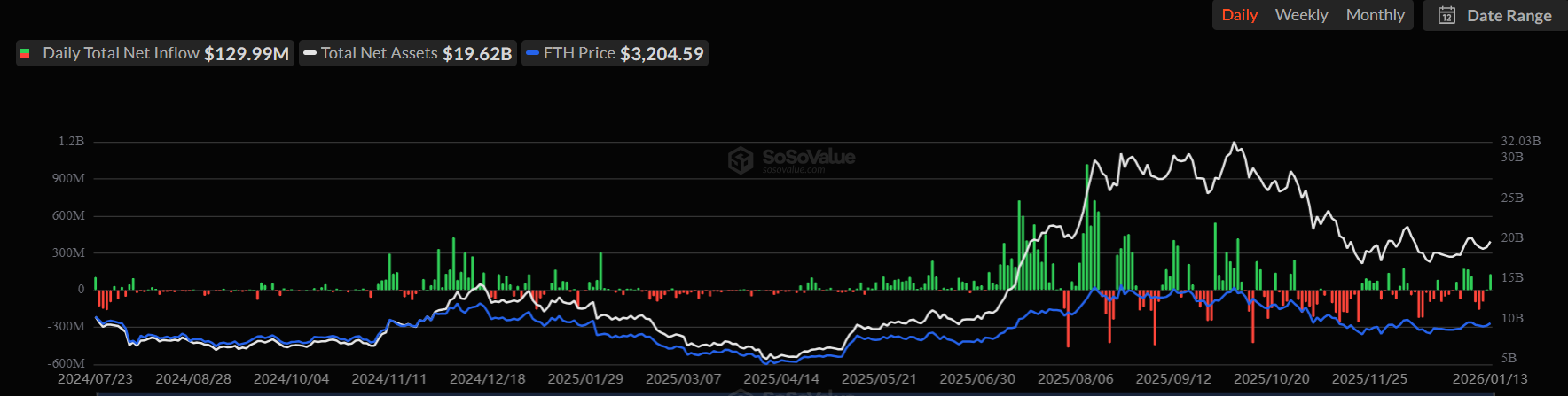
Image Source: SoSoValue
Ethereum has climbed over 5% to trade around $3,293 following a strong daily outing. Broader market sentiment remained positive, supported by strong institutional and retail activity.
Vincent Liu, chief investment officer at Kronos Research, linked the inflows to clearer macro signals.
“[The rally] is driven by sustained ETF inflows absorbing supply well beyond miner issuance, creating a structural tailwind. Improving regulatory clarity and the unwind of over-leveraged short positions further accelerated price action, with the rally notably led by spot demand rather than leverage,”
Liu said.
In his view, sustained ETF demand has played a central role in recent price strength, with absorption of supply and reduced short positioning supporting the rally.
Disclaimer: The information on this page may come from third parties and does not represent the views or opinions of Gate. The content displayed on this page is for reference only and does not constitute any financial, investment, or legal advice. Gate does not guarantee the accuracy or completeness of the information and shall not be liable for any losses arising from the use of this information. Virtual asset investments carry high risks and are subject to significant price volatility. You may lose all of your invested principal. Please fully understand the relevant risks and make prudent decisions based on your own financial situation and risk tolerance. For details, please refer to
Disclaimer.
Related Articles
BTC rises 0.64% in 15 minutes: long-position amplification combined with spot fund inflows drives the move
2026-04-17 12:45 to 2026-04-17 13:00 (UTC), the BTC price fluctuated within the 75720.6 to 76256.6 USDT range, and the return rate within 15 minutes reached +0.64%, with a range of 0.71%. During this period, market attention stayed high, trading activity increased, short-term volatility intensified, reflecting a rapid market move driven by concentrated capital.
The main driving force behind this anomaly is that the long-position structure has been significantly amplified on coin-margined perpetual contracts, along with rapid inflows of funds into the long direction. Data shows that in the 12:45–13:00 window, the long contract positions for BTC surged from 8M to 11.4M, accounting for 57% to 77%. Short-term long funds concentrated into the market, and buy-side strength rose markedly, forming a direct impetus for price upside. At the same time, net inflows of ETF funds in the spot market increased, with holdings in major ETF products rising; institutional buying became more active, and the coordination strengthened spot price support.
In addition, on-chain active addresses remained at a high level, trading volume expanded significantly, and BTC net inflows on mainstream trading platforms on April 17 also rose—together indicating increased market participation. Meanwhile, BTC broke through a key historical price range ($75,000), and technical buying as well as momentum-chasing funds entered in line with the move. Besides structural factors, global macro environmental risks remain elevated. Some capital is inclined toward BTC as a safe haven, and in the short term, multiple factors have converged, jointly pushing up the market’s volatility.
In the near term, with the share of long positions and trading volume rising, if there is an unexpected news event or a reversal in sentiment, it is likely to trigger a rapid pullback. Key risk focus points include: changes in capital flows on mainstream trading platforms, the strength of support in the $75,000 range, and how macro events evolve. Users should be alert to short-term risks during periods of high volatility, monitor key on-chain and macro indicators in real time, and stay on top of more market updates.
GateNews6m ago
American Bitcoin (ABTC) to Release Q1 2026 Earnings on May 6
American Bitcoin (ABTC) will release its Q1 2026 earnings report on May 6, 2026, after U.S. market close, followed by a live earnings call and webcast at 4:30 PM ET.
GateNews22m ago
Solv Protocol and Utexo Launch Bitcoin-Native Yield Infrastructure
Solv Protocol has integrated with Utexo to launch a bitcoin-native yield infrastructure that uses the RGB protocol and Lightning Network to enable direct, atomic swaps between bitcoin and USDT.
Key Takeaways:
Solv Protocol and Utexo integrated to launch native BTC yield with atomic swaps for $2 b
Coinpedia44m ago
Zonda Exchange CEO Blames Missing Founder for $336M in Lost Bitcoin
Zonda CEO Przemysław Kral has attributed the exchange's loss of access to 4,500 BTC, valued at $336 million, to missing founder Sylwester Suszek's failure to transfer private keys. Amid allegations of bankruptcy and intensified withdrawal requests, Kral insists Zonda remains solvent and will pursue legal action while searching for Suszek, who disappeared in 2022.
GateNews2h ago
BTC drops 0.52% in 15 minutes: Whale inflows to exchanges combined with insufficient liquidity amplify sell pressure
From 2026-04-17 10:15 to 2026-04-17 10:30 (UTC), the BTC price rapidly fell within the 75214.3 – 75725.9 USDT range. The cumulative return over 15 minutes was -0.52%, and the amplitude reached 0.68%. During this period, market sentiment shifted from cautious to bearish, volatility on the board increased, mainstream trading pairs saw an increase in主动 sell-side volume, buy-side acceptance became constrained, and overall trading activity declined significantly.
The primary driver behind this unusual move is that large holders (whales) concentrated their short-term inflows into exchanges. On-chain data shows that net inflows to addresses holding more than 1000 BTC per address changed from a steady state to a positive value, directly boosting exchange balances over the short term. Historical data indicates that whale inflows to exchanges are highly correlated with sell pressure in the medium to short term. In the same period, order book snapshots reflected a significant increase in the volume of主动 sell orders, and the成交价梯度 shifted downward, highlighting that weak market absorption capacity caused a short-term drop in price.
In addition, in the derivatives market, the long/short positioning structure tilted toward shorts. The number of主动 sell contracts exceeded that of buys in a short time, and rising pressure to close long positions further intensified the downtrend. Market liquidity overall was relatively weak; the number of active addresses over the past 10 minutes was only about 42k, and both fees and the mempool were near their lowest levels of the recent month. Against a backdrop of insufficient capital absorption, the marginal impact of large sell orders was amplified. On the macro front, the Federal Reserve’s monetary policy tightening and industry media repeatedly downgraded BTC’s near-term expectations led investors’ risk appetite to generally decline, creating a resonance at the level of market sentiment.
In the short term, it is still necessary to stay alert to liquidity risk and the price impact of one-way large transactions in specific trading pairs. Going forward, focus on key developments such as changes in whales’ on-chain holdings, exchange balances, and rebounds in activity metrics, as well as the potential impact of macro policy direction on risk assets. Relevant users should primarily guard against the risk of sharply amplified short-term price volatility and promptly track more market information.
GateNews2h ago
Bitcoin Developers Propose Freezing Coins That Skip Quantum-Safe Migration Under BIP-361
A draft proposal circulating among Bitcoin developers would give holders roughly five years to move their coins to quantum-resistant addresses or watch them become permanently unspendable on the network.
Key Takeaways:
BIP-361, co-authored by Casa CTO Jameson Lopp, proposes freezing Bitcoin in le
Coinpedia3h ago


