XRP fell below $2.2 today, dropping 5.97%. Morgan Stanley submitted BTC and SOL ETFs but skipped XRP; WisdomTree withdrew its application, and institutional neglect has dampened confidence. The Senate’s “Market Structure Act” review on January 15 is a key turning point—holding the $2.0 support and targeting $3.0 in the medium term.
Why Morgan Stanley Skipped XRP ETF
(Source: SoSoValue)
Morgan Stanley officially entered the cryptocurrency spot ETF competition on January 6, submitting S-1 filings for BTC spot ETF and SOL spot ETF. Notably, despite strong demand for XRP spot ETFs in the US since November last year—surpassing BTC and SOL spot ETFs—this major US bank did not file for an XRP spot ETF. This selective omission has triggered market panic in XRP today.
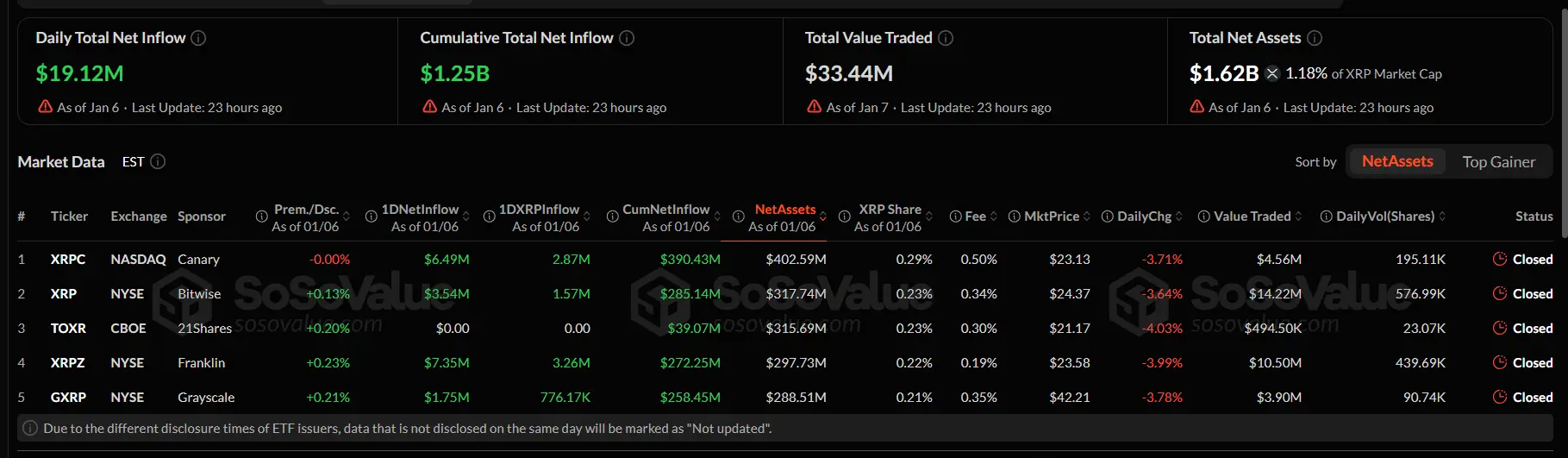
The data contrast is highly ironic. Since the launch of the Canary XRP Spot ETF (XRPC) on November 14, XRP ETF issuers have received $1.25 billion in inflows. In comparison, the US SOL spot ETF, launched in October, reported net inflows of $801.31 million, while BTC spot ETFs have experienced $1.8 billion in net outflows since November 14. According to capital flow logic, Morgan Stanley should prioritize XRP over SOL or BTC, but the reality is quite the opposite.
Bloomberg ETF analyst Eric Balchunas commented on these filings: “I like this move. It’s very smart. They have about $8 trillion in advisory assets, and these advisors are already approved for asset allocation, so instead of paying BlackRock or others, they’re investing in their own brand funds. This might also encourage other brand firms to launch their own Bitcoin funds.”
Balchunas emphasized the significance of Morgan Stanley’s focus on BTC and SOL, suggesting other mainstream financial institutions might follow suit. If investors lack interest in XRP spot ETF applications, it will limit access to the token. This narrative of “being neglected by mainstream finance” undermines market confidence and triggers profit-taking.
Adding to the pressure, WisdomTree also withdrew its XRP spot ETF S-1 filing. Although the issuer did not specify reasons, the market interprets this as a negative outlook for XRP. The 21Shares XRP ETF has only seen $39.07 million in net inflows since launch, a modest figure compared to the early demand of four other XRP spot ETFs, indicating a disadvantage for new XRP ETF issuers.
January 15 Bill Review: A Double-Edged Sword
The US Senate Banking Committee and Agriculture Committee announced they will review the “Market Structure Act” on January 15. Given XRP’s sensitivity to legislative developments, this day could be a critical turning point for XRP today news. Historical data strongly supports this view. On July 17, after the House of Representatives submitted the “Market Structure Act” to the Senate, XRP price surged 14.69%. On December 31, after the Federal Reserve announced it would review the bill, XRP rose 33%, reaching a high of $2.4151 on January 6.
XRP remains highly sensitive to legislative developments. This sensitivity stems from Ripple’s long-standing litigation with the SEC, with the market viewing any legislation favoring clearer crypto regulation as a major positive for XRP. The “Market Structure Act” aims to clarify the regulatory authority division between SEC and CFTC, defining which tokens are securities and which are commodities. If passed, XRP could be officially classified as a commodity rather than a security, removing the final legal uncertainty.
Three Key Technical Levels for XRP Price
(Source: Trading View)
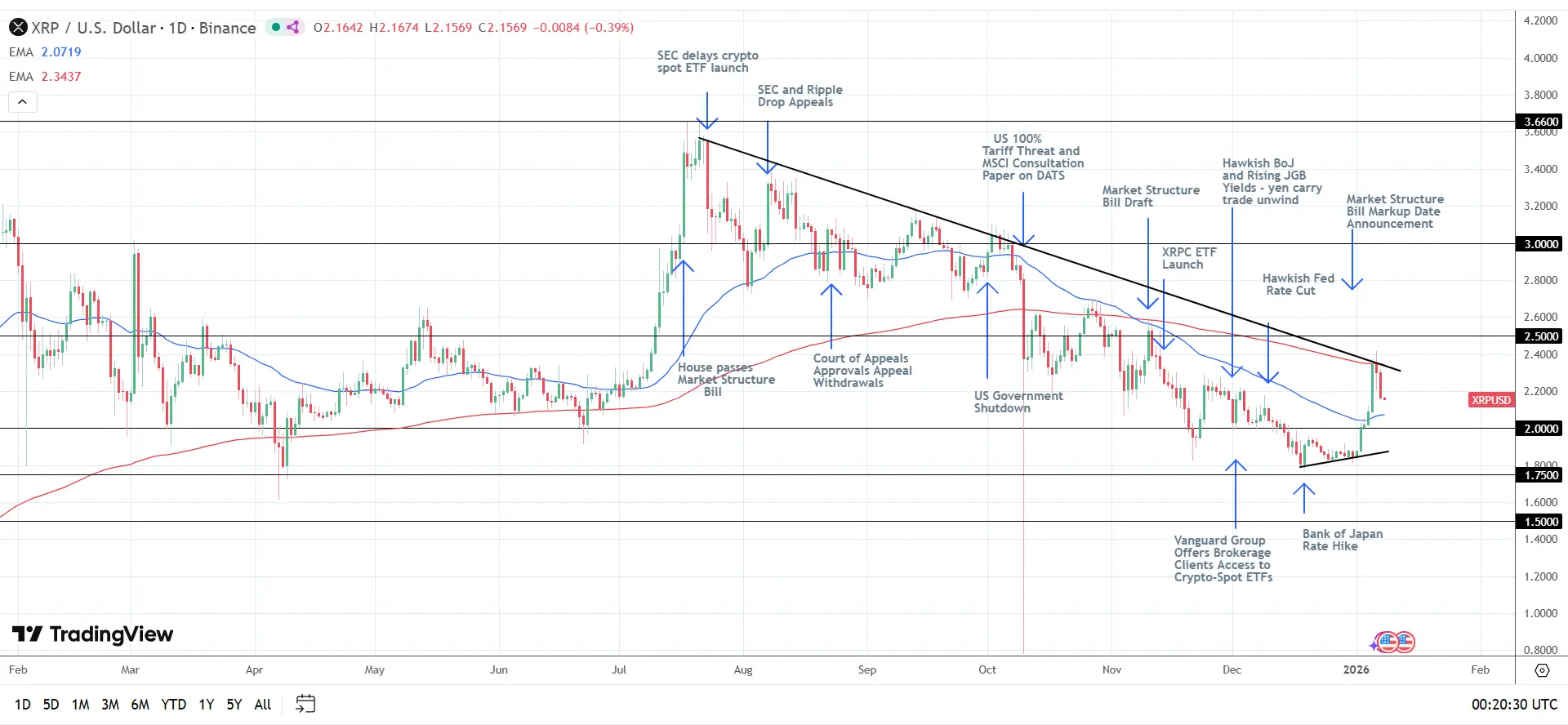
Support levels: $2.00 (psychological level and 50-day EMA), $1.75 (secondary support), $1.50 (deep support)
Resistance levels: $2.3437 (200-day moving average), $2.5 (short-term), $3.0 (mid-term), $3.66 (long-term)
Key observation: Breaking above the 200-day moving average will confirm a bullish trend reversal; falling below $2.0 could trigger a sell-off.
On January 7, XRP dropped 5.97%, after a 1.88% decline the previous day, closing at $2.1653. The selling pressure on this token was greater than the overall crypto market, which fell 2.71%. XRP declined for two consecutive days, breaking below the 200-day moving average but remaining above the 50-day moving average. Despite short-term bullish signals and long-term bearish signals from moving averages, the fundamentals remain positive and dominant.
A Critical Week of Risks and Opportunities
Strong demand for XRP spot ETFs and progress in US crypto-friendly regulation reinforce the short-term (1-4 weeks) bullish outlook, targeting $2.5. Meanwhile, growth in utility demand, expectations of Fed rate cuts, and optimism that the Senate will pass the “Market Structure Act” all support positive targets: $3.0 in the mid-term (4-8 weeks), and $3.66 in the long-term (8-12 weeks).
However, major risks should not be ignored. If the Bank of Japan announces a neutral interest rate range of 1.5% to 2.5%, it could trigger unwinding of yen carry trades. Opposition from US lawmakers against the “Market Structure Act” or XRP spot ETF fund outflows could also cause sell-offs, pushing XRP below $2 and signaling a trend reversal to a bear market.
Maintaining above $2.0 is crucial for a bullish outlook. Breaking above the 200-day moving average will confirm a bullish structure and reaffirm a trend reversal.
Disclaimer: The information on this page may come from third parties and does not represent the views or opinions of Gate. The content displayed on this page is for reference only and does not constitute any financial, investment, or legal advice. Gate does not guarantee the accuracy or completeness of the information and shall not be liable for any losses arising from the use of this information. Virtual asset investments carry high risks and are subject to significant price volatility. You may lose all of your invested principal. Please fully understand the relevant risks and make prudent decisions based on your own financial situation and risk tolerance. For details, please refer to
Disclaimer.


