


BTC Mining in 2025: Post-Halving Profitability, Hash Rate, and Energy Trends
Author: Kyrian Alex, CoinTelegraph; Translated by: Tao Zhu, Jinse Finance
After the halving in 2024, Bitcoin mining will enter its fifth era, with block rewards decreasing from 6.25 BTC to 3.125 BTC. This forces miners to rethink their operations, optimize efficiency, reduce energy costs, and upgrade hardware to maintain profitability. Cointelegraph Research explores this transition in its latest report. The analysis covers enhancements in ASIC efficiency, corporate performance, regional expansion, and new revenue models. As miners adapt, Bitcoin will enter a new era, where institutional momentum and sovereign adoption may redefine its role in the global financial system.
How the Mining Industry Can Respond to Rising Hash Rates and Declining Profit Margins
Despite the adverse financial impact of the halving, the Bitcoin network’s hash rate continues to rise. As of May 1, 2025, the total network computing power reached 831 EH/s. Earlier this month, the hash rate peaked at 921 EH/s, a 77% increase from the 2024 low of 519 EH/s. This rapid recovery highlights the industry’s relentless pursuit of efficiency, with large mining companies reinvesting in miner upgrades and energy optimization to maintain profitability.
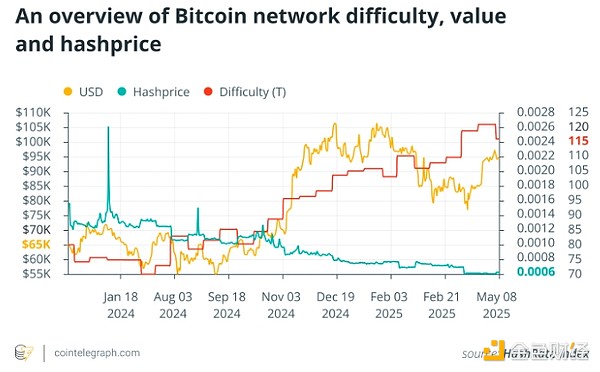
Profitability After Halving: Global Shift to Low-Cost Energy
After the halving, the profitability of Bitcoin mining has significantly decreased. The price of computing power (daily earnings per terahash/second) dropped from $0.12 in April 2024 to about $0.049 in April 2025. Meanwhile, the network difficulty surged to a historic high of 123 terahashes, making it even harder for miners to improve their profitability. To remain competitive, operations must maximize every watt of power. This shift has intensified the quest for cheap and reliable electricity, driving the expansion of mining operations to areas with lower energy costs.
Today, electricity prices determine the profitability of mining. In Oman, licensed miners enjoy government subsidies, with electricity prices ranging from $0.05 to $0.07 per kilowatt-hour; while in the UAE, semi-government projects have even lower electricity prices, only $0.035 to $0.045 per kilowatt-hour. These incentives make the region the preferred destination for institutional-scale mining. Meanwhile, in the United States, industrial electricity costs often exceed $0.1 per kilowatt-hour, and miners face shrinking profits, forcing them to relocate to more cost-effective areas. Africa, the Middle East, and Central Asia have become key battlegrounds in this race, providing miners with the energy arbitrage opportunities needed for survival.
! 5JYKM56XBIzPLKNnJ5iUpZb56uz5h1zUxDsm8W4i.jpeg
What does the future hold for Bitcoin mining?
The halving in 2024 reinforces a harsh reality: efficiency is no longer optional, but a necessity. The entire industry is moving towards more streamlined and optimized operational models, where only the most energy-efficient miners will thrive. The rise of artificial intelligence computing, changes in global regulations, and ongoing hardware advancements will continue to shape the development of the industry in the next 12-18 months.