The quality of training data directly determines the upper limit of an AI model’s capabilities. As large models enter a phase of more refined development, data labeling, the critical step where human knowledge is infused into AI, is shifting from a scale-driven approach to a quality-driven one. This transition exposes structural weaknesses in traditional data labeling systems.
Against this backdrop, Perle introduces a Web3-based architecture that moves the data labeling process on-chain. By combining expert networks, an on-chain reputation system, and PRL token incentives, it aims to build a verifiable and auditable data production infrastructure. Within the AI data value chain, Perle can be seen as a “Human Layer,” connecting high-quality data supply with model training demand.
Traditional data labeling platforms are essentially centralized crowdsourcing systems. Built on Web2 infrastructure, they connect enterprise clients with a global workforce of annotators, offering multimodal data labeling services across images, video, text, and speech. The typical workflow involves enterprises submitting tasks, platforms distributing them, annotators completing the work, and the platform conducting quality checks before delivery.
The main advantage of this model lies in scale and efficiency. Large platforms maintain vast annotator networks, enabling them to process massive datasets quickly. Automation tools and API integrations further improve delivery speed. However, the limitations are equally clear. Annotators are often anonymous, incentives are primarily short-term, and data traceability depends on internal platform records. As a result, enterprises cannot independently verify data sources or quality processes.
Perle’s Data Production Model (Web3 Approach)
Perle adopts a model that combines “expert-in-the-loop” workflows with on-chain coordination. By building a global network of domain experts, it focuses on high-precision and complex data production tasks. Unlike traditional crowdsourcing, participants include not only general annotators but also professionals with specialized expertise.
In this model, enterprises publish tasks on-chain. Experts complete annotation and validation, after which the system evaluates data quality using an on-chain reputation mechanism and distributes PRL token rewards instantly. All contributions are traceable, forming a complete and transparent data production loop.
The key innovation lies in linking reputation with incentives. Contributors build an on-chain reputation by consistently delivering high-quality data, which unlocks higher-value tasks and better rewards. This mechanism improves data quality while strengthening long-term engagement.
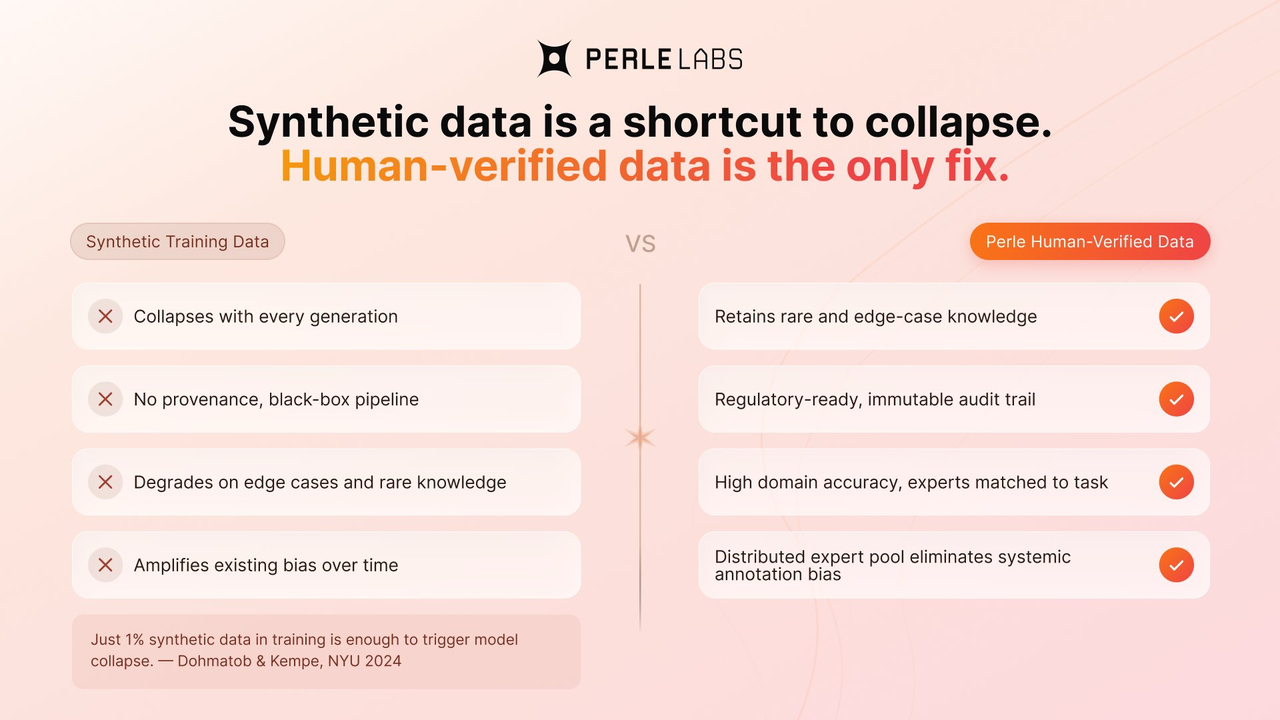 Image source: Perle
The differences between Perle and traditional platforms span several key dimensions, summarized below:
| Dimension |
Traditional Platforms (Scale AI / Appen) |
Perle (Web3 Model) |
| Data Quality |
Automation + centralized QA, high accuracy but reliant on sampling, prone to edge-case errors |
Expert network + on-chain evaluation, benchmarks exceed traditional by 70%, up to 99.9% accuracy, rewards precision over speed |
| Incentives |
Fixed pay per task/hour, platforms take ~70%, short-term focus |
PRL tokens + on-chain reputation, contributors retain 80–90%, aligned with long-term quality |
| Cost Structure |
High platform fees + QA cleaning costs (avg. $600K annually) |
Disintermediation, instant settlement, reduced rework and delays (30–90 days → 400ms) |
| Data Trust |
Centralized and opaque, enterprises rely on platform trust |
Immutable on-chain records, each data point tied to expert reputation |
| Scalability |
Web2 cloud, large crowds but complex management, low retention |
High-throughput blockchain + expert guilds, reputation improves retention, modular scaling |
Data Quality
Traditional platforms prioritize speed and scale, often relying on automated pre-labeling combined with manual review. However, quality depends on centralized sampling, and anonymous workers may prioritize quantity over accuracy, leading to regression issues in model training.
Perle, by contrast, leverages domain-specific expert guilds, such as doctors labeling medical images or lawyers reviewing contracts, combined with on-chain accuracy incentives. Benchmark results show performance exceeding traditional approaches by 70% in fields like medical imaging and robotics, making it better suited for high-risk, high-precision use cases.
Incentive Mechanisms
In traditional systems, annotators receive fixed compensation while platforms capture most of the value, resulting in low retention and limited motivation.
Perle introduces a dual system of PRL rewards and reputation assets. High-quality contributions accumulate on-chain scores, unlocking better tasks and higher earnings, creating a positive feedback loop between contribution, reputation, and reward.
Cost Structure
Enterprises using traditional platforms often incur additional costs for data cleaning and delayed payments, typically ranging from 30 to 90 days.
With on-chain instant settlement and a disintermediated structure, Perle helps reduce costs by an average of $600,000 annually, while also increasing annotator earnings and improving ecosystem efficiency.
Data Trust
The “black box” nature of traditional platforms makes it difficult for enterprises to verify data origins, introducing risks such as “ghost data.”
Perle records every contribution on-chain, linking it to expert identity and reputation. This allows enterprises to audit the entire data lifecycle, improving compliance and model interpretability.
Scalability
Traditional platforms, constrained by Web2 architecture, face high coordination costs when managing millions of anonymous workers.
Perle uses modular blockchain infrastructure and reputation-based filtering to scale a global expert network efficiently while maintaining high retention.
How Web3 Is Reshaping the AI Data Market
Web3 technologies are transforming the AI data market at three levels. First, blockchain provides immutable records, turning data from an internal platform asset into a verifiable asset. Second, token-based incentives allow participants to share in the value they create, addressing the incentive misalignment in traditional models.
In addition, decentralization reduces intermediaries’ control over data, enabling more direct matching between supply and demand. This shift is driving the evolution from large-scale crowdsourced production to expert-driven production, while also laying the groundwork for future data DAOs and on-chain data marketplaces.
Perle’s Advantages and Challenges
From a strengths perspective, Perle shows strong potential in high-quality data supply and transparency. Its expert participation model supports complex AI tasks, while on-chain verification enhances trust and auditability. Its incentive design also helps attract high-quality global contributors.
However, challenges remain. High-quality data depends on specialized talent, which may limit supply scalability. At the same time, the usability of Web3 technology and ecosystem maturity still need improvement. Enterprise adoption rates and regulatory environments will also play a critical role in its growth.
From an application perspective, the two models are more likely to complement each other rather than fully replace one another.
Traditional platforms are better suited for cost-sensitive, large-scale tasks with relatively lower accuracy requirements, such as basic image classification or simple text labeling.
Perle is better suited for scenarios requiring high precision and traceability, such as medical imaging analysis, legal document processing, or complex reasoning datasets. These tasks demand extremely high data quality and rely heavily on expert input.
| Scenario |
Recommend Traditional Platforms |
Recommend Perle |
| Large-scale general labeling (e.g., image classification) |
High throughput, low barrier, ideal for mass production |
Expert QA improves accuracy, but at higher cost |
| High-risk domains (e.g., medical imaging, legal contracts) |
QA depends on platform, weak traceability |
On-chain expert reputation + audit records, ideal for compliant models |
| Startups with limited budgets |
Standardized services, easy onboarding |
Lower long-term costs, but requires Web3 integration |
| Compliance scenarios requiring data ownership and explainability |
Complex internal audits |
Fully transparent on-chain records, easier regulatory approval |
Conclusion
The comparison between Perle and traditional data labeling platforms reflects a broader shift from centralized trust to protocol-based trust. Traditional platforms solve problems through scale and efficiency, while the Web3 model seeks to optimize data production through transparency and incentive alignment.
In the long run, the AI data market is likely to evolve into a layered structure. Traditional platforms will continue serving large-scale demand, while protocols like Perle will focus on high-value data supply. The interplay between the two may ultimately define the upper limits of AI model performance.
FAQs
What is the biggest difference between Perle and Scale AI?
Scale AI emphasizes automation and crowdsourced throughput, while Perle focuses on on-chain expert networks and reputation incentives, delivering higher precision and auditability, especially in high-risk domains.
Through centralized QA sampling, automation tools, and multi-stage review processes. However, traceability depends on internal records and cannot be verified on-chain.
Why is Perle’s data quality higher?
Because it incorporates expert participation combined with on-chain reputation and incentive mechanisms.
How are annotators selected in Perle?
Through verified expert guilds, such as doctors or lawyers, combined with on-chain reputation scores that prioritize high-quality contributors.
Is the Web3 model always better?
Not necessarily. It is more suitable for high-quality, high-stakes scenarios rather than all data tasks.
What AI use cases is Perle best suited for?
Medical imaging, legal documentation, robotics perception, and other domains requiring high-precision, traceable data, rather than simple large-scale labeling tasks.