Global investment in AI infrastructure is expected to exceed $700 billion. This article uses the "AI Five-Layer Cake" model (energy, chips, cloud, models, applications) to deeply deconstruct the profit flow patterns in the AI era: revenue flows upward, while capital sinks downward. The article reveals a harsh truth: while model companies like OpenAI are still "burning cash" on billions in computing costs, the underlying layers—Nvidia (chips), TSMC (manufacturing), ASML (equipment), and power suppliers—are reaping huge profits through monopolistic barriers in the physical world. This is an investment guide that teaches you how to switch from a "consumer mindset" to a "supply chain mindset" to identify确定性 opportunities within the AI technology stack.
2026-03-17 10:53:11
AI agents for market research are automated systems designed to collect, process, and interpret large volumes of data for decision-making. In market research, they combine structured data and real-time information sources such as Gate News and Gate Info to identify trends, assess sentiment, and generate insights. As digital asset markets evolve, integrating multiple data layers has become essential for understanding market behavior. Examining how these systems operate helps clarify their role in modern financial analysis workflows.
2026-03-17 09:49:13
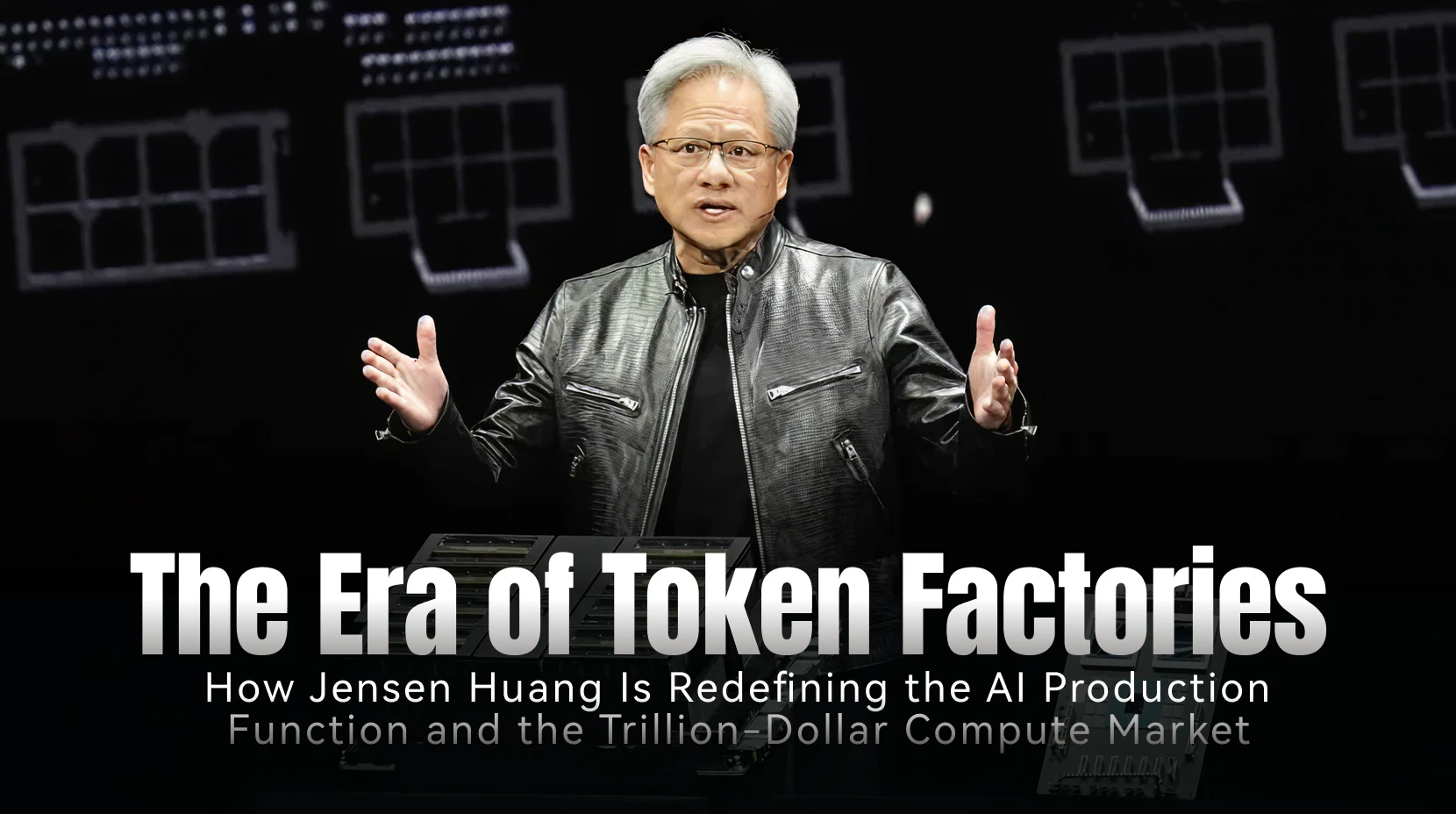
At NVIDIA GTC 2026, Jensen Huang characterized the data center as a “token factory,” signaling AI’s transition from model competition to an inference-driven economy. This article delivers a comprehensive analysis of the AI token economy, computational power business models, and the structural dynamics underpinning the trillion-dollar market.
2026-03-17 09:33:04
Gate Exchange for AI provides access to centralized exchange trading systems, while Gate DEX for AI connects AI agents to on-chain decentralized finance environments. These two execution paths differ in transaction routing, custody structure, and operational control. Understanding how these execution architectures work helps explain how AI agents interact with centralized and decentralized financial infrastructure in modern crypto ecosystems.
2026-03-17 09:18:31
YZi Labs has announced a lead investment of $52 million to support RoboForce, a Silicon Valley AI robotics company, in developing its Physical AI technology and TITAN robotics platform. RoboForce specializes in tackling workforce shortages in demanding sectors including energy, manufacturing, and logistics. The company leverages data flywheel strategies and AI models to continuously improve the performance of its robots.
2026-03-17 07:45:29
AI model routing refers to a technical mechanism that dynamically selects the most suitable AI model to handle a request when multiple models are available. It is also commonly called an AI model router or LLM router. Through a model routing system, AI applications can automatically choose different large language models based on factors such as task complexity, cost, and response speed, allowing them to balance performance and operational efficiency.
2026-03-17 01:00:11
An AI Agent API refers to the mechanism through which AI agents call AI models or external services via application programming interfaces (APIs). Through these APIs, AI agents can access large language models, data services, and blockchain applications, enabling them to automatically execute complex tasks without direct human intervention.
2026-03-17 00:54:58
The x402 protocol is a Web3 API payment standard designed for AI agents that addresses the challenge of paying for API services in automated environments. The protocol builds on the HTTP standard 402 Payment Required status code and combines it with blockchain based payment mechanisms, allowing programs to automatically complete payments and settlement when requesting API services. Through this design, x402 provides new infrastructure for machine to machine service transactions on the internet.
2026-03-17 00:48:45
GateRouter is an AI model router and large language model gateway within the Gate for AI ecosystem. It enables developers and AI agents to access multiple large language models from different providers through a single API interface, including models such as ChatGPT, Claude and Gemini.
2026-03-17 00:46:27
GateRouter and OpenRouter are both AI model routers, but they differ in architecture, payment mechanisms, and Web3 integration. This guide compares their core designs, AI agent compatibility, and typical use cases.
2026-03-17 00:45:05

AI agents in financial systems are software systems that can interpret goals, use external tools, gather market context, and decide which actions to take, while crypto trading bots are typically rule-based programs that execute predefined trading logic automatically. Agent-based systems have drawn more attention as crypto markets have become more fragmented across centralized exchanges, decentralized exchanges, wallets, news feeds, and on-chain data sources. Platforms such as Gate for AI reflect this shift by exposing trading, wallet, news, and on-chain capabilities to AI systems through Model Context Protocol (MCP) connections and modular skills, rather than limiting automation to a single execution script.
The difference matters because crypto environments change quickly. Price moves, liquidity conditions, sentiment signals, and cross-platform opportunities often evolve faster than static rules can adapt. Understanding how bots and AI agents differ helps clarify where simple automation remains useful and wh
2026-03-16 11:21:55
GateClaw and OpenClaw represent two types of technical environments designed for deploying and running Web3 AI agents. GateClaw is designed as a visual AI agent workstation that connects AI models, tool interfaces, and Web3 networks, allowing agents to execute automated tasks within a unified system. OpenClaw typically appears as an open source AI agent framework, where developers build and run agents through code and extend functional modules according to specific needs.
2026-03-16 09:10:06
BEAT is the native token of the Audiera network, designed to support the sharing, access, and collaboration of music data within a decentralized environment. Through its token mechanism, Audiera aims to create a sustainable incentive structure that connects music creators, data contributors, and AI developers, allowing data provision, data usage, and technological development to operate within a coordinated ecosystem.
2026-03-16 06:11:38
Audiera's AI music data network combines blockchain recording mechanisms with data authorization frameworks to manage how music datasets move through AI training and application environments. By recording the origin of data, the terms of authorization, and the way datasets are used, the network allows music data accessed by AI systems to generate a traceable history while also supporting mechanisms that may distribute value to data contributors.
2026-03-16 06:08:43
Audiera combines blockchain infrastructure with artificial intelligence to build a music data network designed for creators, data contributors, and AI developers. The network provides a verifiable and permission-based environment where music data can be shared while maintaining traceable ownership records. Through on-chain recording and token-based incentives, Audiera aims to create a decentralized data infrastructure that allows music datasets used in AI training to maintain clearer provenance tracking and more transparent revenue distribution.
2026-03-16 06:05:36