In traditional AI systems, model training and data resources are largely controlled by major technology companies, such as cloud platforms and proprietary AI service providers. This centralized structure limits open collaboration and makes it difficult for contributors to receive fair compensation. As a result, AI capabilities tend to concentrate within a small number of platforms.
Bittensor introduces a decentralized alternative by integrating machine learning models into a blockchain-based incentive system. In this network, models compete in an open market and are rewarded based on performance. The core of Bittensor’s operation lies in its modular architecture and consensus mechanism, which together enable continuous model improvement and value distribution across participants.
Bittensor Network Architecture
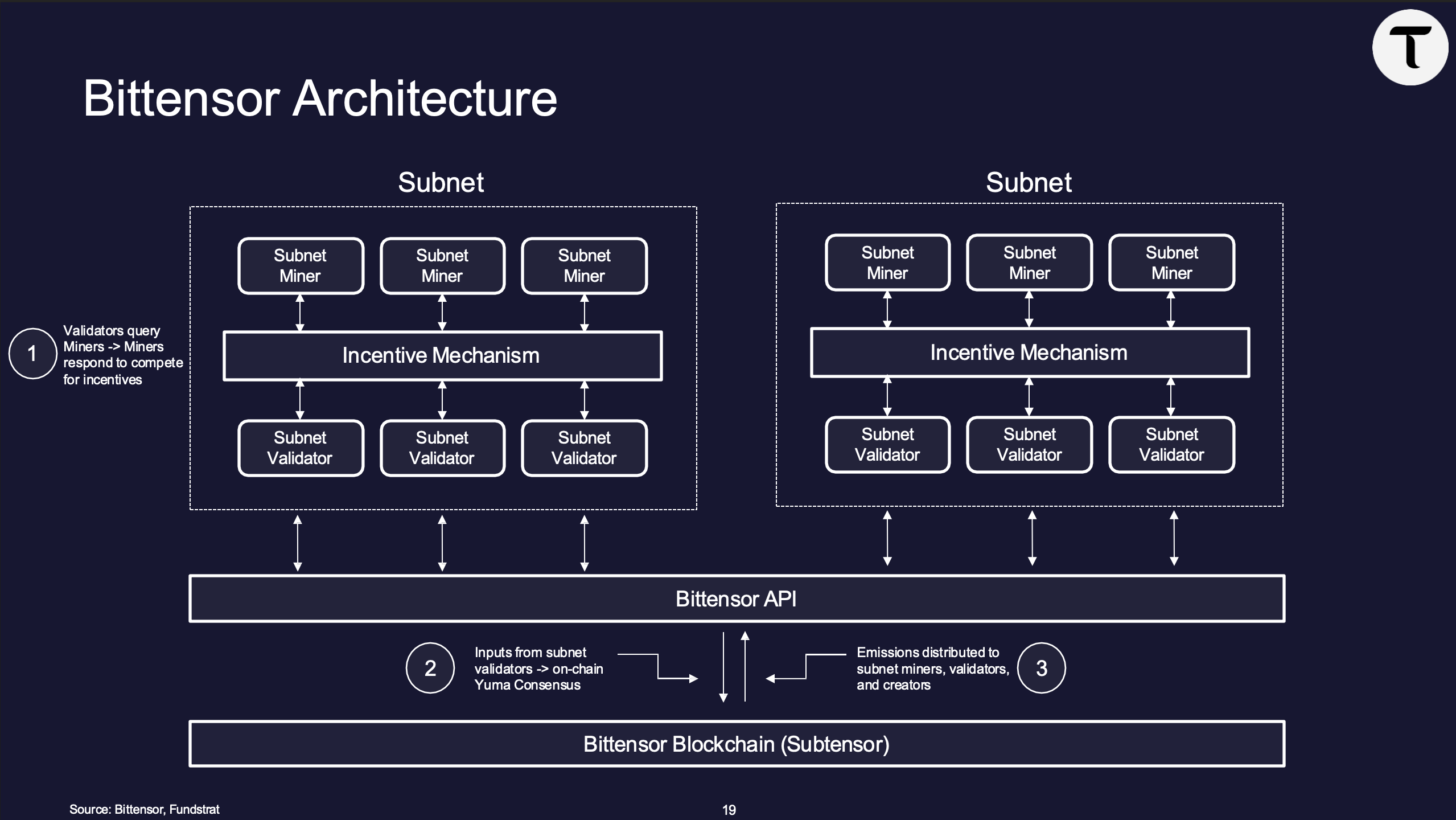
Bittensor’s architecture is built around multiple roles and modules that work together to form a decentralized machine learning marketplace.
 Source: Bittensor, Fundstrat
Subnet: AI Task Networks
Subnet is the core unit of the Bittensor network. It can be understood as a specialized network designed for a specific AI task, such as text generation, image recognition, or data analysis.
Each subnet operates with its own rules, incentive structure, and participant set. This allows different types of AI workloads to run in optimized environments. As a result, the network can scale more effectively while supporting highly specialized AI applications.
Miner: AI Model Providers
Miners are responsible for providing machine learning models and generating outputs within the network.
These models can include language models, recommendation systems, or other AI solutions. Miners compete based on performance, and higher quality outputs lead to stronger recognition from the network. This directly increases their share of TAO rewards.
Validator: Model Evaluators
Validators evaluate the outputs produced by miners and assign scores based on criteria such as accuracy, relevance, and overall quality.
These scores determine how rewards are distributed across the network. Because of this, validators play a critical role in maintaining fairness and ensuring that high quality models are properly incentivized. Validators must also remain objective in their evaluations, as biased behavior can affect their own rewards and credibility within the system.
Bittensor Consensus Mechanism: Yuma Consensus
Bittensor does not rely on traditional blockchain consensus models such as Proof of Work or Proof of Stake. Instead, it introduces a specialized mechanism designed for AI networks known as Yuma Consensus.
The core logic of Yuma Consensus can be summarized as follows:
-
Validators assign weights based on miner performance
-
The network distributes rewards (TAO tokens) dynamically according to these weights
-
Weights and rewards form a feedback loop that continuously improves model quality
In this system, model performance becomes the basis of consensus. Instead of validating transactions or stake, the network evaluates the usefulness and accuracy of AI outputs. This allows intelligence to be priced within a decentralized market, forming an AI driven token economy.
Dynamic Workflow of the Bittensor Network
Bittensor operates as a continuous and adaptive process that reflects a decentralized AI marketplace.
The step by step workflow can be described as:
-
A user or application submits an AI task to a subnet
-
Miners generate outputs using their models
-
Validators evaluate and score the results
-
The network distributes TAO rewards based on evaluation scores
-
Miners and validators adjust their strategies based on incentives
This cycle creates a self reinforcing system where competition drives improvement. Over time, higher quality models receive more rewards, and the network evolves through continuous optimization of machine learning performance.
Significance of the Bittensor Mechanism
Bittensor’s design is not only a technical innovation but also reflects the broader convergence of AI and blockchain. Its architecture introduces new ways to organize, evaluate, and distribute machine intelligence in an open system.
-
Reducing AI centralization: Decentralized participation lowers barriers to entry, allowing more developers to contribute models and training resources
-
Creating an open AI marketplace: AI models become tradable assets, where value is determined through market based competition
-
Incentivizing high quality models: Reward mechanisms direct resources toward models that deliver better performance and usefulness
-
Building Web3 AI infrastructure: Bittensor functions as a foundational layer within the AI crypto ecosystem, supporting decentralized intelligence networks
Conclusion
Bittensor builds a modular decentralized AI network through Subnets, Miners, and Validators, with Yuma Consensus enabling model evaluation and reward distribution. Its key innovation lies in integrating model performance into the consensus process, creating a system where intelligence is continuously evaluated and incentivized.
As decentralized AI continues to develop, Bittensor has the potential to become an important infrastructure layer connecting machine learning and blockchain systems.
FAQs
What is the core purpose of Bittensor?
Bittensor aims to create a decentralized AI network where machine learning models can be shared, evaluated, and rewarded.
What is the role of a Subnet in Bittensor?
A subnet is a specialized network that handles specific AI tasks, allowing different applications to operate in tailored environments.
How does Bittensor work?
Bittensor operates through collaboration between subnets, miners, and validators, with Yuma Consensus determining evaluation and reward distribution.
What is Yuma Consensus?
Yuma Consensus is Bittensor’s mechanism that assigns rewards based on model performance rather than computational power or stake.
Bittensor is decentralized and incentive driven, enabling open participation, while traditional AI platforms are typically controlled by centralized entities.







