As AI and blockchain technology rapidly converge, Web3 data infrastructure is becoming the essential foundation for real-world AI application deployment. Whether it’s an AI Agent executing trades automatically or an on-chain intelligent analytics system, both require high-quality, standardized, and real-time accessible data sources. However, challenges like data structure inconsistencies across multiple chains, fragmented interfaces, and high data access costs are limiting the efficiency of AI in on-chain environments. In this context, infrastructure protocols focused on on-chain data services are emerging as key players in the AI + Web3 landscape.
SkyAI and Chainbase are currently two of the most prominent projects in this sector. While both aim to enhance on-chain data availability, their technical approaches and value propositions differ. Chainbase is more oriented toward building on-chain data indexing and a unified access layer, whereas SkyAI is working to add AI Agent invocation capabilities and data liquidity mechanisms on top of this foundation.
From an industry standpoint, these two models represent distinct positions: “data service infrastructure” and “AI data interaction infrastructure.”
How Do SkyAI and Chainbase Differ in Positioning?
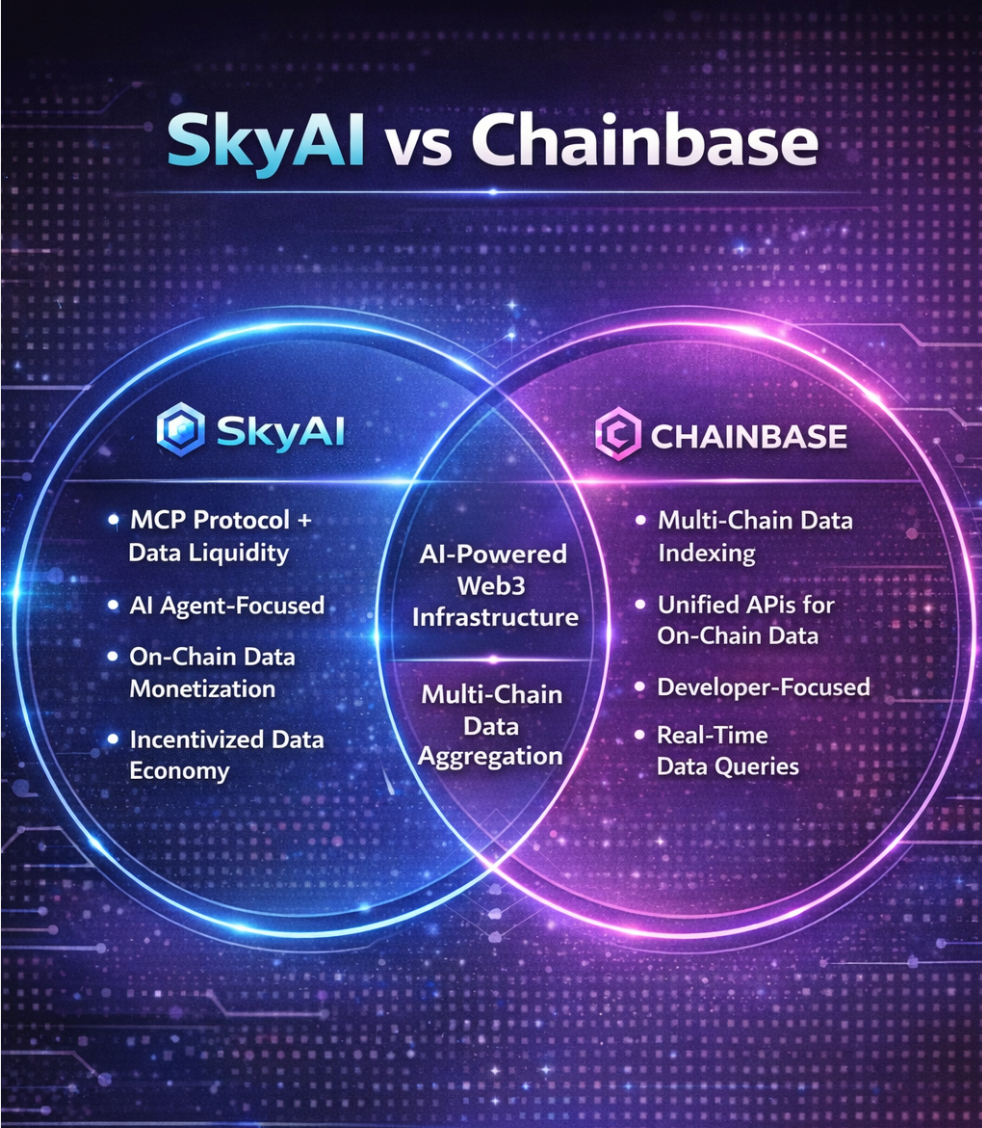
The primary distinction between SkyAI and Chainbase lies in their protocol positioning. Chainbase is designed to serve as the foundational Web3 data network infrastructure, offering developers and applications efficient data access through unified standards and multi-chain data indexing services. Its core mission is to help developers overcome the challenges of accessing and processing on-chain data, thereby lowering the entry barriers for data utilization.
In contrast, SkyAI is laser-focused on the data needs of AI Agents operating on-chain. Beyond simply providing data services, it leverages the MCP protocol to establish standardized data interaction interfaces for AI models and introduces a Data Liquidity mechanism to enable data resources to have both liquidity and value exchange capabilities. In essence, SkyAI is not just about making data more accessible—it’s about ensuring data can be invoked in real time by AI and participate in value transfer.
Viewed this way, Chainbase functions as an on-chain data service layer, while SkyAI acts as a data interaction layer purpose-built for AI Agents.
What Are the Technical Architecture Differences Between SkyAI and Chainbase?
Although both SkyAI and Chainbase are Web3 data infrastructure protocols, their technical architectures are fundamentally different. Chainbase takes a traditional data indexing network approach, aggregating multi-chain data and providing unified interfaces for developers to access information. SkyAI, by contrast, builds on data aggregation by adding AI Agent invocation protocols and data liquidity mechanisms, making data not only accessible but also available for real-time AI invocation and value exchange.
From a technical perspective, Chainbase primarily addresses on-chain data indexing and standardization, while SkyAI aims to build a data interaction layer for AI Agents, emphasizing real-time collaboration between data and AI models in its protocol design.
| Comparison Dimension |
SkyAI |
Chainbase |
| Core Positioning |
AI Agent Data Interaction Infrastructure |
Multi-chain Data Indexing Infrastructure |
| Main Functions |
Data Invocation + Data Liquidity |
Data Indexing + Data Access |
| Protocol Focus |
MCP Protocol + Data Liquidity |
Data Indexing + API Service |
| Service Target |
AI Agent, Automated Apps |
Developer, DApps |
| Data Value Mechanism |
Data Can Be Invoked and Incentivized for Circulation |
Primarily Provides Data Access |
| Applicable Scenarios |
AI Agent, Automated Trading, Intelligent Execution |
Data Query, On-chain Analytics, Application Development |
| Value Logic |
Data Interaction Value + Data Liquidity |
Data Service Network Value |
In summary, Chainbase is positioned as a data infrastructure layer for developers, while SkyAI is positioned as a data execution layer for AI Agents. Rather than being direct competitors, they represent different stages in the evolution of AI-driven Web3 data infrastructure.
If AI Agents become a primary gateway for on-chain applications, solutions like SkyAI—with standardized interaction protocols and data liquidity mechanisms—could demonstrate greater scalability and growth in AI + Web3 use cases.
How Do SkyAI and Chainbase Differ in Value Capture Logic?
When it comes to value capture, Chainbase’s core value is derived from its data service network. As more developers utilize its services, the protocol’s network value increases, driving ecosystem expansion. This model is similar to traditional data infrastructure platforms, where value growth depends primarily on developer adoption and rising demand for data services.
SkyAI’s value capture logic is more sophisticated. In addition to growing demand for data services, its Data Liquidity mechanism transforms on-chain data into liquid assets, making data invocation itself a process of value exchange. AI Agents pay tokens to access data, while data providers are rewarded for supplying data, creating an economic model centered on data circulation.
This means Chainbase’s value is anchored in “data service scale,” while SkyAI’s is built on a “data interaction and liquidity network.”
Which Is More Suitable for AI Agent Scenarios?
For AI Agent scenarios, SkyAI’s design is clearly more specialized. AI Agents require not only on-chain data access but also structured context to make rapid, automated decisions. The MCP protocol at the heart of SkyAI is designed to meet these needs, enabling AI Agents to read standardized data through a unified interface and perform on-chain operations.
While Chainbase can also support AI applications with data services, its design is more focused on foundational data access and is not specifically optimized for the real-time interaction needs of AI Agents. For AI Agents requiring automated execution and instant decision-making, SkyAI offers a more comprehensive support framework.
This is why SkyAI is positioned as AI Agent infrastructure in the AI + Web3 narrative, whereas Chainbase is positioned as a general-purpose data service protocol.
Potential and Differentiated Development of SkyAI and Chainbase
Looking at long-term potential, both SkyAI and Chainbase have growth prospects that depend on the pace of AI + Web3 development. Chainbase’s strength lies in its robust infrastructure capabilities and clear demand for multi-chain data services, making it suitable for a broad range of Web3 applications and ensuring strong baseline market demand.
SkyAI’s potential is closely tied to the growth of the AI Agent ecosystem. If on-chain automation expands rapidly, protocols that deliver standardized data interaction and liquidity for AI Agents will command greater value. In other words, SkyAI’s upside could be higher, but it is also more dependent on the speed of AI Agent market adoption.
As a result, Chainbase aligns with a steady, infrastructure-driven growth model, while SkyAI offers greater upside flexibility driven by the AI narrative.
Summary
SkyAI and Chainbase are not direct competitors; instead, they occupy different layers within the data infrastructure ecosystem. Chainbase delivers data access infrastructure for developers, while SkyAI provides data interaction infrastructure for AI Agents.
If the market focus is on multi-chain data services, Chainbase offers strong infrastructure value. If AI Agents become a core application scenario in Web3, SkyAI’s protocol design is more forward-looking.
From a trend perspective, SkyAI represents a deeper integration of AI and on-chain data interaction, while Chainbase is a critical element of the current on-chain data infrastructure. Each corresponds to a different stage of industry development—both are worth watching, but the rationale for doing so is distinct.
FAQs
What is the main difference between SkyAI and Chainbase?
The main difference lies in their positioning: Chainbase specializes in multi-chain data services, whereas SkyAI focuses on AI Agent data interaction and data liquidity.
Why is SkyAI more suitable for AI Agents?
Because SkyAI’s MCP protocol delivers standardized on-chain data context for AI Agents, supporting real-time automated decision-making.
What is Chainbase’s core advantage?
Chainbase’s strength is its powerful multi-chain data indexing and standardized data service capabilities.
Which has greater potential, SkyAI or Chainbase?
Chainbase offers steadier growth, while SkyAI may have higher growth potential as the AI Agent ecosystem expands.