When users explore Highstreet, they often want to know whether the token serves only as a payment method or if it powers more sophisticated economic functions. Because the platform integrates virtual goods, real-world e-commerce, and NFT assets, the token’s role directly shapes transaction mechanisms and the structure of the overall ecosystem.
This question covers several layers, including the token’s characteristics, transaction functionality, circulation pathways, incentive mechanisms, and economic model. Collectively, these factors define HIGH’s real-world application within Highstreet.
What Is the HIGH Token?
HIGH is the core utility token within the Highstreet ecosystem. Its main purpose is to bridge virtual goods, user engagement, and the platform’s economic framework.
From a technical perspective, HIGH is a blockchain-issued token. It is transferable, verifiable, and embedded throughout system modules, including transactions, incentives, and governance. Beyond simply facilitating payments, HIGH also enables value transfer and plays a role in balancing the ecosystem.
In practice, users interact with the ecosystem—making purchases or engaging with activities—using HIGH. Smart contracts handle asset transfers and records automatically. This decentralized design ensures that HIGH operates according to on-chain rules, rather than relying on a centralized authority.
The significance here is clear: HIGH doesn’t just enable commerce, it underpins Highstreet’s economic foundation, allowing virtual goods to realize a complete value chain.
Core Functions of HIGH in Highstreet
HIGH’s core utility can be distilled into four pillars: payment, access, incentives, and governance.
- Payment: Users spend HIGH to purchase virtual goods or NFT assets that may be tied to real-world products.
- Access: Certain virtual environments or events may require HIGH for participation.
- Incentives: The platform rewards user engagement with HIGH, incentivizing contributions and activity.
- Governance: Token holders participate in decision-making processes impacting the ecosystem.
| Function Type |
Specific Role |
Impact on Ecosystem |
| Payment |
Purchase virtual goods and NFT assets |
Supports transactional demand |
| Access |
Enter exclusive environments or events |
Enhances user engagement |
| Incentive |
Reward users and contributors |
Drives platform activity |
| Governance |
Participate in ecosystem decisions |
Strengthens community ownership |
| Circulation |
Connect users and brands |
Builds a sustainable economic cycle |
These functions are interconnected through token circulation: user spending triggers payments, and the platform allocates a portion of tokens as incentives, sustaining the ecosystem’s momentum.
This structure positions HIGH as a multi-utility token, not just a simple payment instrument.
How Virtual Goods Transactions Leverage HIGH
Highstreet’s core marketplace revolves around the digital exchange of both virtual and physical goods.
Here’s how a typical transaction unfolds: users browse virtual goods or NFT assets, which are frequently linked to tangible products. Payment is completed with HIGH, after which the system validates the purchase and allocates the relevant NFT or rights to the user per the established rules.
The transaction process includes the following steps: the user selects a product and initiates a purchase; the system processes the payment and triggers a smart contract; the NFT or digital asset is transferred; and the user receives the associated rights.
The critical advantage is that HIGH serves as the settlement currency, enabling transactions to finalize on-chain. NFTs guarantee asset uniqueness and verifiability.
Compared to traditional e-commerce, this model gives products both consumption and asset attributes, expanding their use cases.
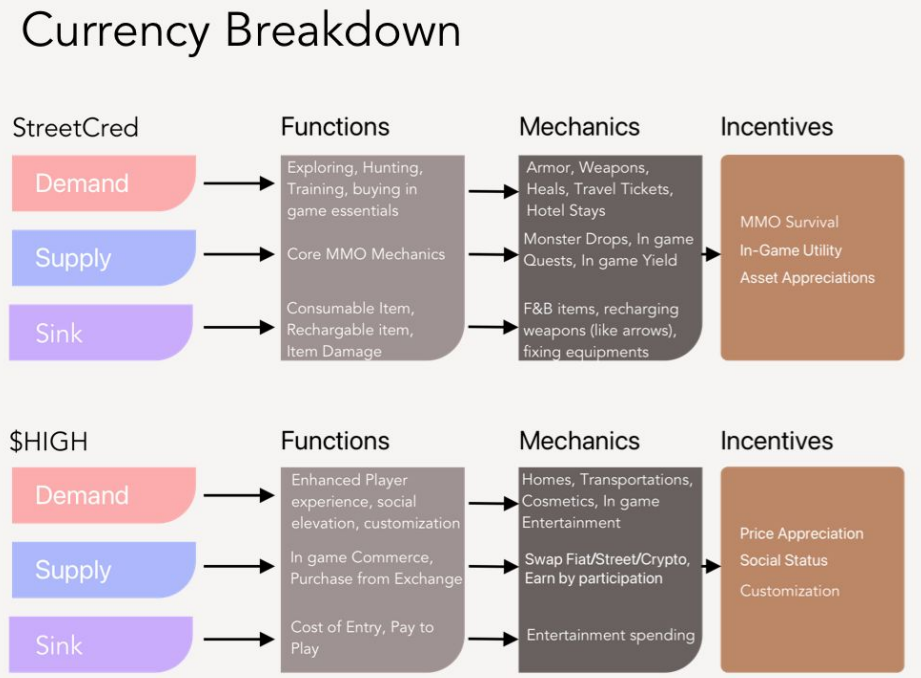
How HIGH Circulates Within the Ecosystem
HIGH’s circulation model is centered on the dynamic interactions between users, brands, and the platform.
A typical cycle works like this: users acquire tokens via transactions or platform activities and then spend them on goods or for ecosystem participation. Brands and merchants, in turn, use the tokens for platform services or operational needs. The platform strategically allocates a portion of tokens for incentives and ecosystem development.
Here’s a summary of the token flow:
| Circulation Stage |
Action |
Token Flow |
| Acquisition |
User purchases or engages with activities |
External/system → User |
| Consumption |
User buys goods |
User → Merchant |
| Distribution |
Platform rewards or allocates |
Platform → User or Creator |
| Recirculation |
User engages again |
User → Ecosystem |
The central feature of this cycle is that tokens continuously circulate among participants, instead of being depleted by a single party.
The efficiency of this circulation directly influences ecosystem vitality and the platform’s ability to sustain a robust economic system.
How Incentives and Governance Drive User Engagement
HIGH’s incentive and governance mechanisms are designed to boost user engagement and fuel ecosystem growth.
- Incentives: The platform distributes HIGH to reward users who participate in activities, complete tasks, or contribute content. These rewards can be spent on additional purchases or participation, creating a self-reinforcing loop.
- Governance: HIGH holders can vote on decisions such as resource allocation or strategic direction, making users active stakeholders rather than just consumers.
The key is to directly link user actions with token rewards: deeper engagement leads to greater token earnings, increasing user loyalty and retention.
Structurally, incentives and governance work together—HIGH supports not only transactions but also the organization of ecosystem collaboration.
How HIGH’s Economic Model Shapes Ecosystem Growth
HIGH’s economic model—total supply, distribution structure, and circulation mechanism—directly determines the Highstreet ecosystem’s stability.
- Supply: HIGH is capped at 100 million tokens, ensuring scarcity. The current circulation rate is high, indicating that market supply is stabilizing.
- Distribution: The breakdown is as follows:
| Distribution Category |
Proportion |
| Private Sale |
32.84% |
| Play-to-Earn Incentives |
30.00% |
| Ecosystem Reserve |
9.50% |
| Treasury |
9.16% |
| Team |
8.00% |
| Marketing and Partnerships |
4.00% |
| Public Sale |
2.50% |
| Advisors |
2.00% |
| Launchpool and Early Stage |
2.00% |
Approximately 30% of the tokens are allocated to gaming incentives, highlighting the ecosystem’s heavy reliance on user engagement and virtual consumption. A significant share goes to early investors, linking market supply to historical allocations.
Highstreet also employs a dual-token model: HIGH is responsible for value accrual and governance, while a secondary token supports in-game transactions. This approach clearly separates long-term value from everyday utility.
Overall, HIGH’s economic framework uses supply control and incentive alignment to power a value cycle centered on virtual goods and user activity.
Summary
Within the Highstreet ecosystem, the HIGH token delivers payment, transactional, incentive, and governance functionality—connecting users, brands, and the platform through a robust circulation mechanism. Its economic model, defined by supply, allocation, and incentives, is the foundation for ecosystem stability and growth. Integrated with the virtual goods marketplace, HIGH is a critical pillar for the operation of metaverse commerce.
FAQ
What is the main use case for the HIGH token?
HIGH is primarily used for transactions, user incentives, and governance within the Highstreet ecosystem.
What is the total HIGH supply?
HIGH is capped at 100 million tokens, operating under a fixed supply model.
What distinguishes HIGH’s distribution structure?
A large portion is dedicated to gaming incentives and early investors, underscoring its ecosystem-driven and market-oriented design.
How does HIGH facilitate virtual goods transactions?
Users pay for goods with HIGH, and the system completes the transfer of NFT assets or rights.
Why is HIGH’s economic model important?
The economic model determines token supply, circulation, and incentive structures, shaping the entire ecosystem’s operation.