

Trade
Basic
Futures
Futures
Hundreds of contracts settled in USDT or BTC
TradFi
Gold
Trade global traditional assets with USDT in one place
Options
Hot
Trade European-style vanilla options
Unified Account
Maximize your capital efficiency
Demo Trading
Futures Kickoff
Get prepared for your futures trading
Futures Events
Participate in events to win generous rewards
Demo Trading
Use virtual funds to experience risk-free trading
Earn
Launch
CandyDrop
Collect candies to earn airdrops
Launchpool
Quick staking, earn potential new tokens
HODLer Airdrop
Hold GT and get massive airdrops for free
Launchpad
Be early to the next big token project
Alpha Points
Trade on-chain assets and enjoy airdrop rewards!
Futures Points
Earn futures points and claim airdrop rewards
Investment
Simple Earn
Earn interests with idle tokens
Auto-Invest
Auto-invest on a regular basis
Dual Investment
Buy low and sell high to take profits from price fluctuations
Soft Staking
Earn rewards with flexible staking
Crypto Loan
0 Fees
Pledge one crypto to borrow another
Lending Center
One-stop lending hub
VIP Wealth Hub
Customized wealth management empowers your assets growth
Private Wealth Management
Customized asset management to grow your digital assets
Quant Fund
Top asset management team helps you profit without hassle
Staking
Stake cryptos to earn in PoS products
Smart Leverage
New
No forced liquidation before maturity, worry-free leveraged gains
GUSD Minting
Use USDT/USDC to mint GUSD for treasury-level yields

More


Trending Topics
View More42.47M Popularity
159.9K Popularity
123.84K Popularity
1.67M Popularity
516.41K Popularity





Pin
Market Focus "Strait of Hormuz": Theoretically Open, but "Ships Turn Around," Premiums Soar
The United States launched a military strike against Iran, causing global energy markets to be highly alert, with energy prices and inflation risks rising in tandem. According to Xinhua News Agency, on February 28, the U.S. and Israel jointly initiated a “preemptive” military attack on Iran, which Iran responded to with strikes against multiple targets in Israel and the Middle East region.
Reported by Iran’s Tasnim News Agency, the Iranian Islamic Revolutionary Guard Corps has issued radio warnings to passing commercial ships, stating that the Strait of Hormuz is currently “unsafe.” Several major traders immediately announced suspensions of oil shipments through the strait, and insurers also urgently canceled or significantly adjusted related policy terms.
Currently, the Iranian authorities have not issued an official statement on whether the strait is officially closed. According to a European Union naval officer quoted by Reuters, a spokesperson for the IRGC has broadcast via very high frequency radio to merchant ships, explicitly stating that “no vessels are permitted to pass through the Strait of Hormuz.”
Meanwhile, President Trump stated that the U.S. is launching a major military operation, targeting a broader scope than last year’s actions against Iran’s nuclear facilities. The situation continues to escalate, drawing intense attention from global energy markets.
The Strait of Hormuz is the world’s most critical energy export route, with about one-fifth of daily global oil consumption passing through it. Market analysts warn that a vertical blockade of the strait, even limited disruptions such as harassment or seizure of ships, could be enough to push up freight costs and cause oil supply tensions.
Edward Fishman, Director of Geopolitical Studies at the U.S. War College, said:
Traders suspend shipments, oil tankers turn back
According to Lloyd’s List, affected by the situation, several major traders have announced suspensions of their oil tankers passing through the Strait of Hormuz. Several veteran traders said that the warnings from the Iranian navy are quite credible, and no ships are expected to risk crossing in the coming days. Reuters also cited a major trader saying that its vessels “will suspend transit for several days.”
Automatic ship identification system data from Lloyd’s List shows that many ships in the Persian Gulf and Oman Sea have turned around, but some continue to pass through the strait. Additionally, The Wall Street Journal reports that an informed source said a Shell-chartered fully loaded oil tanker initially planned to pass through the Strait of Hormuz has now anchored locally, while another is heading at full speed toward South Korea. Industry insiders also report explosions near Iran’s main oil export hub, Kharg Island, which accounts for about 90% of Iran’s crude oil exports.
Meanwhile, reports indicate that an oil tanker turned around near the Bab el-Mandeb Strait under threats from Yemen’s Houthi forces, showing regional tensions spreading across multiple key maritime routes.
According to Bloomberg journalist Stephen Stapczynski, who obtained data from the port, although the Strait of Hormuz remains open and shipping has not been fully interrupted, an increasing number of oil, refined products, and liquefied natural gas carriers are actively avoiding the area. Stapczynski posted on social platform X:
Insurance market reacts rapidly, rates up to 50% higher
The Financial Times reports that war risk insurers began issuing policy cancellations for ships navigating the Persian Gulf and Strait of Hormuz before the trading day on Saturday, with some premiums expected to rise by up to 50% in the coming days.
Marsh, a major insurance broker,’s head of Marine & War Risks in the UK, Dylan Mortimer, told FT: “Currently, war risk premiums in the Persian Gulf are about 0.25% of the vessel’s replacement value, but this week we expect significant increases.” For example, a vessel valued at $100 million could see single-trip premiums rise from $250,000 to approximately $375,000. Meanwhile, insurers covering cargoes like oil and grains transported by tankers also plan to adjust premiums for related cargo policies starting Monday.
Mortimer noted that the biggest concern among insurers is whether Iran will officially declare the closure of the Strait of Hormuz, and they are also assessing risks related to Iranian proxy forces attempting to board and seize ships, which will be factored into pricing. After policy cancellations, insurers are expected to renegotiate with shipowners at significantly higher rates rather than completely withdraw coverage for ships entering the area.
Brent crude may surpass $100, posing new inflationary pressures worldwide
Brent crude oil prices have risen 19% since 2026, closing at $73 per barrel on February 28. Since Brent futures only resume trading in New York on Sunday evening, the full market impact of this military strike will only be clearer then.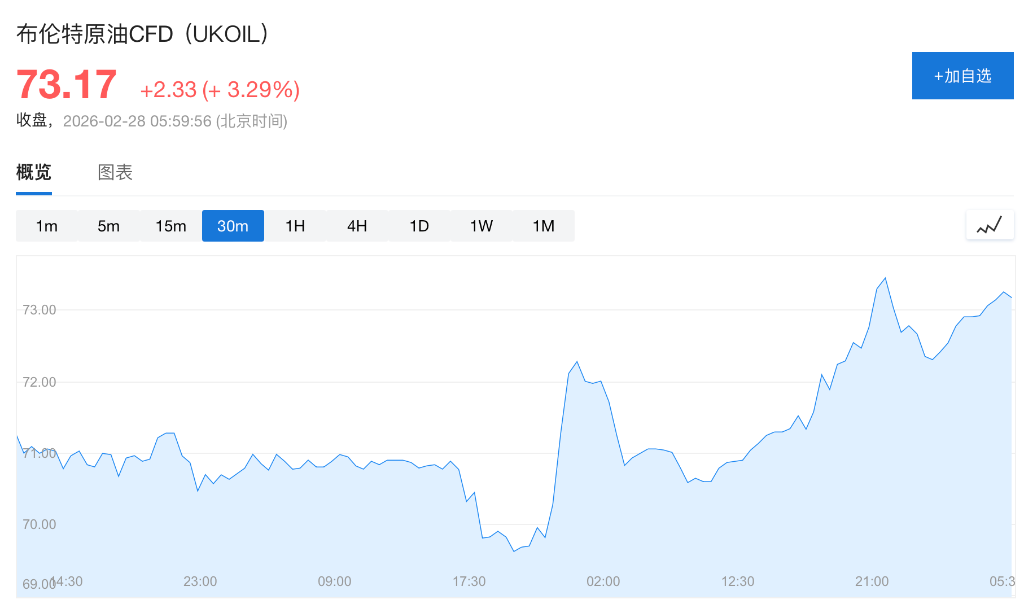
Market research firm Capital Economics noted in a report to clients that if the strike is limited in scope, oil prices could approach $80 per barrel; but if the conflict persists and causes actual supply disruptions, prices could surge significantly, impacting global inflation. The firm estimates that if oil rises to $100 per barrel, the global average inflation rate could increase by 0.6 to 0.7 percentage points.
Edward Fishman of the Council on Foreign Relations warned that the impact of this conflict could be very serious, as oil is a fundamental infrastructure element of the global economy. He expects chain reactions in monetary policy and inflation to follow. Rising energy costs will further squeeze consumer spending power and may prompt the Federal Reserve and other major central banks to adjust their planned rate cuts, or even raise interest rates.
Limited supply buffers, balancing the rise with quantitative measures
Despite escalating geopolitical risks, analysts suggest that several new factors may temporarily restrain further oil price increases.
According to The Wall Street Journal, before the U.S. military strikes Iran, Iran and other major oil producers have accelerated shipments, and Asian refiners have completed large pre-purchases. OPEC has reportedly activated contingency plans to boost exports to their highest levels in nearly three years to counter potential supply disruptions. Saudi Arabia has also increased shipments of crude to overseas storage tanks.
OPEC was scheduled to hold a meeting on Sunday, with analysts previously expecting the Saudi-led coalition to agree on production increases starting in April. However, The Wall Street Journal reports that the current tensions may prompt OPEC to consider implementing the increase earlier to stabilize the market.
Low probability of full blockade, but partial disruptions are already happening
Analysts generally believe that a complete Iranian closure of the Strait of Hormuz is unprecedented and operationally very difficult, making it a low-probability but high-impact extreme scenario. More realistic threats include Iran’s harassment, interception, or seizure of oil tankers, as well as the Houthis resuming attacks on ships in the Red Sea.
Energy data firm Vortexa’s Director of Maritime Risk and Intelligence, Claire Jungman, said:
Vortexa also pointed out that more direct supply risks exist—if Iran’s export infrastructure, including Kharg Island or offshore loading systems, are targeted, actual supply reductions could occur within days rather than weeks.