In traditional DeFi trading architecture, most decentralized exchanges rely on the AMM model to execute trades. While this approach is permissionless and highly composable, it has clear limitations in performance, slippage control, and support for complex order types. As demand for onchain derivatives trading has grown, the market has started exploring solutions that feel closer to the experience of centralized exchanges. The combination of the order book model and Layer2 scaling has gradually become an important direction for improving both performance and user experience.
In the current decentralized perp DEX landscape, Lighter represents a typical “hybrid architecture” path, where execution efficiency is handled offchain while trust is preserved through onchain verification. This design is becoming an important development direction for high performance DeFi infrastructure.
Lighter’s Overall Operating Architecture
Broadly speaking, Lighter’s operation can be divided into three key layers: the order input layer, the matching and execution layer, and the settlement and verification layer. User interaction with the system begins with order submission, and the full cycle ends with an onchain state update.
Unlike systems that execute entirely onchain, Lighter moves the most performance intensive part, matching, offchain, while using zk technology to ensure that every result can be verified. This allows it to strike a balance between efficiency and security.
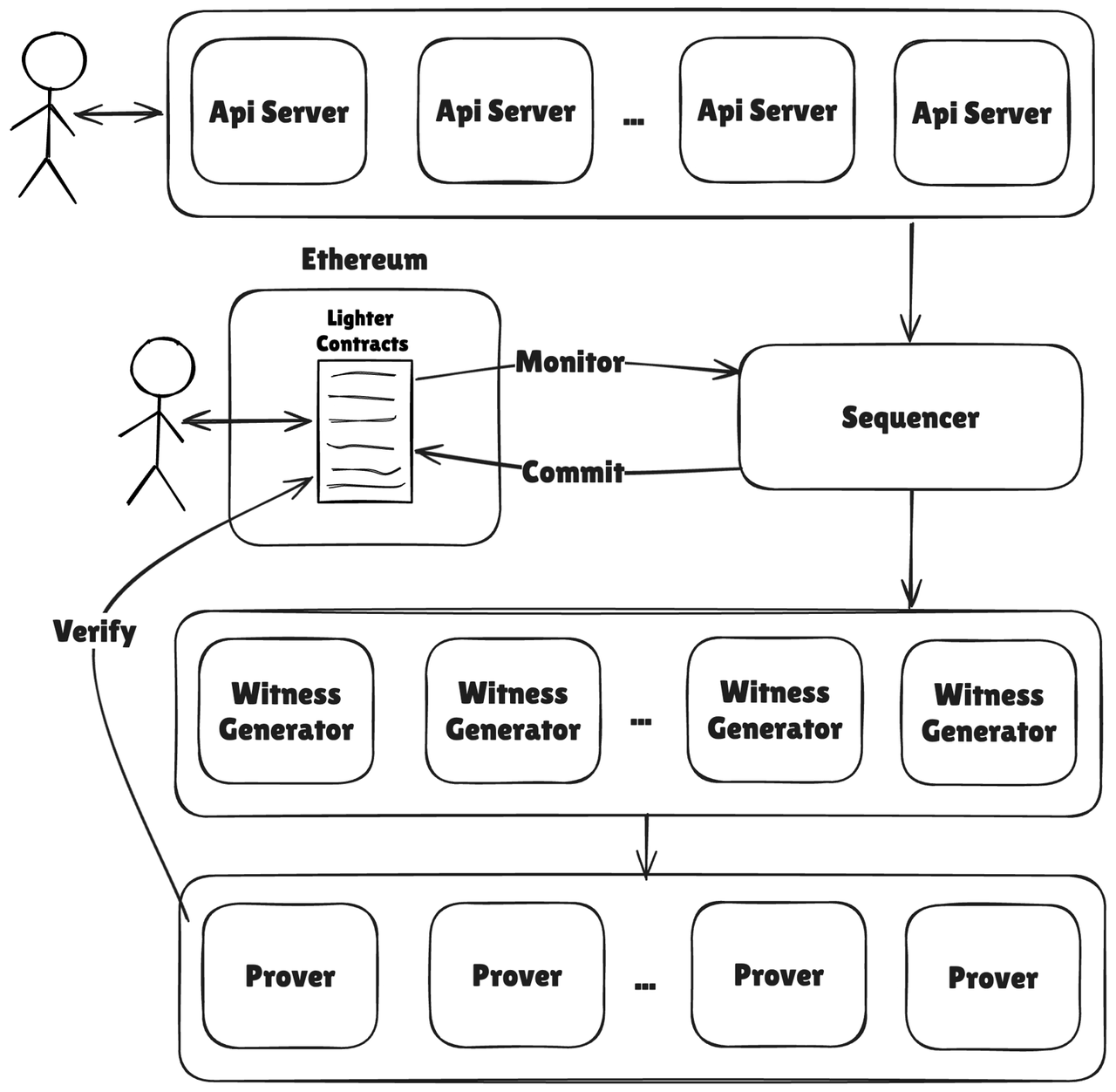
Simplified diagram of Lighter’s technical architecture. Source: Lighter
From Order Submission to Settlement: A Complete Flow Breakdown
In Lighter, a trade typically goes through several stages from initiation to final settlement, and together these stages form the foundation of its high performance trading experience.
First, when a user submits an order, the order information is not executed immediately on the main chain. Instead, it enters the system’s offchain matching engine. The goal at this stage is to quickly collect and sort orders in preparation for matching.
Next, the matching engine pairs buy and sell orders according to price and time priority. Once an order is successfully matched, the trade result is recorded and waits to enter the next batch processing stage. Because this process takes place offchain, it can achieve very low latency and high throughput.
The system then packages multiple trade results together and generates the corresponding zk proof. This data is submitted to the zk rollup contract, where the main chain verifies its correctness. This stage is critical to the system’s security because it ensures that all offchain computation results can be verified.
Finally, once verification passes, the trade results are settled onchain and the user’s asset balances are updated accordingly. At that point, the full lifecycle of a trade is complete.
The core advantage of this flow is that it keeps high frequency operations offchain, while leaving final state confirmation to the chain, so performance and security can both be maintained.
The Role of zk rollup in the Process
Throughout the trading flow, zk rollup acts as the “verification and settlement layer.” It not only compresses transaction data, but also uses zero knowledge proofs to ensure the correctness of every state transition.
Unlike traditional Layer1 systems that execute transactions one by one, zk rollup uses batch processing, packaging a large number of trades together for unified verification. This mechanism significantly reduces gas costs and improves overall system throughput.
More importantly, zk technology means users do not need to trust the matching engine itself, because any error or tampering would fail the onchain verification logic. This is a key reason Lighter can adopt offchain matching in the first place.
Matching is one of the most resource intensive parts of any trading system. If it were executed entirely onchain, costs would be high and performance would still be constrained by block times.
By placing the matching engine offchain, Lighter allows order matching to run at speeds much closer to traditional trading systems. This design enables support for more complex order types and higher frequency trading behavior.
At the same time, because the final results still have to be verified through zk rollup, the system does not give up security. In simple terms, offchain handles “speed,” while onchain handles “trust.”
Settlement and Asset Security Mechanisms
After trading is completed, settlement is the key step that ensures asset states are updated correctly. Lighter’s settlement process relies on zk rollup state updates, so all account balance changes are recorded onchain and can be verified.
Because user assets are always controlled by smart contracts rather than a centralized custodian, users do not face the risk of an exchange misusing their funds. This design preserves one of DeFi’s core strengths, namely self custody and transparency.
At the same time, the batch settlement mechanism further improves system efficiency, allowing it to remain stable even under heavy load.
Conclusion
Lighter’s operating model is essentially an efficient layered design. By handling order matching offchain and using zk rollup for onchain verification and settlement, it successfully balances performance and security.
This model of “offchain execution + onchain verification” not only improves trading speed, but also provides infrastructure support for future high frequency trading and institutional grade applications. As DeFi continues moving toward greater specialization, this architecture is likely to become one of the mainstream directions.
FAQs
What are the main steps in Lighter’s trading flow?
It generally includes order submission, offchain matching, trade batching, zk proof generation, and onchain settlement. Together, these steps form a complete trading loop.
Why does Lighter use offchain matching?
Offchain matching can significantly improve trading speed and reduce costs, while also supporting more complex order types. Security is then ensured through zk rollup.
What is the core role of zk rollup in Lighter?
zk rollup is responsible for verifying the correctness of all trade results and completing final settlement onchain. It is the core of the system’s security.
Is Lighter’s trading fully decentralized?
Its asset custody and settlement are decentralized, but the matching process is executed offchain, so it represents a tradeoff between performance and full decentralization.
Is this architecture scalable in the future?
Because it uses a modular design, Lighter’s architecture has strong scalability and can support more trading pairs, additional features, and upgrades for higher throughput.







