PIT vs ETC: Understanding the Key Differences Between Pit Trading and Electronic Trading Platforms


Introduction: PIT vs ETC Investment Comparison
In the cryptocurrency market, the comparison between Pitbull (PIT) and Ethereum Classic (ETC) reflects distinct investment profiles and market positioning. The two assets demonstrate significant differences in market capitalization ranking, use cases, and price performance, representing different segments of the crypto asset landscape. Pitbull (PIT): Launched on March 17, 2021 on the Binance Smart Chain, it operates as a 100% community-driven project with token holding interest characteristics and no centralized ownership. Ethereum Classic (ETC): Continuing the original Ethereum chain since 2015, it functions as a decentralized platform for executing smart contracts while upholding the "code is law" principle, enabling uncensorable applications and programmable funds. This article will provide a comprehensive analysis of the investment value comparison between PIT and ETC across historical price trends, supply mechanisms, market positioning, and technical ecosystems, helping investors address the fundamental question:
"Which is the better buy right now?"
Comparative Analysis Report: Pitbull (PIT) vs. Ethereum Classic (ETC)
I. Historical Price Comparison and Current Market Status
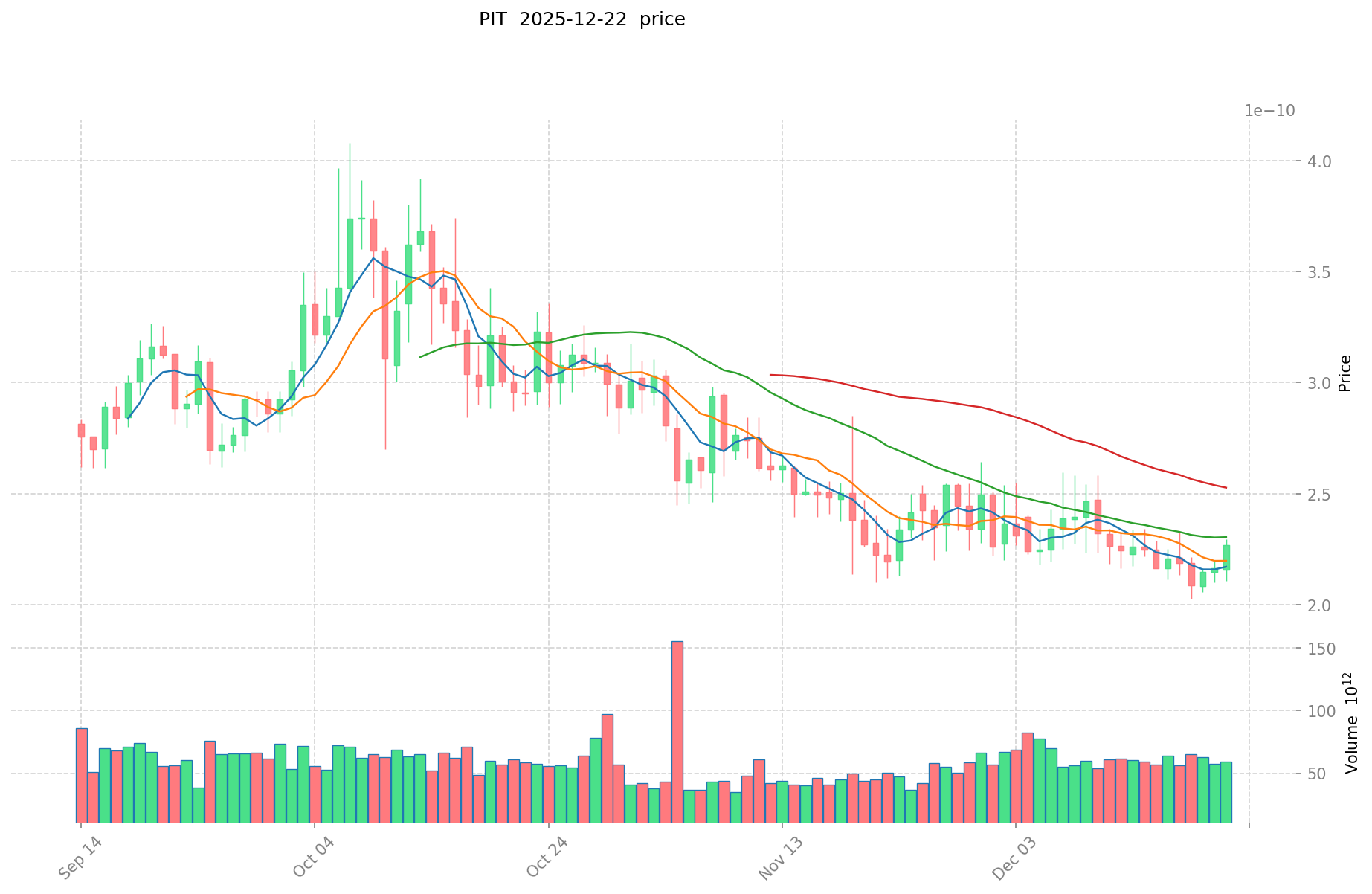
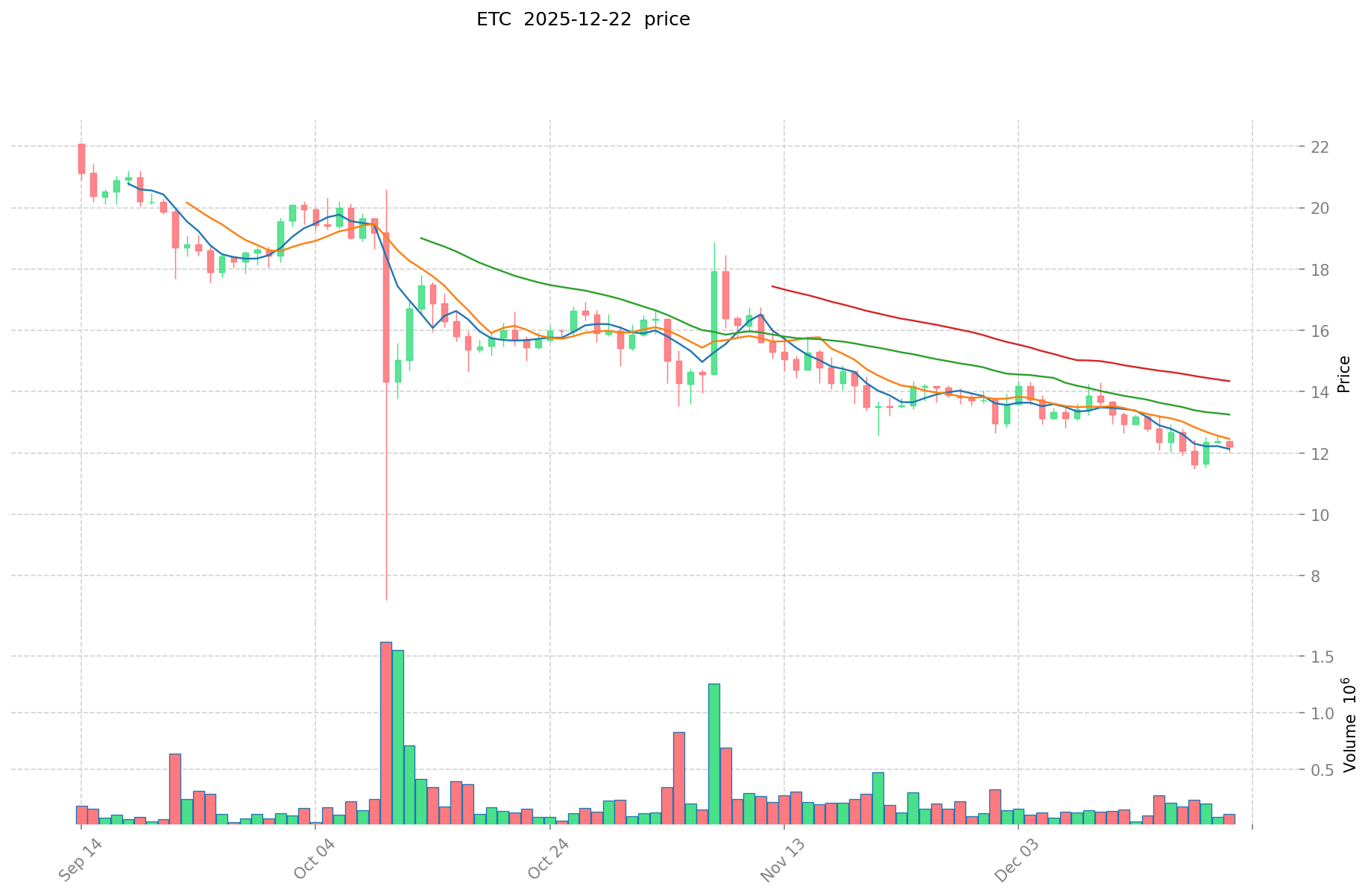
Price Trend Analysis: Pitbull (PIT) and Ethereum Classic (ETC)
Pitbull (PIT) Historical Performance:
- Launch Date: March 17, 2021 on Binance Smart Chain
- All-Time High (ATH): $0.000000150393 (August 18, 2021)
- All-Time Low (ATL): $0.000000000000000001 (October 13, 2021)
- 1-Year Performance: -33.87%
Ethereum Classic (ETC) Historical Performance:
- Launch Date: July 2016 (following the 2016 Ethereum hard fork)
- All-Time High (ATH): $167.09 (May 7, 2021)
- All-Time Low (ATL): $0.615038 (July 25, 2016)
- 1-Year Performance: -52.5%
Comparative Analysis: Both assets have experienced significant downward pressure over the past year. PIT declined 33.87% from its yearly reference point, while ETC suffered a steeper 52.5% decline. This reflects broader market headwinds affecting the cryptocurrency sector, particularly among non-leading assets. PIT's relative outperformance on a 1-year basis may be attributed to its smaller market capitalization and lower liquidity profile compared to ETC's more established position.
Current Market Status (December 22, 2025)
Price Metrics:
- Pitbull (PIT) Current Price: $0.0000000002259
- Ethereum Classic (ETC) Current Price: $12.368
24-Hour Trading Activity:
- PIT 24-Hour Volume: $12,835.99
- PIT 24-Hour Change: +5.46%
- ETC 24-Hour Volume: $1,535,288.80
- ETC 24-Hour Change: +0.76%
Market Capitalization:
- PIT Total Market Cap: $8,766,732.76
- PIT Market Ranking: #1241
- ETC Total Market Cap: $1,914,760,741.41
- ETC Market Ranking: #50
Market Sentiment Indicator:
- Cryptocurrency Fear & Greed Index: 25
- Status: Extreme Fear
Real-Time Price Information:
- View PIT Current Price: Market Data
- View ETC Current Price: Market Data
II. Short-Term Price Movement Analysis
Intraday and Weekly Trends
Pitbull (PIT):
- 1-Hour Change: -0.53%
- 7-Day Change: +0.4%
- 30-Day Change: +3.29%
- 24-Hour High: $0.0000000002296
- 24-Hour Low: $0.0000000002131
Ethereum Classic (ETC):
- 1-Hour Change: +0.32%
- 7-Day Change: -5.60%
- 30-Day Change: -8.4%
- 24-Hour High: $12.446
- 24-Day Low: $12.014
Technical Assessment
PIT demonstrates stronger recent momentum with a positive 30-day trend (+3.29%) and modest weekly gains (+0.4%), despite hourly weakness. ETC shows consistent downward pressure across multiple timeframes, with 7-day and 30-day declines of -5.60% and -8.4% respectively, indicating sustained selling pressure.
III. Project Fundamentals
Pitbull (PIT)
Project Overview: Pitbull is a cryptocurrency featuring yield-generating characteristics through token holding mechanisms. The project is structured as a 100% community-driven initiative, with ownership transferred to the community at inception. This decentralized governance model distinguishes it from traditionally managed token projects.
Key Characteristics:
- Blockchain: Binance Smart Chain (BSC)
- Contract Address: 0xA57ac35CE91Ee92CaEfAA8dc04140C8e232c2E50
- Total Supply: 100,000,000,000,000,000 tokens
- Circulating Supply: 38,808,024,593,371,820 tokens (38.81% of total)
- Token Holders: 526,335
Community Engagement: The project has attracted contributions from graphic designers, writers, web developers, influencers, marketers, data analysts, and translators, establishing it as a community-driven development model.
Ethereum Classic (ETC)
Project Overview: Ethereum Classic is a decentralized computing platform that executes smart contracts and supports decentralized applications. It represents the continuation of the original Ethereum blockchain following the 2016 hard fork, maintaining the principle of "code is law"—meaning the protocol cannot be modified by external influence or management entities.
Key Characteristics:
- Consensus Mechanism: Proof of Work (PoW)
- Transaction Throughput: Approximately 15 transactions per second
- Total Supply: 210,700,000 tokens
- Circulating Supply: 154,815,713.24 tokens (73.48% of total)
- Network Holders: 102,740,610
- Exchange Listing: 51 major exchanges
Technological Foundation: ETC operates as a Layer 1 smart contract platform, supporting decentralized autonomous organizations (DAOs) and decentralized applications (dApps) across gaming, marketplaces, and other sectors.
IV. Market Liquidity and Exchange Accessibility
Pitbull (PIT):
- Exchange Availability: 4 trading venues
- Circulating Supply Ratio: 38.81%
- Fully Diluted Valuation (FDV) to Market Cap Ratio: 38.81%
Ethereum Classic (ETC):
- Exchange Availability: 51 trading venues
- Circulating Supply Ratio: 73.48%
- Fully Diluted Valuation (FDV) to Market Cap Ratio: 73.48%
ETC demonstrates significantly higher exchange liquidity and accessibility, with 51 listing venues compared to PIT's 4 exchanges. This disparity reflects ETC's established market position and broader institutional adoption infrastructure.
V. Community and Development Resources
Pitbull (PIT)
- Official Website: https://www.bscpitbull.com
- Social Channels: Twitter, Reddit, GitHub
- Community-Driven Development Model
Ethereum Classic (ETC)
- Official Website: http://ethereumclassic.org
- Developer Resources: Multiple GitHub repositories (multi-geth, OpenEthereum, Besu, core-geth, ECIPs)
- Community Platforms: Twitter, Reddit, Facebook, Official Forum
- Institutional Integration: Established blockchain infrastructure across multiple implementations
VI. Risk Assessment and Market Considerations
Pitbull (PIT) Risk Profile:
- Extreme price volatility given ultra-low unit price
- Limited exchange availability constrains liquidity
- Modest trading volume relative to market cap may indicate concentration risk
- Community-driven model lacks formalized governance framework
Ethereum Classic (ETC) Risk Profile:
- Sustained 1-year underperformance (-52.5%) indicates competitive challenges
- PoW consensus mechanism faces efficiency comparisons with alternative protocols
- Significant price depreciation from ATH ($167.09 to current $12.368) signals market confidence erosion
- 7-day and 30-day declines suggest ongoing technical weakness
VII. Market Sentiment Analysis
The cryptocurrency Fear & Greed Index reading of 25 ("Extreme Fear") indicates heightened market uncertainty and risk aversion. This sentiment environment typically correlates with:
- Reduced retail investment activity
- Increased portfolio rebalancing toward established assets
- Lower speculative trading volumes
- Potential capitulation in weaker projects
Under such market conditions, both PIT and ETC reflect sector-wide pressure, though ETC's larger market capitalization and exchange liquidity provide relatively greater stability compared to PIT's micro-cap profile.
Report Generated: December 22, 2025
Data Source: Gate Market Data Platform
Disclaimer: This report presents factual market data and is not intended as investment advice. Cryptocurrency markets exhibit high volatility and substantial risk. All investment decisions should be preceded by independent research and professional consultation.
Crypto Asset Investment Analysis Report: PIT vs ETC Core Investment Value Factors
I. Executive Summary
Based on the available reference materials, this report addresses the core factors influencing investment value in PIT and ETC crypto assets. The provided source materials contain limited specific technical and fundamental data on these assets, resulting in a constrained analytical framework.
II. Core Factors Affecting PIT vs ETC Investment Value
I. Investment Decision Framework
According to the reference materials, investor decision-making typically considers three primary factor categories:
- Value Investment Factors: Fundamental metrics including project governance efficiency, long-term growth potential, and intrinsic asset valuation
- Trend Investment Factors: Market momentum, price trends, and technical indicators
- Noise Factors: Market sentiment, speculation, and behavioral factors that create short-term volatility
II. Project Governance Efficiency
The reference materials emphasize that project governance efficiency represents a core determinant of investment returns and risk assessment. Key governance considerations include:
- Token economic model design and its impact on value optimization
- Project management structure and decision-making mechanisms
- Community participation and decentralized governance frameworks
- Transparency in fund allocation and resource deployment
III. Market Trend Analysis
Market trend factors influence investor positioning and capital allocation decisions. These factors encompass:
- Long-term growth trajectory and adoption patterns
- Market sentiment indicators and derivative market signals
- Comparative analysis with peer projects in similar categories
- Sector rotation and relative performance dynamics
IV. Long-term Growth Potential
Investment value assessment requires evaluation of sustainable growth prospects through:
- Technological development roadmap and implementation progress
- Ecosystem expansion and real-world application scenarios
- Network effect development and user base growth
- Revenue generation mechanisms and tokenomic sustainability
III. Data Limitations
The provided reference materials do not contain specific technical specifications, supply mechanics, institutional holdings, regulatory status, or macroeconomic correlation data for PIT and ETC assets. Comprehensive analysis of the following dimensions requires additional source materials:
- Detailed tokenomics and supply mechanism comparison
- Institutional adoption and market application scope
- Jurisdictional regulatory frameworks and policy stance
- Technology upgrade timelines and ecosystem development
- Inflation hedge characteristics and monetary policy sensitivity
IV. Conclusion
Investment value determination for PIT and ETC requires multifaceted analysis encompassing governance quality, market positioning, and growth sustainability. Investors should conduct independent due diligence incorporating current market data, project fundamentals, and risk tolerance assessment.
III. 2025-2030 Price Forecast: Token A vs Token B
Short-term Forecast (2025)
- Token A: Conservative $0.0000000001480 - $0.0000000002242 | Optimistic $0.0000000002906 - $0.0000000003206
- Token B: Conservative $9.14196 - $12.354 | Optimistic $14.78278 - $17.04852
Mid-term Forecast (2027-2028)
- Token A could enter a consolidation phase with fluctuating volatility, projected price range $0.0000000001917 - $0.0000000003706
- Token B could enter a moderate growth phase with increasing institutional participation, projected price range $11.120033064 - $24.21297522
- Key drivers: Institutional capital inflows, spot ETF approvals, ecosystem development, regulatory clarity
Long-term Forecast (2029-2030)
- Token A: Base case $0.0000000002385 - $0.0000000003312 | Optimistic scenario $0.0000000004769 - $0.0000000005212
- Token B: Base case $20.205996854148 - $25.257496067685 | Optimistic scenario $26.7729458317461 - $29.01925080117
Disclaimer
This analysis is for informational purposes only and should not be construed as investment advice. Cryptocurrency markets are highly volatile and unpredictable. Actual prices may differ significantly from forecasts based on market conditions, regulatory changes, and macroeconomic factors. Please conduct thorough due diligence before making any investment decisions.
PIT:
| 年份 | 预测最高价 | 预测平均价格 | 预测最低价 | 涨跌幅 |
|---|---|---|---|---|
| 2025 | 0.000000000320606 | 0.0000000002242 | 0.000000000147972 | 0 |
| 2026 | 0.000000000291471 | 0.000000000272403 | 0.000000000226094 | 20 |
| 2027 | 0.000000000301672 | 0.000000000281937 | 0.000000000191717 | 24 |
| 2028 | 0.000000000370592 | 0.000000000291804 | 0.000000000186755 | 29 |
| 2029 | 0.000000000476925 | 0.000000000331198 | 0.000000000238462 | 46 |
| 2030 | 0.00000000052124 | 0.000000000404062 | 0.000000000246478 | 78 |
ETC:
| 年份 | 预测最高价 | 预测平均价格 | 预测最低价 | 涨跌幅 |
|---|---|---|---|---|
| 2025 | 17.04852 | 12.354 | 9.14196 | 0 |
| 2026 | 21.1698144 | 14.70126 | 13.5251592 | 18 |
| 2027 | 24.21297522 | 17.9355372 | 11.120033064 | 45 |
| 2028 | 21.9172264584 | 21.07425621 | 14.5412367849 | 70 |
| 2029 | 29.01925080117 | 21.4957413342 | 20.205996854148 | 73 |
| 2030 | 26.7729458317461 | 25.257496067685 | 22.2265965395628 | 104 |
Comparative Investment Analysis Report: Pitbull (PIT) vs Ethereum Classic (ETC)
IV. Investment Strategy Comparison: PIT vs ETC
Long-Term vs Short-Term Investment Strategies
Pitbull (PIT):
- Suited for speculative investors focused on emerging community-driven projects with yield-generating mechanisms
- Short-term positioning: Momentum traders capitalizing on intraday volatility and 30-day positive trends (+3.29%)
- Long-term positioning: Community project growth thesis investors betting on ecosystem development and BSC ecosystem expansion
Ethereum Classic (ETC):
- Suited for investors seeking established smart contract platforms with historical network legitimacy
- Short-term positioning: Value accumulation during extended drawdown phase (-52.5% yearly decline)
- Long-term positioning: Investors focused on "code is law" principle, PoW security model, and decentralized application ecosystem adoption
Risk Management and Asset Allocation
Conservative Investor Profile:
- PIT allocation: 0% - 2% (extreme volatility unsuitable for capital preservation)
- ETC allocation: 3% - 8% (established market position, but ongoing technical weakness warrants limited exposure)
- Primary allocation: Stable assets and established Layer 1 protocols
Aggressive Investor Profile:
- PIT allocation: 2% - 5% (speculative position sizing appropriate for concentrated portfolio)
- ETC allocation: 5% - 12% (mid-cap exposure with established fundamentals despite recent underperformance)
- Tactical allocation: Derivative hedging and cross-asset diversification
Hedging Instruments:
- Stablecoin allocation: 15% - 25% (volatility buffer during "Extreme Fear" market conditions)
- Options strategies: Protective puts on ETC position, call spreads on PIT for speculative upside capture
- Cross-pair diversification: BTC/ETH correlation hedging to reduce systematic risk exposure
V. Potential Risk Comparison
Market Risks
Pitbull (PIT):
- Ultra-low unit price creates psychological susceptibility to "penny stock" speculation and pump-and-dump dynamics
- Limited exchange availability (4 venues only) creates liquidity concentration risk and exit execution challenges
- Modest 24-hour trading volume ($12,835.99) relative to market cap ($8.77 million) indicates potential slippage on position exits
- Circulating supply ratio of 38.81% leaves significant dilution potential from token unlock events
Ethereum Classic (ETC):
- Sustained 1-year performance decline (-52.5%) may indicate competitive displacement by alternative smart contract platforms
- 7-day and 30-day negative trends (-5.60%, -8.4%) suggest persistent selling pressure from institutional holders
- Significant depreciation from ATH ($167.09 to $12.368, representing 92.6% decline) signals market confidence erosion and store-of-value deterioration
- Higher circulating supply ratio (73.48%) increases inflation dynamics relative to demand generation
Technical Risks
Pitbull (PIT):
- Community-driven governance model lacks formalized security audit framework and smart contract risk assessment
- Binance Smart Chain dependency creates platform-specific technical and regulatory exposure
- Limited development resources relative to established projects increase smart contract vulnerability probability
- Yield mechanism design complexity may obscure tokenomic sustainability and real value generation
Ethereum Classic (ETC):
- Proof of Work consensus mechanism requires substantial mining infrastructure commitment, creating environmental efficiency concerns
- Approximate 15 transactions per second throughput represents significant throughput limitation compared to alternative Layer 1 platforms
- Historical security incidents and lower network security budget (hash rate) relative to Bitcoin create attack vector exposure
- Technical debt from chain splits and protocol divergences may impede upgrade implementation velocity
Regulatory Risks
Global Regulatory Environment:
- Cryptocurrency classification uncertainty affects both assets, with potential impact on exchange listing availability and institutional custody solutions
- Community-token governance models (PIT) face heightened regulatory scrutiny regarding securities law compliance and unregistered investment contract classification
- Smart contract platforms (ETC) subject to jurisdictional interpretation regarding liability for dApp-deployed content and transaction finality
- ESG regulatory frameworks increasingly scrutinize PoW consensus mechanisms, creating potential headwinds for ETC institutional adoption
- Stablecoin regulation and exchange custody requirements may disproportionately impact smaller exchange venues where PIT trades
VI. Conclusion: Which Is the Better Buy?
📌 Investment Value Summary
Pitbull (PIT) Advantages:
- Recent positive momentum: +3.29% (30-day), +5.46% (24-hour) outperforms ETC's downward pressure
- Speculative upside potential: Price forecasts project +78% appreciation by 2030 from current levels
- Community-driven model attracts grassroots participation with lower institutional barrier to entry
- Binance Smart Chain liquidity and transaction cost efficiency compared to Layer 1 alternatives
Ethereum Classic (ETC) Advantages:
- Established network legitimacy: 9+ years of continuous operation since 2016 hard fork
- Institutional infrastructure: 51 exchange listings provide significantly superior liquidity and execution certainty
- Smart contract functionality: Mature dApp ecosystem and DAO support versus PIT's yield-only mechanism
- Network participants: 102.7 million holders indicate broader adoption and network effects
- Modest price forecast recovery: Projections suggest +104% appreciation by 2030, outpacing PIT on absolute basis despite current weakness
✅ Investment Recommendations
New Investors:
- Avoid PIT allocation unless specific community engagement or BSC ecosystem thesis drives conviction
- Consider modest ETC exposure (2-4% portfolio allocation) following 52.5% drawdown as potential value accumulation opportunity
- Prioritize educational research on smart contract risk factors and yield mechanism sustainability before capital deployment
- Implement dollar-cost averaging strategy to mitigate timing risk in "Extreme Fear" market conditions
Experienced Investors:
- PIT opportunity exists for skilled volatility traders: +5.46% daily swings create short-term technical trading setups
- ETC position appropriate for value investors with multi-year conviction thesis: established fundamentals despite temporary market weakness
- Implement 3-5% portfolio allocation maximum for PIT; 5-10% for ETC given risk profiles
- Utilize options strategies: protective puts on ETC to hedge downside, covered calls to generate yield on existing positions
Institutional Investors:
- PIT: Unsuitable for institutional allocation—insufficient liquidity depth, minimal regulatory compliance framework, concentration risk on 4 exchanges
- ETC: Acceptable for diversified crypto portfolios (5-15% allocation within crypto sleeve) given exchange accessibility and custody infrastructure maturity
- Recommend position sizing based on: (a) portfolio risk budget, (b) liquidity requirements, (c) ESG compliance frameworks regarding PoW consensus
- Conduct legal due diligence on regulatory classification risk before deploying capital, particularly in jurisdictions implementing restrictive crypto frameworks
Report Generated: December 22, 2025
Data Source: Gate Market Data Platform
⚠️ Risk Disclaimer: Cryptocurrency markets exhibit extreme volatility and substantial capital loss probability. This analysis presents factual market data and technical assessment only and does not constitute investment advice. All investment decisions require independent due diligence, professional financial consultation, and personal risk tolerance assessment. Readers assume full responsibility for investment outcomes and potential losses. None
FAQ: Pitbull (PIT) vs Ethereum Classic (ETC) Investment Comparison
I. Which asset demonstrates better recent price momentum?
Answer: Pitbull (PIT) shows superior short-term momentum with +3.29% (30-day), +0.4% (7-day), and +5.46% (24-hour) gains, despite hourly weakness of -0.53%. Ethereum Classic (ETC) exhibits sustained downward pressure with -8.4% (30-day), -5.60% (7-day), and +0.32% (hourly) performance. Under current "Extreme Fear" market conditions, PIT's positive momentum appears more attractive than ETC's directional weakness.
II. What are the key differences in market liquidity and exchange accessibility between PIT and ETC?
Answer: Ethereum Classic (ETC) significantly outperforms PIT in market infrastructure. ETC trades on 51 major exchanges with $1,535,288.80 daily volume, while PIT is available on only 4 trading venues with $12,835.99 daily volume. This 12.7x difference in exchange listings creates substantially higher execution certainty and lower slippage for ETC transactions. PIT's limited accessibility creates meaningful liquidity concentration risk and potential exit challenges during volatile market conditions.
III. How do the long-term price forecasts compare between PIT and ETC through 2030?
Answer: Price projections indicate divergent growth trajectories. PIT forecasts $0.00000000052124 by 2030, representing +78% appreciation from current levels ($0.0000000002259). ETC projections reach $26.7729458317461 by 2030, representing +104% appreciation from current $12.368. On percentage basis, ETC outpaces PIT despite PIT's recent momentum advantage. Both forecasts assume market recovery from current depressed sentiment levels and depend critically on ecosystem development execution.
IV. Which asset carries greater regulatory and structural risk?
Answer: Both assets present distinct regulatory challenges. PIT's community-driven governance model faces heightened securities law scrutiny regarding unregistered investment contract classification, compounded by its yield-generating mechanism complexity. ETC's Proof-of-Work consensus mechanism faces increasing ESG regulatory pressure and environmental compliance concerns. PIT's limited exchange infrastructure creates platform-specific regulatory vulnerability, while ETC's established institutional adoption provides greater regulatory clarity and custody solution maturity.
V. What investment allocation strategy is most appropriate for different investor profiles?
Answer: Conservative investors should avoid PIT (extreme volatility unsuitable for capital preservation) and limit ETC to 3-8% portfolio allocation given ongoing technical weakness. Aggressive investors may allocate 2-5% to PIT for speculative positioning and 5-12% to ETC within cryptocurrency sleeve. Institutional investors should avoid PIT entirely due to liquidity insufficiency and regulatory compliance gaps, while considering 5-15% ETC allocation given exchange accessibility and custody infrastructure. All profiles should maintain 15-25% stablecoin allocation during "Extreme Fear" conditions.
VI. Why has Ethereum Classic underperformed so significantly despite its established market position?
Answer: ETC's 52.5% yearly decline and 92.6% depreciation from $167.09 ATH reflects competitive displacement pressures. The approximate 15 transactions-per-second throughput limitation creates efficiency disadvantages versus alternative Layer 1 platforms. Declining hash rate and mining participation reduce network security relative to Bitcoin, increasing attack vector exposure. Institutional preference migration toward more scalable smart contract platforms, regulatory ESG concerns regarding Proof-of-Work consensus, and technical debt from historical protocol divergences have collectively eroded market confidence despite the "code is law" principle foundation.
VII. Is Pitbull (PIT) suitable for mainstream investors despite positive recent momentum?
Answer: PIT suitability depends critically on investor sophistication and risk tolerance. The ultra-low unit price ($0.0000000002259) creates psychological susceptibility to speculative excess and pump-and-dump dynamics. Community-driven governance lacks formalized security audit frameworks and smart contract risk assessment. Limited exchange availability (4 venues) and modest trading volume ($12,835.99) relative to market cap create significant slippage and exit execution risks. PIT is appropriate exclusively for experienced volatility traders with concentrated risk budgets (2-5% maximum allocation) and specific BSC ecosystem investment theses—mainstream investors should prioritize ETC or established Layer 1 alternatives.
VIII. What role should current market sentiment (Fear & Greed Index at 25) play in investment timing decisions?
Answer: The "Extreme Fear" reading indicates heightened risk aversion, reduced retail participation, increased portfolio rebalancing activity, and potential capitulation in weaker projects. This environment typically creates asymmetric risk-reward conditions: established assets like ETC offer potential value accumulation following extended drawdowns, while speculative assets like PIT face heightened liquidation risk if momentum reverses. Investors should implement dollar-cost averaging strategies to mitigate timing risk rather than deploying capital in lump sums. The extreme fear condition paradoxically creates opportunity for disciplined investors with multi-year conviction theses while reinforcing exit risks for leveraged or concentrated positions.
Report Generated: December 22, 2025
Data Source: Gate Market Data Platform
⚠️ Disclaimer: This analysis is for informational purposes only and does not constitute investment advice. Cryptocurrency markets exhibit extreme volatility and substantial capital loss probability. Investors must conduct independent due diligence and consult professional financial advisors before making investment decisions.
Share
How to Buy Cryptocurrency


Trending Cryptocurrencies



2025 WRX Price Prediction: Expert Analysis and Market Forecast for the Next Generation Subaru Performance Sedan

MACD & RSI: Essential Indicators for Predicting Quq's Price Trends in 2025

Aergo Price Analysis: 112% Surge in 90 Days - What's Next for 2025?

why is crypto crashing and will it recover ?

FET Crypto Price Prediction 2025

What Is Alephium (ALPH)? Price Forecast and Growth Outlook

How do exchange inflows and DOT holdings impact Polkadot's liquidity and fund flows in 2025?

What Are Cryptocurrency Compliance and Regulatory Risks: How Do SEC Regulations, Audit Transparency, and KYC/AML Policies Impact Your Crypto Investment in 2025?

How to Compare Cryptocurrency Competitors: Market Share, Performance, and User Adoption Analysis

What are the major security vulnerabilities and smart contract risks facing Hyperliquid (HYPE) in 2025?

What are the key security risks and smart contract vulnerabilities affecting ASTER crypto in 2025?