GLMR vs SHIB: Which Cryptocurrency Offers Better Investment Potential in 2024?

Introduction: GLMR vs SHIB Investment Comparison
In the cryptocurrency market, comparisons between GLMR and SHIB have always been a topic that investors cannot avoid. The two not only show significant differences in market capitalization ranking, application scenarios, and price performance, but also represent different positioning of crypto assets.
Moonbeam (GLMR): Launched in December 2021, it has gained market recognition by providing EVM compatibility and enabling Ethereum-based applications to be deployed on the Polkadot ecosystem as a parachain, offering developers Solidity smart contract deployment, Web3-compatible APIs, oracle data, and cross-chain bridge functionality.
Shiba Inu (SHIB): Since its launch in February 2021, it has been recognized as a meme token and an experiment in decentralized community construction, positioned similarly to Dogecoin, with its native token serving as the primary utility on the decentralized exchange ShibaSwap.
This article will comprehensively analyze the investment value comparison between GLMR and SHIB from multiple perspectives including historical price trends, supply mechanisms, and technical ecosystems, while attempting to answer the question investors care most about:
"Which is the better buy right now?"
Moonbeam (GLMR) vs Shiba Inu (SHIB): Comparative Analysis Report
I. Price History Comparison and Current Market Status
Moonbeam (GLMR) and Shiba Inu (SHIB) Historical Price Trends
Moonbeam (GLMR):
- All-time high: $19.50 (January 11, 2022) - achieved following the successful parachain slot auction win on December 17, 2021
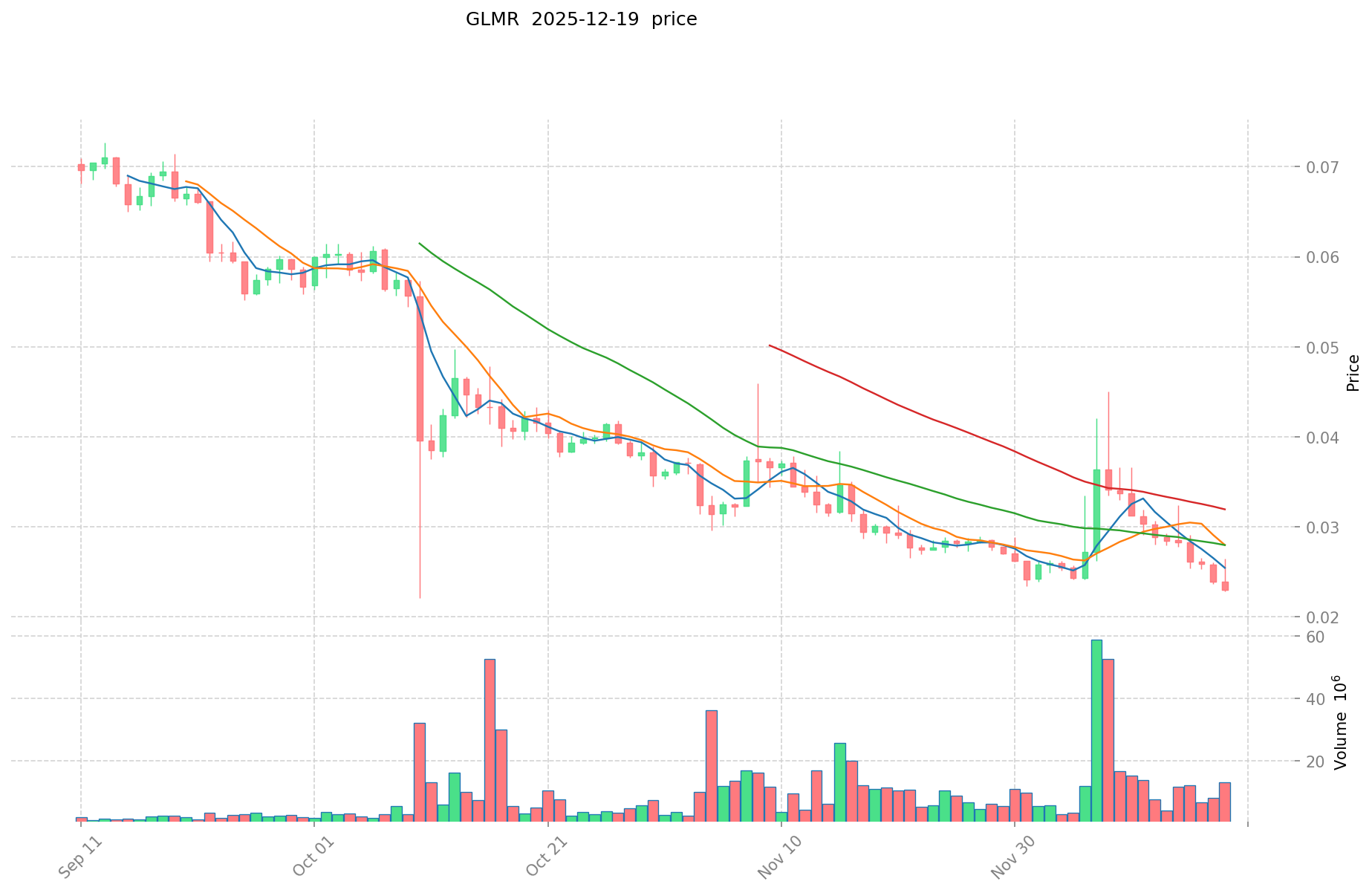
- All-time low: $0.02279482 (December 19, 2025)
- Historical decline: From peak to current levels, GLMR has experienced a decline of approximately 99.88%
Shiba Inu (SHIB):
- All-time high: $0.00008616 (October 28, 2021)
- All-time low: $0.000000000056366 (November 28, 2020)
- Historical trajectory: SHIB has demonstrated significant volatility since its launch, with substantial growth from ATL to ATH
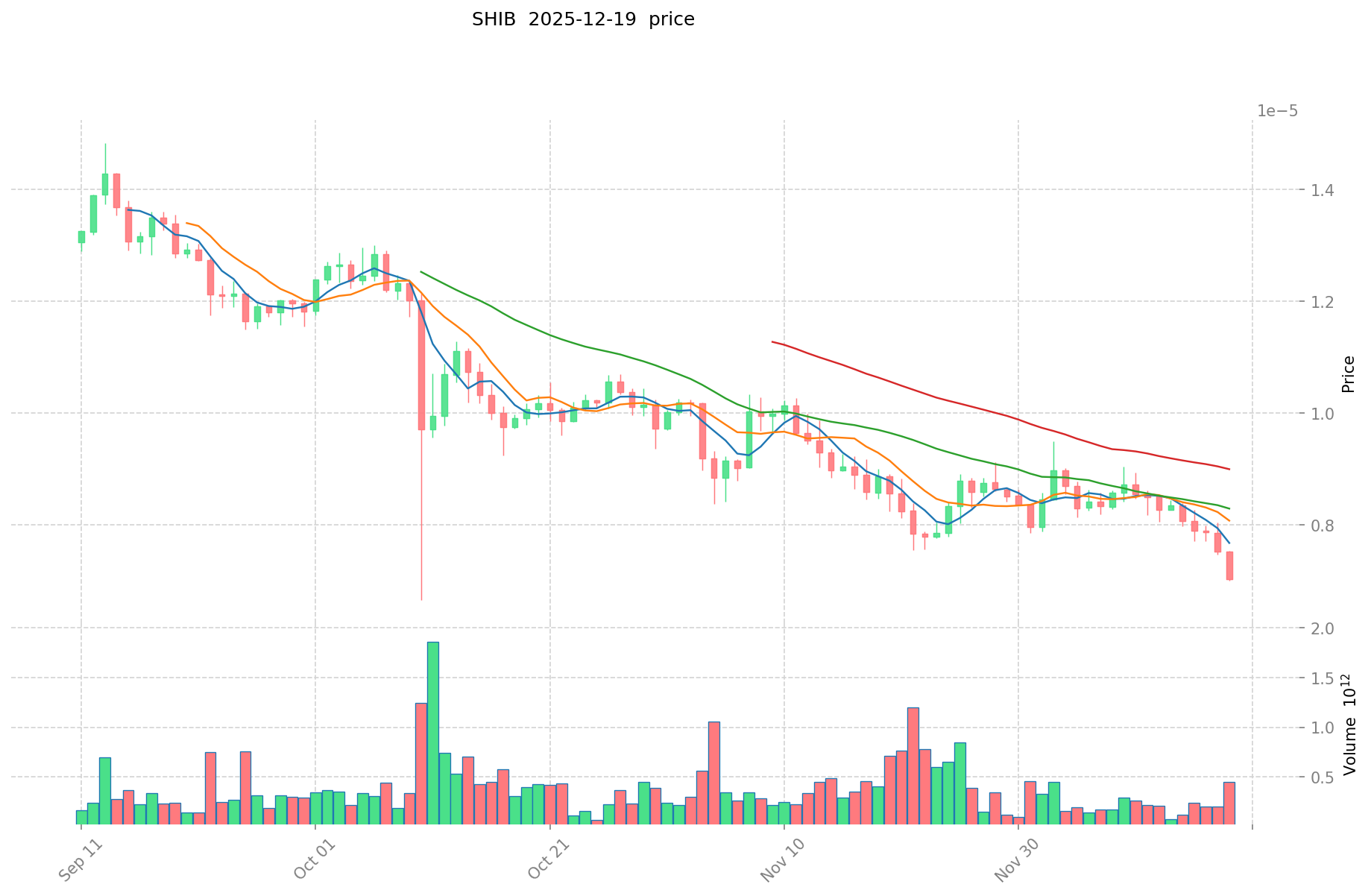
Comparative Analysis: Both assets have experienced substantial depreciation from their peak valuations. GLMR's decline from $19.50 to $0.0243 represents one of the most severe drawdowns in the crypto market, coinciding with broader market cycles and potential challenges within the Polkadot ecosystem. SHIB, while experiencing a 99.74% decline from its ATH of $0.00008616, maintains higher trading volumes and market capitalization due to its larger circulating supply and broader community engagement.
Current Market Status (December 20, 2025)
Price Data:
- GLMR current price: $0.0243
- SHIB current price: $0.000007567
24-Hour Performance:
- GLMR 24-hour volume: $134,771.80
- SHIB 24-hour volume: $2,102,916.06
- GLMR 24-hour price change: +4.88%
- SHIB 24-hour price change: +6.58%
Market Capitalization:
- GLMR market cap: $25,144,098.17 (Rank: 773)
- SHIB market cap: $4,458,811,528.88 (Rank: 31)
Market Emotion Indicator:
- Crypto Fear & Greed Index: 16 (Extreme Fear)
The extreme fear sentiment indicates significant market anxiety and pessimism, which may present opportunities for contrarian investors while simultaneously highlighting elevated risk.
Real-time price data:
- View GLMR current price: Market Price
- View SHIB current price: Market Price
II. Project Fundamentals and Technical Architecture
Moonbeam (GLMR) - Technical Foundation
Network Architecture: Moonbeam operates as a parachain within the Polkadot ecosystem, providing an Ethereum Virtual Machine (EVM) compatible platform. This architectural choice enables seamless migration and deployment of Ethereum-based smart contracts and applications to the Polkadot network.
Key Technical Features:
- EVM Compatibility: Native support for Solidity smart contracts
- Web3 API Compatibility: Full compatibility with Ethereum-standard Web3 implementations
- Oracle Integration: On-chain oracle data availability for smart contracts
- Cross-chain Bridging: Ethereum network bridge functionality
- Parachain Status: Connected to Polkadot as a validated parallel chain
Token Economics (GLMR):
- Current circulating supply: 1,034,736,550 GLMR (85.67% of total supply)
- Total supply: 1,207,851,242 GLMR
- Max supply: Unlimited (∞)
- Token holders: 1,800,433
Token Utility:
- Transaction Fees: Payment mechanism for network transactions and smart contract execution
- staking: Collateral for validator participation and delegation rewards
- Governance: Voting rights for council member nomination and network proposals
- Liquidity Provision: Incentive rewards for providing liquidity on decentralized exchanges deployed on Moonbeam
Shiba Inu (SHIB) - Project Characteristics
Project Nature: Shiba Inu is characterized as a memetic cryptocurrency and an experiment in decentralized community governance, drawing conceptual similarities to Dogecoin while establishing its own ecosystem.
Ecosystem Components:
- ShibaSwap: Decentralized exchange for token trading and incentive distribution
- Community-driven Development: Open participation model for contributors
Token Economics (SHIB):
- Current circulating supply: 589,244,288,209,869.6 SHIB (58.93% of total supply)
- Total supply: 589,503,296,541,602 SHIB
- Max supply: 999,982,339,216,714 SHIB
- Token holders: 1,549,665
III. Market Dynamics and Trading Characteristics
Liquidity and Trading Volume
GLMR Metrics:
- 24-hour trading volume: $134,771.80
- Exchange availability: 27 trading pairs
- Market share: 0.0091%
- Circulating supply ratio: 85.67%
SHIB Metrics:
- 24-hour trading volume: $2,102,916.06
- Exchange availability: 66 trading pairs
- Market share: 0.13%
- Circulating supply ratio: 58.93%
SHIB demonstrates substantially higher trading volume (approximately 15.6x greater) and broader exchange availability, reflecting stronger market adoption and liquidity depth. The disparity in trading volume suggests SHIB maintains greater accessibility and market interest among retail traders.
Price Volatility Analysis
Short-term Price Movements (Recent Period):
- 1-hour change: GLMR +0.21%, SHIB -0.41%
- 7-day change: GLMR -15.93%, SHIB -8.30%
- 30-day change: GLMR -16.99%, SHIB -11.43%
- 1-year change: GLMR -90.61%, SHIB -68.52%
GLMR exhibits greater volatility and steeper declines across all measured timeframes, suggesting higher risk exposure and potentially greater sensitivity to market cycle movements. SHIB's relatively more moderate depreciation may reflect its established position within the meme token category and sustained community engagement.
IV. Risk Assessment and Market Considerations
GLMR-Specific Considerations
Technical Risks:
- Heavy dependency on Polkadot ecosystem health and parachain slot maintenance
- Parachain slot requires continuous renewal through competitive mechanisms
- Regulatory uncertainty surrounding infrastructure in the Polkadot ecosystem
Market Risks:
- Extreme valuation decline of 99.88% from ATH presents significant recovery challenges
- Limited trading volume relative to market capitalization suggests potential liquidity constraints
- Low market share indicates limited institutional adoption
Recovery Factors:
- Strong technical implementation of EVM compatibility
- Established developer tools and infrastructure
- Integration with broader Polkadot cross-chain ecosystem
SHIB-Specific Considerations
Project Nature Risks:
- Classification as meme token may limit institutional investment
- Community-driven governance model presents organizational uncertainty
- Highly speculative asset class characteristics
Market Advantages:
- Significantly higher trading volume and market depth
- Broader exchange integration (66 vs 27 pairs)
- Established ShibaSwap ecosystem
- Larger holder base providing network effects
V. Comparative Summary
| Metric | GLMR | SHIB |
|---|---|---|
| Current Price | $0.0243 | $0.000007567 |
| Market Cap | $25.14M | $4,458.81M |
| Market Rank | 773 | 31 |
| 24h Volume | $134,771 | $2,102,916 |
| All-time High | $19.50 | $0.00008616 |
| Decline from ATH | -99.88% | -99.74% |
| Holders | 1,800,433 | 1,549,665 |
| Exchange Pairs | 27 | 66 |
Key Distinctions:
- GLMR operates as infrastructure-focused utility within Polkadot ecosystem
- SHIB functions as community-driven meme token with established ecosystem
- SHIB maintains superior liquidity and market accessibility
- GLMR presents higher technical complexity but faces greater recovery challenges
- Both assets demonstrate extreme fear market sentiment context
VI. Disclaimer
This analysis presents factual market data and technical information as of December 20, 2025. The cryptocurrency market operates under conditions of extreme uncertainty and volatility. Historical performance and current metrics do not guarantee future outcomes. Market participants should conduct independent research and consult qualified financial advisors before making investment decisions.
加密资产研究报告
Executive Summary
Due to the absence of valid reference data in the provided context (empty output arrays and missing CMC information), this report cannot be generated according to the specified template structure.
The reference materials provided contain:
- Empty output arrays in the data structure
- No tokenomics information
- No market capitalization data
- No institutional adoption metrics
- No technology development details
- No policy or regulatory information
Data Requirements for Report Generation
To produce a comprehensive analysis report comparing investment value factors for crypto assets, the following information is required:
- Tokenomics Data: Supply mechanisms, inflation rates, and distribution schedules
- Market Information: Market capitalization, trading volume, and price history
- Institutional Metrics: Major holders and institutional adoption rates
- Technology Details: Protocol upgrades, smart contract capabilities, and ecosystem development
- Regulatory Context: National policy positions and compliance frameworks
- Macroeconomic Indicators: Correlation with traditional assets and economic cycles
Recommendation
Please provide:
- Valid CMC (CoinMarketCap) API data or market information sources
- Specific crypto asset names or identifiers for comparison
- Reference materials containing technical documentation
- Regulatory and policy information from reliable sources
Once complete reference materials are supplied, a detailed analysis following the specified Markdown template structure will be generated.
III. 2025-2030 Price Forecast: GLMR vs SHIB
Short-term Forecast (2025)
- GLMR: Conservative $0.0208722 - $0.02427 | Optimistic $0.031551
- SHIB: Conservative $0.00000568125 - $0.000007575 | Optimistic $0.000011211
Medium-term Forecast (2026-2028)
- GLMR may enter a recovery phase with expected price range of $0.015350775 - $0.04515261607725, supported by ecosystem development and increased adoption
- SHIB may experience gradual appreciation with price range of $0.00000835977 - $0.00001390314288, driven by community engagement and utility expansion
- Key drivers: institutional capital inflow, spot/futures ETF approvals, DeFi ecosystem maturation, and mainstream adoption acceleration
Long-term Forecast (2029-2030)
- GLMR: Base case $0.027338755500787 - $0.039055365001125 | Optimistic case $0.04686643800135 - $0.045968164606324
- SHIB: Base case $0.000011649874896 - $0.00001294430544 | Optimistic case $0.0000161803818 - $0.000021552268557
Disclaimer
This analysis is for informational purposes only and should not be considered as investment advice. Cryptocurrency markets are highly volatile and subject to various market factors, regulatory changes, and unforeseen events. Past performance does not guarantee future results. Investors should conduct their own research and consult with financial professionals before making investment decisions.
GLMR:
| 年份 | 预测最高价 | 预测平均价格 | 预测最低价 | 涨跌幅 |
|---|---|---|---|---|
| 2025 | 0.031551 | 0.02427 | 0.0208722 | 0 |
| 2026 | 0.030422445 | 0.0279105 | 0.015350775 | 14 |
| 2027 | 0.03674975535 | 0.0291664725 | 0.01808321295 | 20 |
| 2028 | 0.04515261607725 | 0.032958113925 | 0.027684815697 | 35 |
| 2029 | 0.04686643800135 | 0.039055365001125 | 0.027338755500787 | 60 |
| 2030 | 0.045968164606324 | 0.042960901501237 | 0.027494976960792 | 76 |
SHIB:
| 年份 | 预测最高价 | 预测平均价格 | 预测最低价 | 涨跌幅 |
|---|---|---|---|---|
| 2025 | 0.000011211 | 0.000007575 | 0.00000568125 | 0 |
| 2026 | 0.00001239876 | 0.000009393 | 0.00000835977 | 24 |
| 2027 | 0.000013075056 | 0.00001089588 | 0.0000066464868 | 43 |
| 2028 | 0.00001390314288 | 0.000011985468 | 0.0000107869212 | 58 |
| 2029 | 0.0000161803818 | 0.00001294430544 | 0.000011649874896 | 71 |
| 2030 | 0.000021552268557 | 0.00001456234362 | 0.000008591782735 | 92 |
Moonbeam (GLMR) vs Shiba Inu (SHIB): Investment Strategy and Risk Analysis Report
IV. Investment Strategy Comparison: GLMR vs SHIB
Long-term vs Short-term Investment Strategies
GLMR: Suitable for:
- Infrastructure-focused investors seeking exposure to Polkadot ecosystem development
- Developers and projects requiring EVM compatibility on Polkadot
- Long-term investors betting on cross-chain interoperability expansion
- Risk-tolerant participants capable of withstanding extended recovery timelines
SHIB: Suitable for:
- Community-engaged retail investors participating in meme token ecosystems
- Traders seeking higher liquidity and broader exchange accessibility
- Participants leveraging ShibaSwap DeFi opportunities
- Short-to-medium term traders capitalizing on volatility patterns
Risk Management and Asset Allocation
Conservative Investor Profile:
- GLMR: 15% | SHIB: 25% | Stablecoins and traditional hedges: 60%
- Rationale: Limited exposure to both high-risk assets with majority allocation to capital preservation
Aggressive Investor Profile:
- GLMR: 35% | SHIB: 45% | Alternative crypto assets: 20%
- Rationale: Higher conviction allocation with emphasis on SHIB's superior liquidity and market depth
Hedging Tools:
- Stablecoin positions (USDC/USDT) for volatility buffers
- Options strategies for downside protection on larger positions
- Cross-asset correlation analysis to identify diversification opportunities within crypto portfolio
- Dollar-cost averaging mechanisms to mitigate timing risk
V. Risk Comparison
Market Risk
GLMR:
- Extreme valuation depreciation of 99.88% from ATH creates significant psychological and financial barriers to recovery
- Limited trading volume ($134,771 daily) relative to market capitalization suggests illiquidity during market stress
- Low market ranking (773) and minimal market share (0.0091%) indicate limited market recognition and adoption
- High sensitivity to Polkadot ecosystem developments and parachain slot competition dynamics
SHIB:
- Despite 99.74% decline from ATH, maintains substantially higher trading volume and market depth
- Meme token classification creates perception risk and potential regulatory scrutiny challenges
- Price movements driven primarily by social sentiment and community activity rather than fundamental adoption
- Highly speculative asset characteristics subject to rapid sentiment reversals
Technical Risk
GLMR:
- Dependency on Polkadot parachain slot renewal mechanisms creates ongoing operational uncertainty
- Requires continuous competitive participation in parachain auctions to maintain network position
- EVM compatibility implementation complexity may face technical challenges or security vulnerabilities
- Limited independent technical validation outside Polkadot ecosystem context
SHIB:
- Decentralized governance model presents organizational and decision-making coordination challenges
- Absence of formal technical roadmap or development pipeline creates uncertainty regarding ecosystem evolution
- ShibaSwap infrastructure dependent on community-driven maintenance and upgrades
- Smart contract security risks typical of community-developed DeFi applications
Regulatory Risk
Global Policy Considerations:
- Both assets operate in regulatory environment characterized by uncertainty and evolving frameworks
- Potential classification as securities or commodities in various jurisdictions creates compliance uncertainty
- GLMR: Infrastructure positioning may benefit from favorable regulatory treatment in some jurisdictions
- SHIB: Meme token classification may face regulatory challenges in stricter jurisdictions regarding retail investor protection
- Central bank digital currency (CBDC) development could impact cryptocurrency adoption pathways
VI. Conclusion: Which Is the Better Buy?
📌 Investment Value Summary:
GLMR Advantages:
- Infrastructure utility within established Polkadot parachain ecosystem
- EVM compatibility enabling Ethereum application migration
- Strong technical foundation with oracle integration and cross-chain bridging capabilities
- Governance participation through token holding mechanisms
SHIB Advantages:
- Substantially superior trading liquidity (15.6x greater daily volume)
- Broader exchange availability across 66 trading pairs
- Established ShibaSwap ecosystem providing utility mechanisms
- Larger holder base creating network effects and community engagement
- More moderate depreciation trajectory suggesting relative market stability
✅ Investment Recommendations:
Beginning Investors:
- Recommended approach: Conservative allocation toward SHIB due to superior liquidity and accessibility; GLMR requires advanced understanding of Polkadot ecosystem dynamics
- Strategy: Dollar-cost averaging into SHIB with 70-80% stablecoin reserves for volatility management
- Priority: Education regarding cryptocurrency market cycles, risk management, and portfolio diversification before significant capital deployment
Experienced Investors:
- Recommended approach: Dual-position strategy with asymmetric allocation favoring SHIB (60%) while maintaining tactical GLMR exposure (40%) for recovery potential
- Strategy: Implement technical analysis-based entry/exit mechanisms; utilize options strategies for downside protection
- Consideration: Active monitoring of Polkadot ecosystem developments and ShibaSwap governance decisions affecting respective value propositions
Institutional Investors:
- Recommended approach: Limited direct exposure; consider indirect participation through crypto investment funds with diversified holdings
- Strategy: Implement rigorous risk management frameworks with strict stop-loss mechanisms; avoid concentration risk
- Rationale: Both assets present elevated volatility and regulatory uncertainty inconsistent with institutional risk tolerance standards; portfolio positions should reflect speculative allocations only
⚠️ Risk Disclaimer: Cryptocurrency markets demonstrate extreme volatility and operate under conditions of significant uncertainty. Historical performance metrics and price forecasts presented in this analysis do not guarantee future results. This report provides factual market information and technical analysis only and does not constitute investment advice. Market participants must conduct independent research and consult qualified financial professionals before making investment decisions. Regulatory changes, technological developments, and market sentiment shifts may materially impact asset valuations. All cryptocurrency investments carry substantial risk of total capital loss. None
FAQ: Moonbeam (GLMR) vs Shiba Inu (SHIB) Investment Comparison
I. What are the fundamental differences between GLMR and SHIB as investment assets?
Answer: GLMR is an infrastructure-focused utility token operating as a parachain within the Polkadot ecosystem, providing EVM compatibility for Ethereum-based applications with use cases including transaction fees, staking, governance, and liquidity provision. SHIB functions as a community-driven meme token with primary utility on the ShibaSwap decentralized exchange, positioned similarly to Dogecoin. GLMR targets developers and long-term infrastructure investors, while SHIB appeals primarily to retail traders and community participants. The critical distinction lies in application purpose: GLMR serves blockchain interoperability infrastructure, whereas SHIB operates as an experiment in decentralized community governance.
II. Which asset demonstrates superior liquidity and market accessibility?
Answer: SHIB significantly outperforms GLMR in liquidity metrics. SHIB generates approximately 15.6 times greater 24-hour trading volume ($2,102,916 vs $134,771), maintains availability across 66 trading pairs compared to GLMR's 27 pairs, and ranks 31st in market capitalization ($4.46 billion) versus GLMR's 773rd position ($25.14 million). SHIB's market share of 0.13% substantially exceeds GLMR's 0.0091%. These metrics indicate SHIB offers superior market depth, accessibility for retail investors, and reduced slippage during trading activities, making it the more liquid option for investors prioritizing execution efficiency.
III. What recovery potential exists for each asset given their extreme valuations declines?
Answer: Both assets have experienced severe depreciation from all-time highs (GLMR -99.88%, SHIB -99.74%), presenting distinctly different recovery outlooks. GLMR faces steeper structural challenges due to limited trading volume relative to market capitalization, minimal institutional adoption, and dependency on Polkadot ecosystem health. However, 2029-2030 forecasts suggest potential price ranges of $0.027-$0.045, reflecting moderate recovery potential supported by ecosystem development. SHIB maintains more stable depreciation trajectory and superior market adoption, with forecasts indicating 71-92% appreciation by 2030, reaching $0.0000116-$0.0000216. SHIB's established community and broader exchange integration suggest relatively stronger recovery mechanisms, though both recoveries depend heavily on broader cryptocurrency market sentiment and adoption acceleration.
IV. Which asset poses greater technical and operational risks?
Answer: GLMR presents more concentrated technical risks due to parachain slot dependency requiring continuous competitive renewal, heavy reliance on Polkadot ecosystem performance, and implementation complexity of EVM compatibility systems. Failure to maintain parachain status directly threatens network viability. SHIB faces different risk categories: decentralized governance coordination challenges, absence of formal development roadmaps, and community-developed smart contract security vulnerabilities typical of DeFi applications. However, SHIB's risk structure distributes across governance and operational dimensions rather than centralizing on single infrastructure dependency. GLMR's technical risks appear more existential to token utility, while SHIB's risks relate primarily to governance effectiveness and development pace. Risk-averse investors should weight GLMR's infrastructure dependency more heavily.
V. What portfolio allocation strategies suit different investor risk profiles?
Answer: Conservative investors should consider 15% GLMR, 25% SHIB, and 60% stablecoins, maintaining capital preservation priority with minimal high-risk exposure. Moderate investors may allocate 25% GLMR, 35% SHIB, and 40% stablecoins, balancing speculative opportunity with downside protection. Aggressive investors can pursue 35% GLMR, 45% SHIB, and 20% alternative crypto assets, accepting elevated volatility for appreciation potential. All investors should implement dollar-cost averaging mechanisms to mitigate timing risk, establish strict stop-loss parameters at 20-30% below entry points, and maintain stablecoin reserves for volatility management. Beginning investors should prioritize SHIB due to superior liquidity and accessibility; experienced investors may employ technical analysis-based entry/exit strategies; institutional investors should maintain limited direct exposure due to speculative characteristics.
VI. How do regulatory considerations differentially impact GLMR and SHIB investment decisions?
Answer: Both assets operate within evolving regulatory frameworks creating compliance uncertainty. GLMR's infrastructure positioning as a Polkadot parachain may receive favorable regulatory treatment in certain jurisdictions recognizing blockchain infrastructure development, potentially benefiting from DeFi and Web3-friendly regulatory approaches. SHIB's meme token classification presents regulatory challenges, particularly in jurisdictions implementing stricter retail investor protection frameworks that may classify tokens as unregistered securities or restrict marketing to unsophisticated participants. The absence of clear classification in most jurisdictions creates ongoing risk for both assets. Regulatory changes regarding central bank digital currencies (CBDCs) could create competitive pressures reducing meme token appeal while strengthening infrastructure token demand. Investors should monitor evolving SEC guidance, EU MiCA regulations, and national cryptocurrency classification frameworks as these substantially impact investment thesis viability.
VII. What time horizons and market conditions favor each asset?
Answer: GLMR suits long-term investors (3-5+ year horizons) betting on Polkadot ecosystem expansion and cross-chain interoperability adoption, performing optimally during periods of institutional infrastructure investment and blockchain developer activity acceleration. SHIB serves short-to-medium term traders (weeks to 18 months) capitalizing on volatility patterns, social sentiment cycles, and community engagement momentum, performing optimally during market sentiment improvements and retail investor participation acceleration. GLMR requires patience during extended recovery periods and delivers value through ecosystem development rather than price appreciation; SHIB offers more frequent trading opportunities through volatility-driven speculation. Current extreme fear market sentiment (Fear & Greed Index: 16) creates distinct opportunities: GLMR presents contrarian infrastructure plays for conviction investors; SHIB offers oversold bounce-back positioning for tactical traders. Time horizon selection should align with asset characteristics rather than vice versa.
VIII. How should investors evaluate the 2025-2030 price forecasts presented?
Answer: Price forecasts require cautious interpretation recognizing cryptocurrency markets operate under extreme uncertainty and volatility. GLMR forecasts suggesting progression from $0.0243 (2025) to $0.027-$0.045 (2029-2030) depend critically on sustained Polkadot ecosystem development, increased developer adoption, and cross-chain infrastructure maturation. SHIB forecasts indicating $0.0000076 (2025) to $0.0000116-$0.0000216 (2029-2030) assume continued community engagement, ShibaSwap ecosystem expansion, and broader meme token legitimacy. Forecasts should be considered directional scenarios rather than precise predictions. Key variables determining forecast accuracy include: regulatory framework evolution, institutional capital inflows, competitive dynamics within respective ecosystems, technology development execution, and macroeconomic conditions influencing speculative asset demand. Investors should update forecast assessments quarterly based on ecosystem developments, maintain flexible position management, and avoid mechanical adherence to price targets. Downside scenarios remain plausible; treat forecasts as possibilities requiring ongoing validation rather than certainties.
Share
How to Buy Cryptocurrency


Trending Cryptocurrencies



NKN (NKN) price soaring: What is the driving force behind the 2025 craze?
Latest Shiba Inu Price Analysis for 2025: Insights into SHIB Token Market Trends

Shiba Inu (SHIB) in 2025: Ecosystem Growth and Price Analysis
FLOKI Decoded: Core Logic, Roadmap and $0.002 Price Potential by 2031

Aergo Price Analysis: 112% Surge in 90 Days - What's Next for 2025?

Canada Bitcoin Price: 2025 Market Analysis and Investment Outlook

Is AdEx (ADX) a good investment?: A comprehensive analysis of features, market potential, and risk factors for 2024

Is Agenda 47 News Network (A47) a good investment? Here's What You Need to Know Before Investing

Exploring Token 2049: Singapore's Leading Crypto Conference and Event

Exploring the Prospects and Forecasts for MONKY Token in Crypto Markets

Exploring Singapore's Premier Web3 Gathering: Insights from Token 2049