


Ethereum's Vitalik Buterin Details 4-Year Roadmap for Faster Transaction Confirmation and Quantum Resistance
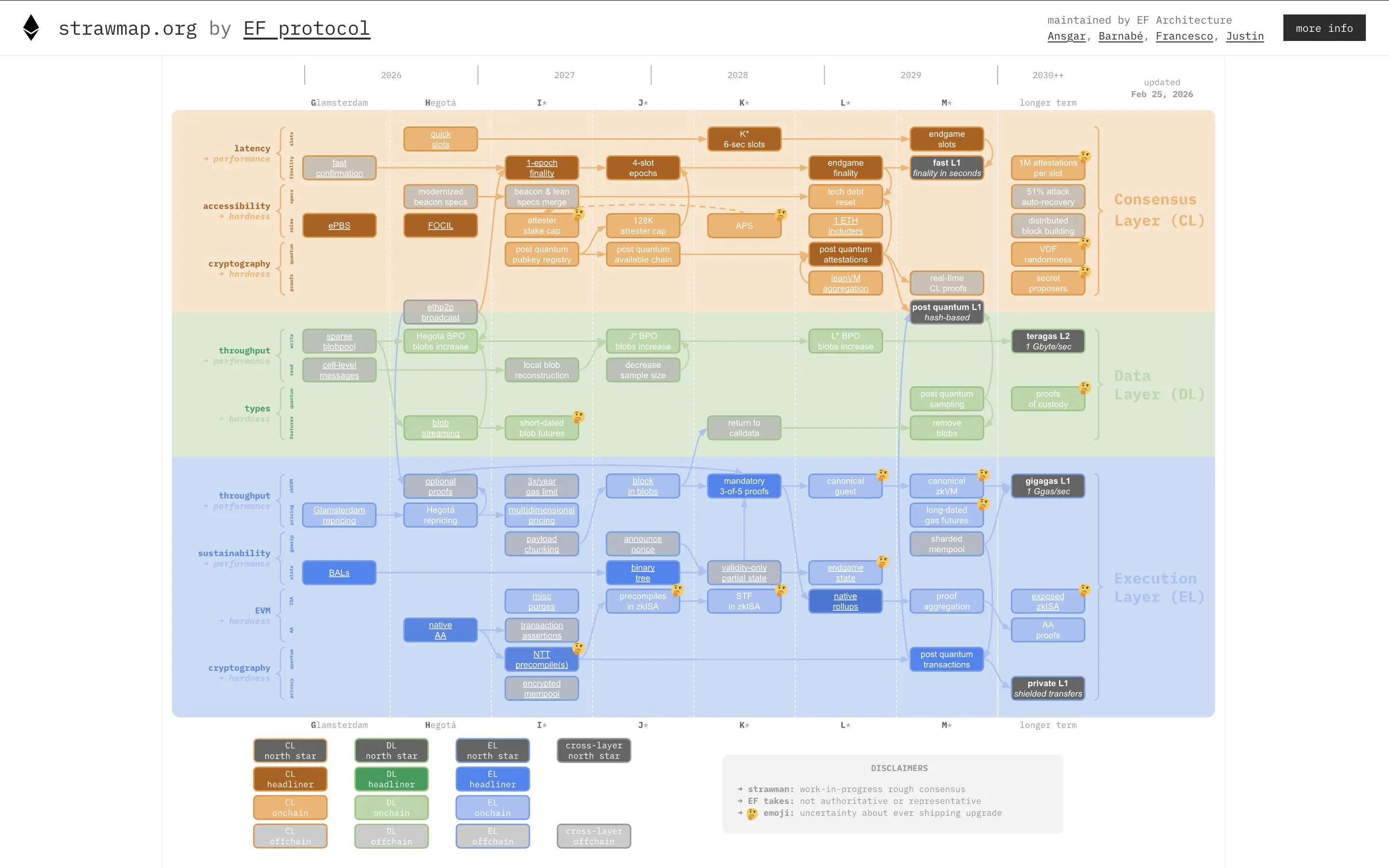 Ethereum co-founder Vitalik Buterin provided additional details on February 26, 2026, regarding the “Strawmap,” a technical roadmap published by the Ethereum Foundation’s Protocol team outlining plans to reduce block slot times from 12 seconds to as low as 2 seconds and transaction finality from approximately 16 minutes to between 6 and 16 seconds over the next four years.
The roadmap, which projects seven forks through 2029, includes transitioning to post-quantum hash-based signatures and achieving “gigagas” throughput on Layer 1 alongside “teragas” scaling on Layer 2 through data availability sampling.
Strawmap Overview: A Holistic Protocol Vision
The Ethereum Foundation’s Protocol team released a visual roadmap called “Strawmap” (a portmanteau of “strawman” and “roadmap”) as a discussion starter originating from a January 2026 workshop. The document is intended primarily for researchers, developers, and Ethereum governance participants, providing a unified perspective on Layer 1 protocol upgrades extending through the end of the decade.
The strawmap explicitly disclaims being an “official” roadmap, acknowledging that rough consensus in a decentralized ecosystem is inherently uncertain. It is positioned as an “accelerationist coordination tool” sketching one coherent path among millions of possible outcomes, with quarterly updates expected as community feedback and research and development (R&D) advance.
Five North Stars Guiding Development
The roadmap identifies five long-term objectives presented as “north stars” on the right side of the visual:
-
Fast L1: User experience improvements through short block slots and finality measured in seconds
-
Gigagas L1: Achieving 1 gigagas per second (approximately 10,000 transactions per second) via zkEVMs and real-time proving
-
Teragas L2: Scaling to 1 gigabyte per second (approximately 10 million transactions per second) through data availability sampling
-
Post-Quantum L1: Implementing durable cryptography via hash-based signature schemes
-
Private L1: Enabling first-class privacy through shielded ETH transfers
Reducing Slot Time: From 12 Seconds to 2 Seconds
Buterin explained that “fast slots” occupy their own lane at the top of the roadmap, independent of other upgrade paths. Slot time—the interval required for Ethereum to produce new blocks—currently stands at approximately 12 seconds. The roadmap aims to reduce this incrementally to as low as 2 seconds, making the blockchain feel like a live, responsive system rather than one requiring waiting periods.
“I expect that we’ll reduce slot time in an incremental fashion,” Buterin stated, suggesting reductions following a roughly square-root-of-two formula: from 12 seconds down through 8, 6, 4, and eventually 2 seconds.
He emphasized that peer-to-peer (p2p) improvements—upgrades to how Ethereum nodes communicate, share new blocks, and propagate data without redundant downloads—can significantly reduce block propagation time, “making shorter slots viable with no security tradeoffs.”
Accelerating Finality: From Minutes to Seconds
The second major improvement targets transaction finality—the point at which a transaction becomes mathematically irreversible. Current finality requires approximately 16 minutes. The roadmap aims to reduce this to between 6 and 16 seconds by replacing Ethereum’s current complex confirmation system with a cleaner, simpler alternative that also incorporates quantum resistance.
“The goal is to decouple slots and finality, to allow us to reason about both separately,” Buterin explained. He described this as a “very invasive set of changes,” necessitating bundling the largest steps with a “switch of the cryptography, notably to post-quantum hash-based signatures.”
Quantum Resistance: Phased Implementation
Buterin highlighted an important consequence of the incremental approach: quantum-resistant slots could arrive significantly earlier than quantum-resistant finality.
“One interesting consequence of the incremental approach is that there is a pathway to making the slots quantum-resistant much sooner than making the finality quantum-resistant,” he said.
Under this phased implementation, if quantum computers suddenly emerged, “we lose the finality guarantee, but the chain keeps chugging along.” The network would continue processing and confirming blocks even without the mathematical irreversibility guarantee, providing a safety margin during cryptographic transitions.
Fork Schedule and Timeline
The strawmap outlines seven forks scheduled through 2029, based on a rough cadence of approximately one fork every six months. Consensus layer forks follow a star-based naming scheme with incrementing first letters: Altair, Bellatrix, Capella, Deneb, Electra, Fulu, continuing through Glamsterdam, Hegotá, I*, J*, K*, and L*.
Two forks are already confirmed for 2026:
-
Glamsterdam (first half 2026): Headliners include ePBS (execution-layer Payload Boost and Smoothing) on consensus and BALs (Beacon Accountable Limiters) on execution
-
Hegotá (second half 2026): Will introduce FOCIL (Forward Orthogonal Censorship Inhibition Layer), an anti-censorship mechanism at the protocol level
Buterin noted that “L* is an exceptional fork, displaying two headliners tied to the bigger lean consensus fork.” Lean consensus landing in L* would be a “fateful coincidence” according to the documentation.
The strawmap emphasizes that while timelines are grounded in current expectations, they should be treated with “healthy skepticism.” The current draft assumes human-first development, but the document acknowledges that AI-driven development and formal verification could significantly compress schedules.
Technical Architecture and Dependencies
Upgrades are organized into three color-coded horizontal layers:
-
Consensus Layer (CL) : Protocol changes related to proof-of-stake consensus
-
Data Layer (DL) : Improvements to data availability and storage
-
Execution Layer (EL) : Changes to transaction processing and smart contract execution
Dark boxes denote “headliners”—particularly prominent and ambitious upgrades. The modern All Core Devs (ACD) process limits itself to one consensus headliner and one execution headliner per fork to maintain a fast cadence. Grey boxes indicate offchain upgrades, while arrows signal hard technical dependencies or natural upgrade progressions.
Underlined text in boxes links to relevant Ethereum Improvement Proposals (EIPs) and technical write-ups, providing transparency into the specific mechanisms under consideration.
Path Forward: Progressive Deployment
Buterin summarized the approach as “progressive decreases of both slot time and finality time.” The “component-by-component replacement” of Ethereum’s slot structure and consensus will produce a “cleaner, simpler, quantum-resistant, prover-friendly, end-to-end formally-verified alternative.”
The documentation emphasizes that the strawmap is “not a prediction” but rather an invitation to view Layer 1 protocol upgrades holistically. By placing proposals on a single visual, it provides a unified perspective on Ethereum’s long-term ambitions while acknowledging the inherent uncertainty of decentralized governance.
FAQ: Understanding Ethereum’s 4-Year Roadmap
Q: What is the Strawmap and who created it?
A: The Strawmap (a combination of “strawman” and “roadmap”) is a visual document released by the Ethereum Foundation’s Protocol team in February 2026. It originated as a discussion starter at a January 2026 workshop and outlines one possible path for Ethereum’s technical development through 2029. It is intended for researchers, developers, and governance participants, and explicitly disclaims being an “official” roadmap due to Ethereum’s decentralized nature.
Q: How much faster will Ethereum transactions become under this roadmap?
A: The roadmap targets reducing block production (slot time) from the current 12 seconds to as low as 2 seconds through incremental improvements. Transaction finality—the point when transactions become irreversible—would decrease from approximately 16 minutes to between 6 and 16 seconds by replacing the current confirmation system with a simpler, quantum-resistant alternative.
Q: When will Ethereum become quantum-resistant?
A: Quantum resistance will be implemented in phases. Buterin indicated that “slots” (block production) could become quantum-resistant significantly sooner than “finality” (irreversible confirmation). Under this approach, if quantum computers emerged suddenly, the network would continue processing blocks even while losing the mathematical irreversibility guarantee for some period.
Q: What are the five “north stars” guiding Ethereum’s development?
A: The five long-term objectives are: 1) Fast L1 (short slots and seconds-level finality), 2) Gigagas L1 (1 gigagas/second throughput via zkEVMs), 3) Teragas L2 (1 gigabyte/second scaling via data availability sampling), 4) Post-Quantum L1 (durable cryptography), and 5) Private L1 (shielded ETH transfers).
Q: What are the next confirmed upgrades for Ethereum?
A: Two forks are confirmed for 2026: Glamsterdam (first half) featuring ePBS on consensus and BALs on execution, and Hegotá (second half) introducing FOCIL, an anti-censorship mechanism. The roadmap projects seven total forks through 2029 at approximately six-month intervals.
Related Articles
Can dual-currency winning truly navigate bull and bear markets? Six years of backtesting provides the answer.
Ethereum surges past the $2100 mark! Vitalik Buterin introduces the "Strawmap" upgrade framework, potentially signaling a turning point for ETH price
Michael Saylor names Solana and Ethereum as distribution channels! Bitcoin digital credit framework revealed
Bitmine buys the dip again! Tom Lee is optimistic about Ethereum with "three major bullish factors" supporting it
Ethereum 2026: Interpreting EF's latest protocol roadmap and officially entering the "engineering upgrade" era?