


Is the traditional payment model on the verge of collapse, and will trillion-dollar stablecoin financial companies soon be born?
The collapse of stablecoins and traditional payment models.
Written by: Rob Hadick, Partner at Dragonfly
Compiled by: AididiaoJP, Foresight News
Stablecoins are not meant to improve the existing payment networks, but rather to completely disrupt traditional payment networks. Stablecoins allow businesses to entirely bypass traditional payment channels; in other words, these traditional payment channels could very likely be fully replaced one day in the future.
When payment networks are based on stablecoins, all transactions are merely changes in numbers on a ledger. Currently, many emerging companies have begun to drive the reconstruction of capital flow methods.
Recently, many people have been discussing how stablecoins can become a banking-as-a-service (BaaS) network platform that connects existing payment channels, from issuing banks to merchant acceptance, and everything in between. While I agree with these viewpoints, I believe that viewing stablecoins merely as a platform to connect existing payment channels actually underestimates their true potential when I think about how enterprises and protocols can create and accumulate value in the future under a new paradigm. Stablecoin payments represent an incremental improvement and embody the possibility of reimagining payment channels from the ground up.
To understand the direction of the future, we need to review history, as history reveals the obvious evolutionary path.
Evolution of Modern Payment Channels
The origins of modern payment systems can be traced back to the early 1950s. The Diners Club, founded by Frank McNamara, launched the first multipurpose charge card. This charge card introduced a closed-loop credit model, making Diners Club a payment intermediary between merchants and cardholders. Before Diners Club, almost all payments were made through cash or proprietary bilateral credit agreements directly between merchants and customers.
After the great success of Diners Club, Bank of America (BofA) saw a tremendous opportunity to expand its credit business and reach a broader customer base, launching the first consumer credit card aimed at the mass market. BofA mailed over 2 million unsolicited, pre-approved credit cards to middle-class consumers, which could be used at more than 20,000 merchants in California. Due to regulatory restrictions at the time, BofA began licensing its technology to other banks in the U.S. and even expanding into international markets, resulting in the first credit card payment network. However, this was accompanied by huge operational challenges and led to severe credit risks, with delinquency rates soaring above 20%. At the same time, rampant fraud nearly brought the entire project to a collapse.
People are beginning to realize that the challenges and chaos within the banking network can only be resolved by establishing a truly cooperative organization that will set rules for managing systems and provide infrastructure. Members of the organization can compete on product pricing but must adhere to unified standards. This organization later became what we know today as Visa. Another organization founded by a California bank, which competed with Bank of America, later became Mastercard. This marked the birth of our modern global payment model and has become the dominant structure in the global payments industry.
From the 1960s to the early 21st century, almost all innovations in the payment field were focused on enhancing, supplementing, and digitizing the current global payment model. After the internet flourished in the 1990s, many innovations shifted to software development.
E-commerce emerged in the early 1990s, with the purchase of Sting’s CD on NetMarket being the first online payment. Subsequently, PizzaNet became the first national retailer to accept online payments. Well-known e-commerce companies such as Amazon, eBay, Rakuten, and Alibaba were established in the following years. The prosperity of e-commerce companies led to the emergence of many early independent payment gateway and processor companies. The most notable are Confinity and X.com, founded in late 1998 and early 1999, respectively, which merged to become today’s PayPal.
Digital payments have spawned numerous household names with market capitalizations in the hundreds of billions of dollars. These companies connect offline merchants and online retail, including payment service providers (PSPs) and payment facilitators (PayFacs) such as Stripe, Adyen, Checkout.com, and Square. They address merchant-side issues by bundling gateways, processing, reconciliation, fraud compliance tools, merchant accounts, and other value-added software and services. However, it is clear that they have not made a disruptive transformation to traditional financial payment networks.
Despite some startups focusing on disrupting traditional banking payment networks and card issuance infrastructure, well-known companies like Marqeta, Galileo, Lithic, and Synapse mainly work on integrating new companies into existing banking networks and infrastructures, rather than disrupting existing payment networks. However, many companies have found that simply adding a software layer on top of the existing infrastructure does not lead to real explosive growth.
Some companies are well aware of the limitations of traditional payment methods and foresee that a payment solution can be built entirely independent of traditional banking infrastructure through internet-based native currencies, with PayPal being the most famous example. In the early 21st century, many startups focused on the development of digital wallets, peer-to-peer transactions, and alternative payment networks. By completely bypassing banks and card-issuing alliances, these companies give end customers a certain degree of monetary autonomy, including PayPal, Alipay, M-Pesa, Venmo, Wise, Airwallex, Affirm, and Klarna.
They initially focused on providing a better user experience, product offerings, and cheaper transactions for groups overlooked by traditional finance, but gradually began to capture more and more market share. Traditional financial payment companies felt the threat from these alternative payment methods (APMs), leading Visa and Mastercard to launch Visa Direct and Mastercard Send, respectively, also focusing on providing real-time payment services for peer-to-peer transactions. Although these models have seen significant improvements, they are still plagued by limitations of the existing infrastructure. These companies still need to pre-fund or bear foreign exchange/credit risks while needing to hedge their own capital pools against each other, making instant transparent settlement unachievable.
The evolution path of modern payment essentially is: closed loop + trusted intermediary → open loop + trusted intermediary → open loop + partial personal autonomy. However, opacity and complexity still dominate, resulting in a poorer user experience, and there are situations of rent extraction at various stages throughout the entire network.
The Evolution of Merchant Payments
Businesses can bypass some or all of the traditional payment network’s technical infrastructure through stablecoins. The diagram below is a simplified illustration of merchant payments:
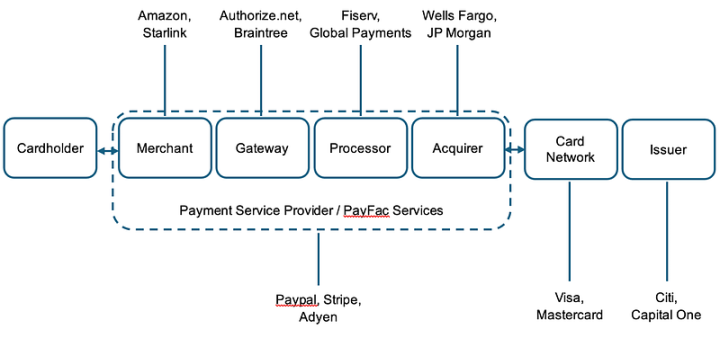
and the responsibilities of each part in the stablecoin payment network:
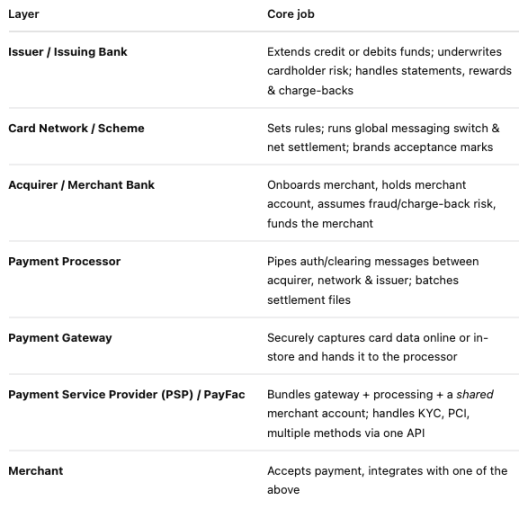
Currently, Stripe can handle a large part of the payment merchant side of operations, including providing merchant accounts and various software for operating businesses and accepting payments. However, they have not established their own issuing organization or issued payment cards.
Now imagine a world where Stripe becomes a central bank, issuing its own stablecoin backed by collateral approved by the GENIUS Act. The stablecoin can facilitate atomic settlements between consumer and merchant accounts through a transparent open-source ledger (blockchain). You no longer need to pay card-issuing banks and acquirers; Stripe (or any other issuer) only needs one (or a few) banks to hold its collateral for issuing the stablecoin. They transact directly on the blockchain via wallets or by initiating minting/redeeming requests to Stripe (the issuer/central bank), which are then settled on the blockchain. The clearing and settlement of funds are accomplished through a series of smart contracts that can handle refunds and disputes (see Circle’s refund policy). Similarly, payment routing and even operations for exchanging to other currencies/products can be programmed. With stablecoins and blockchain technology, the data transfer standards from banks to gateways, processors, and networks become easier. The transparency of data and the reduction of stakeholders also simplify costs and accounting.
In such a world, Stripe seems to have almost completely replaced the current payment model—possessing a complete infrastructure that provides accounts, card issuance, credit, payment services, and networks, all built on better technology, thus reducing intermediaries and allowing wallet holders to have almost complete control over the flow of funds.
Simon Taylor: “If you base everything on stablecoins, all transactions are just changes in numbers on the ledger. Merchants, gateways, PSPs, and banks used to reconcile different ledger entries. With stablecoins, anyone operating with stablecoins is simultaneously a gateway, PSP, and acquiring bank, and all transactions are just changes in numbers on the ledger.”
This sounds like science fiction. Are there many issues in reality related to fraud, compliance, the availability of stablecoins, liquidity / costs, etc.? Will there be incremental steps between today and this potential future? Technologies like real-time payments (RTPs) also have flaws, and the programmability and interoperability of cross-border remittances are problems that RTP cannot solve.
The future is coming step by step, and some companies are preparing for it. Top issuers like Circle, Paxos, and withausd are expanding their products, while blockchain networks focusing on payments like Codex, Sphere, and PlasmaFDN are also moving closer to end consumers and businesses. The future payment networks will significantly reduce intermediaries, increase autonomy, enhance transparency, improve interoperability, and bring more value to customers.
Cross-border payment
B2B cross-border payments are currently one of the significantly growing areas of stablecoin application.
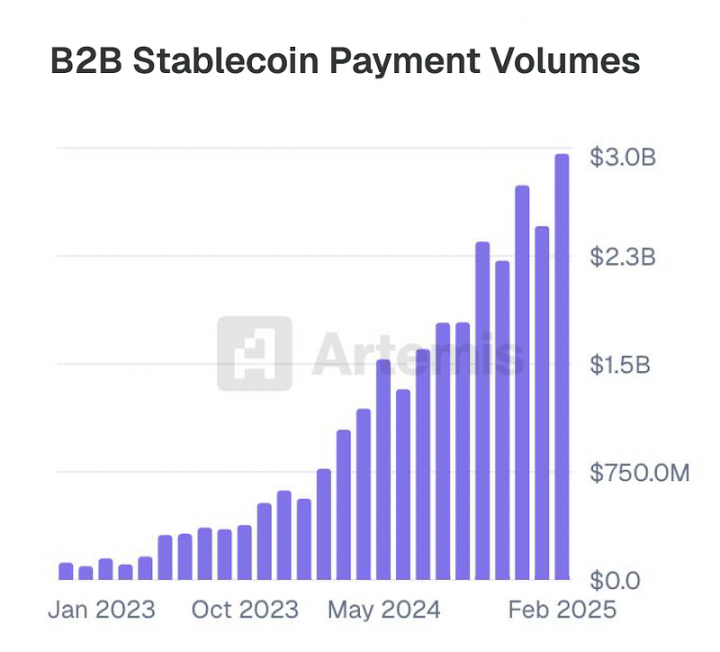
Matt Brown wrote an article about cross-border payments last year, from which it can be seen:
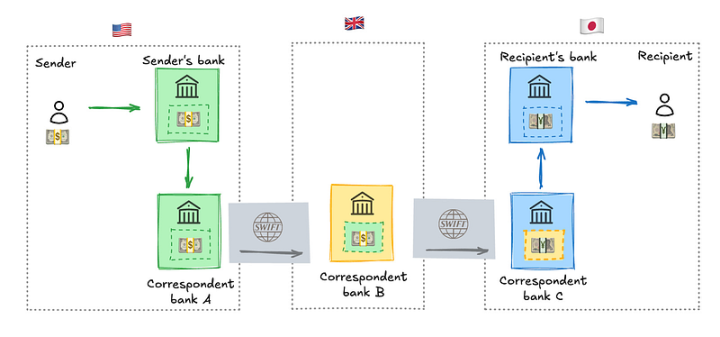
In many cases, there are multiple banks in the middle of cross-border transactions, all of which use SWIFT to deliver information, and SWIFT itself is not a problem, but there is an additional time cost associated with back-and-forth communication between banks, often involving other clearing counterparties. The fact that the liquidation process typically takes 7-14 days to complete is a huge risk and cost, and the process is extremely opaque. For example, it is not uncommon for JPMorgan Chase to “lose” millions of dollars for an extended period of time when transferring funds from a U.S. parent company to a foreign subsidiary. In addition to this, there is foreign exchange risk between multiple counterparties, resulting in a 6.6% increase in average transaction costs. In addition, when a company’s capital flows across borders, it is almost impossible to earn interest.
So it’s no surprise that Stripe recently announced the launch of stablecoin-based financial accounts. This enables businesses to access stablecoin-backed USD financial accounts, mint/redeem stablecoins directly through Bridge, and transfer funds to other wallet addresses through the Stripe dashboard. Use the Bridge API for fiat deposits and withdrawals, issue payment cards backed by stablecoin balances (depending on region, currently using Lead Bank), exchange for other currencies, and eventually convert directly to interest-bearing products for money management. While many of the current functions still rely on traditional systems as temporary solutions, stablecoins and tokenized assets do not rely on traditional systems for sending, receiving, issuance, and exchanging. Fiat deposit and withdrawal solutions are similar to the current state of alternative payment methods (APMs), with companies such as Wise and Airwallex essentially creating their own banking networks to deposit funds in different countries and net them at the end of the day. Airwallex’s co-founder, Jack Zhang, rightly pointed this out last week, but he didn’t consider how the world would change if fiat deposits and withdrawals were no longer required.
If you are just purchasing tokenized assets through stablecoins without needing to exchange them for fiat currency, you essentially bypass the traditional agency model. This will significantly reduce users’ dependence on third parties that actually hold and send assets, allowing customers to capture more value and lowering payment costs for everyone. Startups like Squads protocol, Rain cards, and Stablesea are all working towards enabling the direct buying and selling of tokenized assets through stablecoins, and all companies operating in this space will eventually expand to the entire network.
However, if you want to convert stablecoins into fiat for use, Conduit Pay can collaborate directly with the largest foreign exchange banks in the local market to achieve seamless, low-cost, and almost instant on-chain cross-border transactions. Wallets become accounts, tokenized assets become products, and blockchain becomes the network, significantly improving the user experience. If there is no need for fiat deposits and withdrawals, costs can be even lower. All of this can be achieved through better technology, providing simpler reconciliation, more autonomy, higher transparency, faster speeds, stronger interoperability, and even lower costs.
So what does all this mean?
This means that a payment native world existing on-chain, based on stablecoins (digital changes on the ledger), is coming. It will not only connect current payment models but will gradually replace them. This is why we will see the first trillion-dollar fintech company based on stablecoins about to be born.
I know this article will provoke many reasonable criticisms, such as my failure to consider certain issues. But please understand that I and many entrepreneurs who are starting businesses in this field are already aware of these issues and are working hard to address them. This is what innovation is about; building incrementally on an old system will never truly lead to a brand new system because vested interests will always obstruct the occurrence of this.
Closed loop + trusted intermediary → open loop + trusted intermediary → open loop + partial personal autonomy → a truly open digital native system where everyone can compete in the entire payment network, and customers exercise autonomy through the open network.
This article represents only the author’s subjective views and does not necessarily reflect the views of Dragonfly or its affiliated companies. Dragonfly may have invested in some of the protocols or cryptocurrencies mentioned in this article.