


The impact of the GENIUS Act is comparable to the BTC Spot ETF.
Author: Matt Hougan, Chief Investment Officer of Bitwise; Translated by: AIMan@Golden Finance
The politicians in Washington did the right thing.
It’s been a while since I’ve had a chance to write this sentence, but today I finally got a chance to write about it.
On Monday, the U.S. Senate passed the final debate on the GENIUS Act with a vote of 66 in favor and 32 against, with 16 Democratic senators crossing party lines to vote in favor. The bill provides a solid regulatory framework for stablecoins in the United States.
I don’t want to count my chickens before they hatch, but it looks like we will see the first mature cryptocurrency legislation in the United States this summer.
This is a big deal.
Apart from the approval of the Bitcoin spot ETF in January 2024, this is the most significant regulatory development in the history of cryptocurrencies, and it may even be more important than that.
I believe this lays the foundation for the long-term sustained rise of crypto assets beyond Bitcoin. The biggest beneficiaries are Ethereum (ETH), Solana (SOL), and various decentralized finance (DeFi) assets, such as Uniswap (UNI) and Aave (AAVE).
Before I explain the reasons, let’s briefly discuss what this is all about.
What is the GENIUS Act?
Stablecoins are one of the killer applications of cryptocurrency. They are digital representations of the US dollar and can circulate on blockchains like Ethereum. Bank wire transfers take 24 hours, while stablecoins can settle in just a few seconds—just like text messages or emails.
Stablecoins barely existed in 2019; today their global market capitalization has exceeded 200 billion dollars.
Stablecoin Market Capitalization
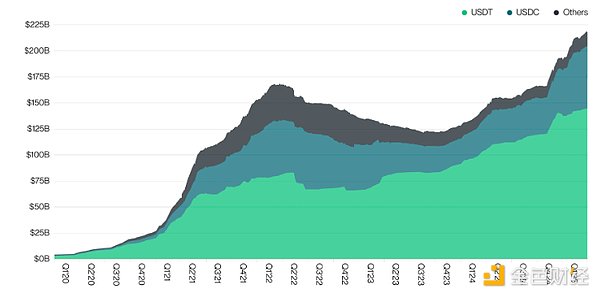
Source: Bitwise Asset Management, data from The Block, Coin Metrics, and CoinGecko. The data range is from the first quarter of 2020 to the first quarter of 2025.
Note: “Others” includes BUSD, crvUSD, DAI, FDUSD, FEI, FRAX, GHO, GUSD, HUSD, LUSD, MIM, PYUSD, TUSD, USDD, USDP, and USDS.
However, stablecoins have long been in a regulatory gray area. Stablecoin issuers like Circle must comply with numerous regulations, but there is currently no overarching federal framework. The “GENIUS Act” provides this framework.
The bill guarantees:
- Stablecoins will be backed 1:1 by U.S. Treasury securities and cash equivalents.
- Large stablecoin issuers will register with federal banking regulators;
- These issuers will undergo regular audits to ensure their robustness; and
- Stablecoin issuers will impose anti-money laundering restrictions on their tokens.
In other words, the bill empowers the federal government to support stablecoins, allowing large banks to issue stablecoins and permitting merchants to accept them.
I’m amazed that stablecoins have grown to over $200 billion in assets without the participation of the world’s largest financial institutions, and consumers can’t easily distinguish between “good stablecoins” like USDC and “bad stablecoins” like TerraUSD.
With these protections, I expect this market to reach $2.5 trillion soon. Close your eyes and imagine a world where JPMorgan Chase and Bank of America issue stablecoins; If you shop with a stablecoin instead of a Visa card, Amazon will give you a 2% discount; Accepting stablecoins is as common as accepting Venmo or PayPal.
This is the world we are about to live in.
It’s just the beginning
While I am excited about stablecoins themselves, I believe this is just the beginning. Once we achieve the normal transfer of dollars on blockchain networks—and with the participation of the world’s largest financial institutions—then transferring stocks, bonds, and other financial assets on the same track will be just a small step.
This is the basic argument for investing in non-Bitcoin crypto assets like Ethereum and Solana: over $1 trillion in financial assets will eventually move to the blockchain. The passage of this bill will exacerbate this trend.
I suspect that the impact here will be similar to that of a Bitcoin ETF.
The approval of spot Bitcoin ETFs has normalized cryptocurrencies as an investment method, and now some of the largest institutions globally are also issuing Bitcoin ETFs and incorporating them into their portfolios. I believe that the approval of stablecoin regulations will normalize cryptocurrencies as a financial tool and pave the way for the world’s largest institutions to issue stablecoins and use them for payments.
What a genius move.