Redefining On-Chain Capital Efficiency with Spark Protocol

Beginner
Quick Reads
Last Updated 2026-03-29 23:01:08
Reading Time: 1m
Spark is a cross-chain financial infrastructure purpose-built to maximize stablecoin efficiency and optimize capital allocation. It targets critical challenges in the DeFi ecosystem, including underutilized capital, idle stablecoins, and significant yield fluctuations.

Background of Spark’s Creation
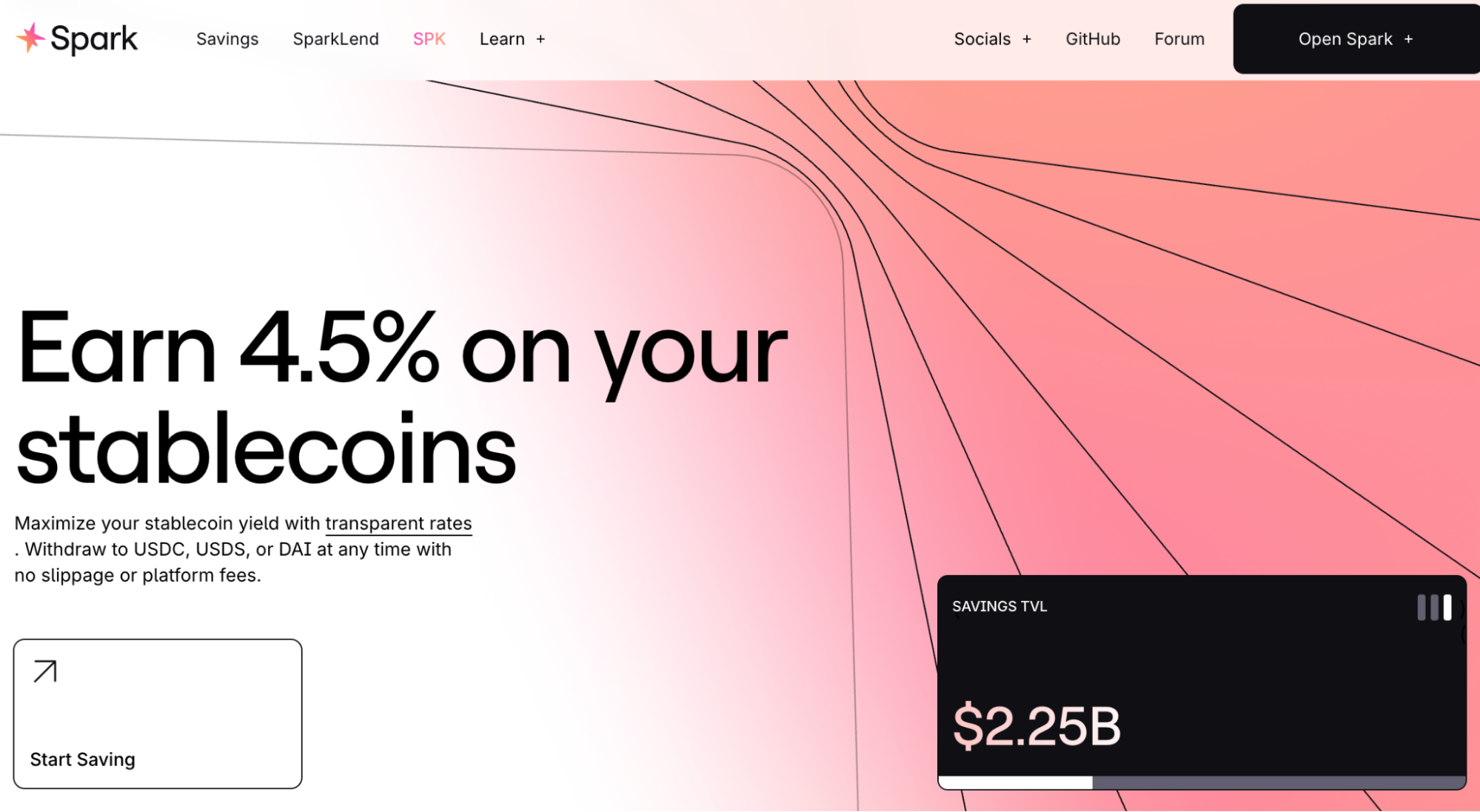

(Source: spark)

As DeFi markets continue to evolve, persistent challenges—such as low capital efficiency, idle stablecoins, and excessive yield volatility—still remain unresolved. As a comprehensive, cross-chain financial infrastructure, Spark was specifically developed to address these pain points. Rather than being just another DeFi application, Spark establishes the fundamental layer for on-chain yield and liquidity management, engineered to maximize stablecoin efficiency and optimize capital deployment.

Spark operates on the Ethereum mainnet and multiple L2 scaling chains. It delivers a unified entry point for financial liquidity. Capital is channeled toward more efficient, stable use cases.

Three Core Modules of Spark

The Spark protocol consists of three core modules, each designed to enhance DeFi’s underlying capital efficiency:

  1. SparkLend: Decentralized smart lending platform
    Users can deposit stablecoins and major crypto assets into SparkLend to earn yield or use them as collateral for borrowing. The platform supports high-efficiency lending (E-Mode), asset isolation, and isolated asset strategies, enabling effective risk management and improving overall capital utilization.
  2. Spark Savings: Stablecoin yield optimization channel
    Spark Savings provides stablecoin holders with an accessible and highly stable yield solution. By allocating funds across DeFi, CeFi, and RWA (real-world assets) markets, the system maximizes annualized stablecoin returns through risk-adjusted deployment.
  3. Spark Liquidity Layer: Liquidity provider for DeFi protocols
    Spark’s liquidity layer serves as a stable capital source for other DeFi protocols, providing deep liquidity, ensuring market efficiency, and further boosting the sustainability of the on-chain financial ecosystem.

SPK Token Design and Distribution Plan

The Spark Protocol governance token, SPK, has an initial total supply of 10 billion tokens and plays multiple roles—including governance, incentives, and protocol security. The issuance and allocation model is designed for long-term sustainability:

Sky Farming Rewards (65%): Core user incentives distributed gradually over a 10-year period.

Ecosystem Development Fund (23%): Supports cross-chain deployment, technical development, and global expansion.

Core Team and Advisors (12%): Subject to a one-year lock-up and a three-year linear vesting schedule to ensure long-term contributor value.
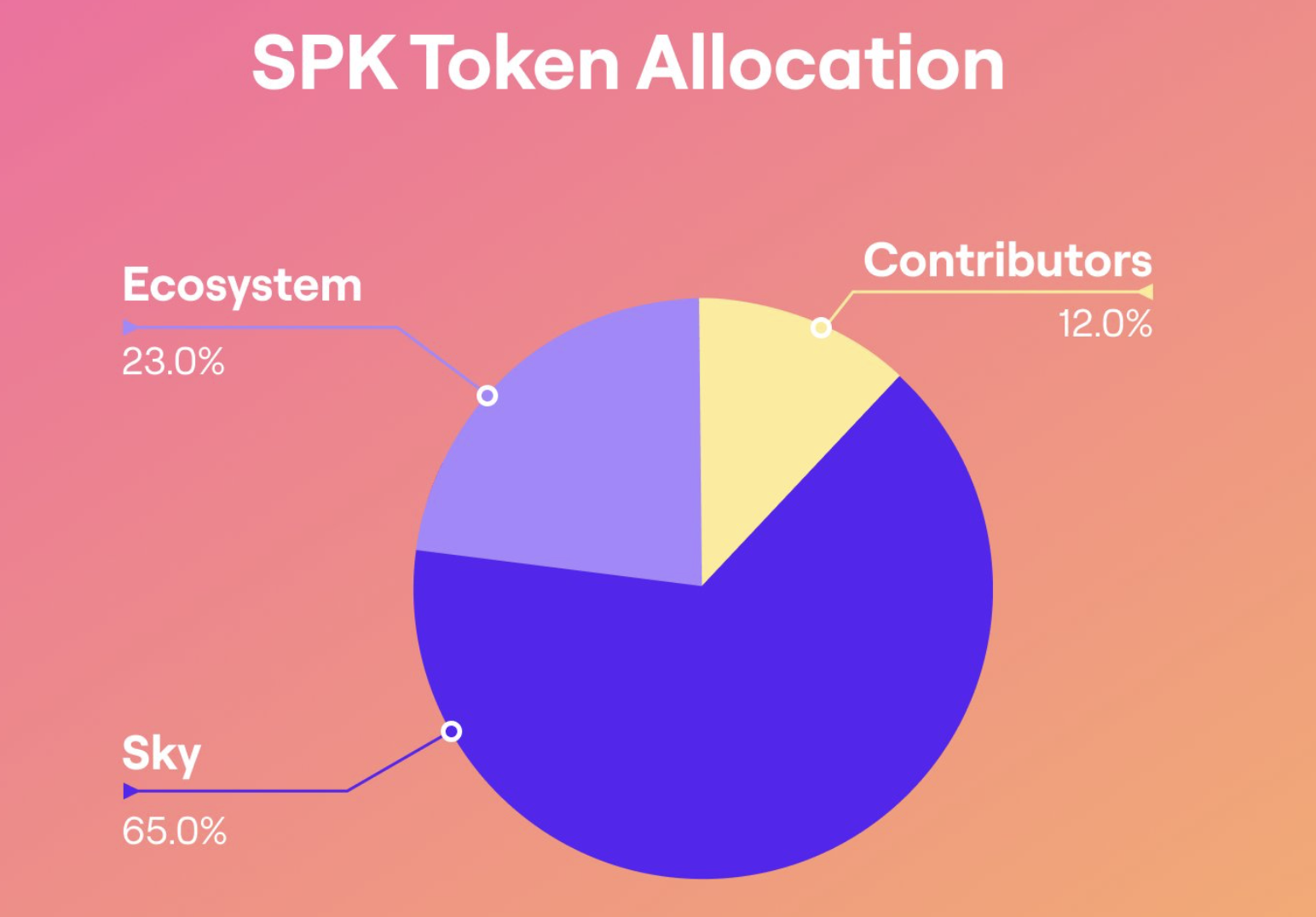

(Source: sparkdotfi)

SPK also features a re-minting mechanism available only under special governance conditions. The DAO can activate this mechanism exclusively for situations such as bad debt liquidation. This ensures protocol security and transparency.

SPK Application Scenarios

Governance participation: SPK holders can join Spark DAO’s Snapshot voting to directly influence protocol strategies, asset support decisions, and incentive parameters.

Staking and protocol security: Staking SPK supports protocol operations and underpins security mechanisms, including insurance pools or validator layers, while providing the opportunity to secure future Spark sub-protocols.

User reward incentives: When users stake SPK, they earn Spark Points that they can redeem for rewards and potential airdrop entitlements within the protocol or partner platforms to drive community engagement and loyalty.

Multi-Chain Deployment and Market Scale

Spark is live on Ethereum, Arbitrum, Base, Optimism, Unichain, Gnosis Chain, and other networks, managing over $3.5 billion in stablecoin assets and generating more than $170 million in annual on-chain yield. This makes Spark one of the few DeFi protocols to achieve both significant scale and efficiency.

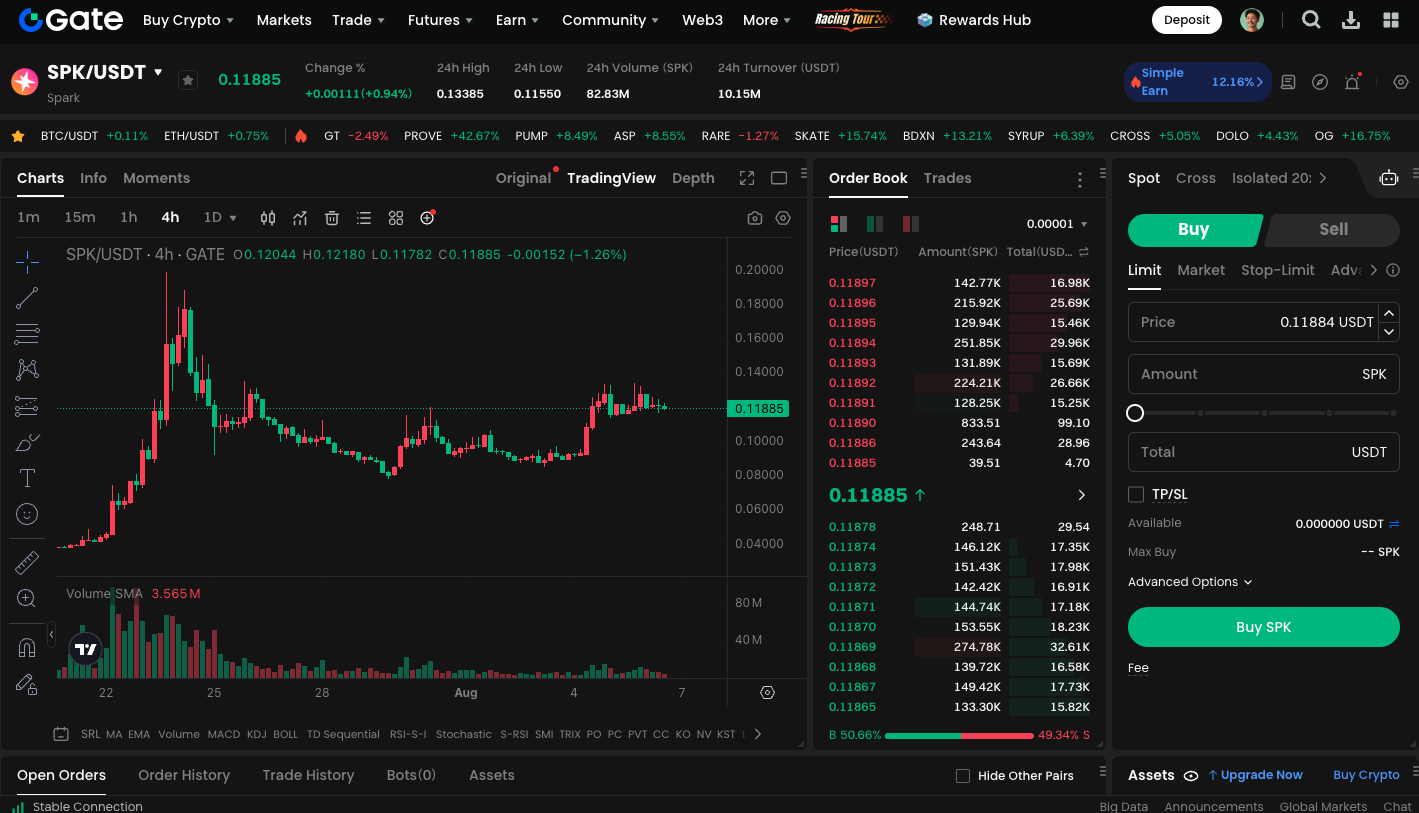
Start spot trading SPK now: https://www.gate.com/trade/SPK_USDT
Conclusion

Spark’s goal is not to replace existing DeFi protocols, but to integrate seamlessly into the on-chain financial system through a modular, collaborative approach. Its yield layer and liquidity core ensure capital is actively put to work and protocols operate in synergy—marking a new era of capital efficiency in DeFi. As SPK advances decentralized governance, deepens cross-chain integration, and fosters further innovation, Spark is poised to become DeFi’s foundational engine, providing sustained momentum for the blockchain financial sector.

Author: Allen
Disclaimer
* The information is not intended to be and does not constitute financial advice or any other recommendation of any sort offered or endorsed by Gate.
* This article may not be reproduced, transmitted or copied without referencing Gate. Contravention is an infringement of Copyright Act and may be subject to legal action.

Related Articles

What is Fartcoin? All You Need to Know About FARTCOIN
Intermediate

What is Fartcoin? All You Need to Know About FARTCOIN

Fartcoin (FARTCOIN) is a representative meme coin within the Solana ecosystem based on an AI-driven narrative. Its core concept originated from an experiment aimed at exploring the "boundaries between AI Agents and humor." More than just a digital asset with social attributes, the project deeply couples absurd humor culture with on-chain financial logic by integrating autonomous AI interaction models.
2026-04-04 22:01:19
Gold Price Forecast for the Next Five Years: 2026–2030 Trend Outlook and Investment Implications, Could It Reach $6,000?
Beginner

Gold Price Forecast for the Next Five Years: 2026–2030 Trend Outlook and Investment Implications, Could It Reach $6,000?

Analyze current gold price trends alongside authoritative five-year forecasts, integrating an evaluation of market risks and opportunities. This gives investors insight into the potential trajectory of gold prices and the main drivers expected to shape the market over the next five years.
2026-03-25 18:13:30
Aster vs Hyperliquid: Which Perp DEX Will Prevail?
Beginner

Aster vs Hyperliquid: Which Perp DEX Will Prevail?

Aster and Hyperliquid are the two representative protocols of the "purpose-built L1 path" within the current decentralized perpetual exchange (Perp DEX) sector. As a pioneer in the field, Hyperliquid has built a deep liquidity moat through its highly mature order book architecture and strong community consensus. Conversely, Aster, as a rising challenger, seeks to leapfrog the competition in high-performance trading through more aggressive multi-chain aggregation logic, private transaction modules, and an underlying execution environment optimized for 2026 market demands.
2026-03-24 11:58:33
ASTER Tokenomics: Buybacks, Burns, and Staking as the Value Foundation of ASTER in 2026
Beginner

ASTER Tokenomics: Buybacks, Burns, and Staking as the Value Foundation of ASTER in 2026

ASTER is the native equity and governance token of the Aster ecosystem, with its core value built upon a radical "Deflationary Engine." Beyond serving as a governance tool, ASTER integrates multiple utilities including staking rewards, trading fee discounts, and liquidity incentives. Through its deep integration with the upcoming dedicated Layer 1 mainnet, it enables direct value capture from protocol cash flow to token holders.
2026-03-25 07:38:07
AI-Native Settlement Layers: How United Stables Is Building the Next Financial Rail
Beginner

AI-Native Settlement Layers: How United Stables Is Building the Next Financial Rail

Stablecoins were originally designed as dollar substitutes within exchanges, primarily used for asset pricing and trade settlement. As on-chain financial ecosystems have matured, their role has expanded beyond simple payments to include collateral assets, cross-chain liquidity mediums, and unified settlement units. In particular, as AI systems and automated agents begin to participate directly in economic activity, demand has risen sharply for programmable value units capable of instant settlement. This shift is pushing stablecoins toward the role of foundational financial infrastructure.
2026-03-25 03:16:17
2026 Silver Price Forecast: Bull Market Continuation or High-Level Pullback? In-Depth Analysis of Silver Candlestick Chart
Beginner

2026 Silver Price Forecast: Bull Market Continuation or High-Level Pullback? In-Depth Analysis of Silver Candlestick Chart

2026 Silver Price Forecast: Latest Outlook This article integrates current market trends, silver candlestick chart analysis, and momentum factors to assess the potential key support and resistance levels, upside targets, and pullback risks for silver prices. The goal is to help investors make informed, rational decisions.
2026-03-25 16:08:59





