As the DeFi ecosystem evolves, on-chain financial products are advancing beyond basic lending and trading, moving into sophisticated return management and interest rate trading scenarios. With the rapid expansion of yield-bearing assets like LSD and Restaking, users increasingly want not just returns—they want to lock in ROI, trade future returns, and hedge against return volatility. Yet most traditional DeFi protocols only offer floating returns, falling short of these specialized needs.
Pendle was developed to address this gap, introducing a yield tokenization mechanism that splits yield assets into PT and YT. This empowers DeFi users to separate and trade returns. The mechanism gives yield assets bond-like and derivative characteristics, positioning Pendle as foundational infrastructure for DeFi fixed income and interest rate markets, with PT and YT as its core components.
What Are PT and YT?
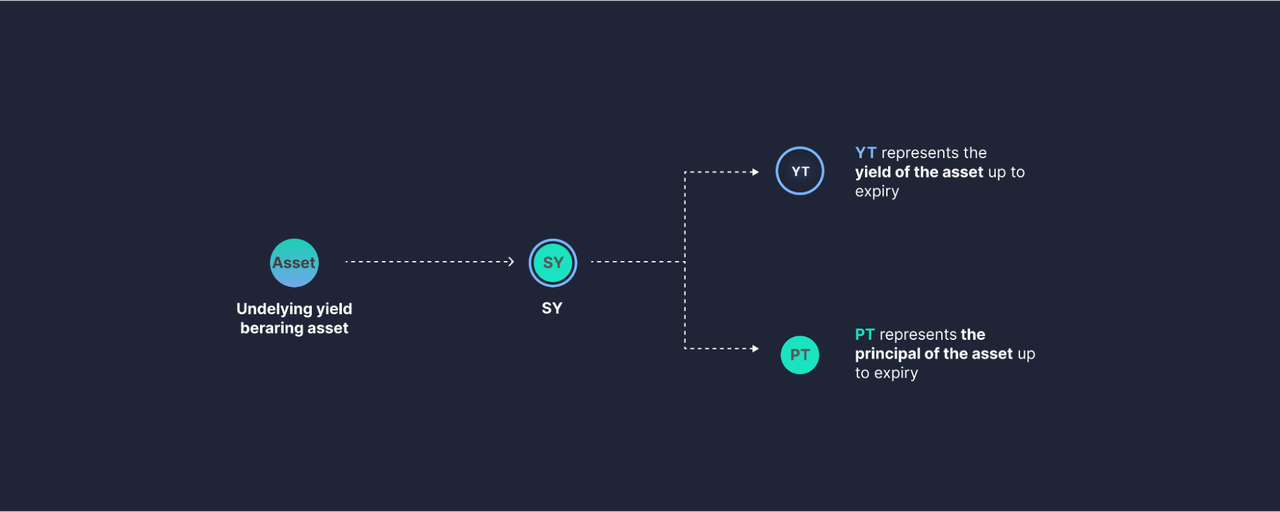
Within the Pendle protocol, when users deposit yield-bearing assets, the system automatically divides them into two parts: PT (Principal Token) and YT (Yield Token). PT represents the principal, while YT represents the rights to future returns. This separation means users can independently trade principal and return rights that were previously bound together.
This design lets users choose return strategies flexibly. For example, risk-averse users can hold PT to secure fixed returns, while users who want to bet on future return growth can purchase YT for exposure to future returns. Pendle thus brings the logic of fixed income and interest rate trading from traditional finance into the DeFi marketplace.
Why Does Pendle Split PT and YT?
Pendle’s core reason for splitting PT and YT is to enhance the flexibility of yield assets. Traditional yield-bearing assets generate ongoing returns, but principal and returns are bound together, preventing users from trading future returns separately or locking in fixed ROI.
Pendle’s split mechanism turns principal and returns into two distinct assets. Users can buy discounted PT to secure fixed returns or trade YT to speculate on ROI changes. This flexibility boosts capital efficiency and provides new tools for return management and interest rate speculation, making yield assets more like fixed income products in traditional finance.
What Is PT? How Does It Work?
PT, or Principal Token, represents the principal portion of a yield asset. When users deposit yield-bearing assets into Pendle, they receive an equivalent amount of PT. PT holders can redeem their principal at face value on the expiration date.

Since PT excludes future return rights, it’s typically traded at a discount. For example, if an asset’s maturity value is 1 ETH but the current PT Market Price is below 1 ETH, users can purchase PT and hold it until maturity to earn fixed returns. This is similar to a zero-coupon bond: buy at a discount, redeem at face value, and lock in returns.
PT is Pendle’s key instrument for fixed returns and the more stable part of the return split mechanism.
What Is YT? How Does It Work?
YT, or Yield Token, represents the rights to future returns from the yield asset. YT holders don’t receive principal, but they get all returns generated by the underlying asset before expiry.
YT’s value is driven by market expectations for future ROI. If the market expects ROI to rise, YT’s value usually increases; if ROI falls, YT’s value may drop. YT functions as a certificate of return rights, ideal for users who want to speculate on future return changes.
Pendle turns otherwise non-tradable future returns into tradable assets via YT, enabling users to participate in ROI speculation and manage return risk.
How Do PT and YT Together Constitute Yield Assets?
PT and YT together represent the full value of the original yield asset. PT stands for principal value, YT for future return value; their sum equals the original yield-bearing asset.
Holding both PT and YT is equivalent to holding the original yield asset. Trading only one separates principal and return risk: holding only PT means foregoing future returns for fixed certainty; holding only YT means taking on return volatility for future return potential.
This split mechanism enables flexible risk-return portfolio strategies and is a core innovation of Pendle.
What Are the Use Cases for PT and YT?
The PT and YT split mechanism lets users tailor return strategies to their objectives. Users seeking stable returns can buy discounted PT for fixed returns—ideal for low-risk strategies. Users bullish on future ROI growth can buy YT for potential upside.
Yield asset holders can also sell YT to lock in returns early and reduce the risk of future return declines. This flexibility makes Pendle suitable for both return enhancement and risk management, broadening yield asset applications in DeFi.
Why Are PT and YT Important?
PT and YT are crucial because they make yield assets “splittable, tradable, and manageable” for the first time. Traditional DeFi models only allowed whole-asset holding; Pendle’s principal and return split lets users control return risk with greater flexibility.
This mechanism offers fixed return and speculation tools, and provides foundational assets for on-chain interest rate markets, enabling ROI to be priced and traded like other financial assets. PT and YT are thus core to Pendle’s return marketplace and underpin its competitive edge in the DeFi fixed income sector.
Summary
PT and YT are the central components of Pendle’s yield tokenization mechanism. PT represents the principal, giving users fixed return tools; YT represents future returns, letting users trade expectations. By splitting yield assets into PT and YT, Pendle shifts return management from passive holding to active trading, building an on-chain interest rate market for DeFi.
As yield asset AUM grows, PT and YT’s mechanism will become even more valuable. As the foundation of Pendle’s return trading system, this split mechanism is driving the DeFi fixed income market toward maturity.
FAQs
What Are Pendle’s PT and YT?
PT is the Principal Token, representing the principal of the yield asset; YT is the Yield Token, representing rights to future returns. Together, they form a complete yield asset.
How Does PT Help Users Achieve Fixed Returns?
PT is typically traded at a discount and redeemed at face value upon maturity, allowing users to earn fixed returns through price differences.
What Determines the Value of YT?
YT’s value is primarily driven by market expectations for future ROI. Higher ROI usually means higher YT value.
Why Does Pendle Split PT and YT?
Splitting allows users to trade principal and return rights separately, enabling them to lock in returns or speculate on future return changes.
What Is the Significance of the PT and YT Mechanism?
This mechanism brings greater flexibility to yield assets, making fixed returns and interest rate trading possible in DeFi.