The recent Pectra upgrade of Ethereum has been launched on the Mainnet.
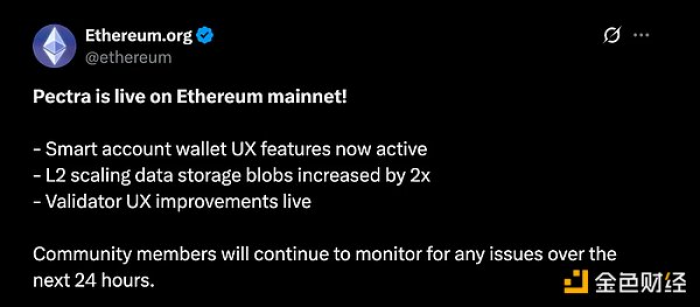
If Ethereum were a city, then Pectra would be like upgrading the city’s infrastructure.
- Resurface the road (enhance user experience).
Improve traffic flow (reduce DA costs).
Modernized grid (validator node operation).
This is not a new skyline or dazzling skyscrapers. This is a tedious yet crucial job that makes the entire city faster and safer, and allows everyone living there to have a better life.
Pectra is not just about gradually improving developer efficiency or cutting down on some gwei. This upgrade actually fundamentally changes the economics and user experience of Ethereum-based applications, enough to unlock new product categories and business models (see the list at the end for details!).
Pectra is the turning point of cost-effectiveness for Ethereum.
Pectra bundles 11 Ethereum Improvement Proposals (EIP) in the execution layer and consensus layer of Ethereum to address some of its most pressing pain points: cumbersome user experience, high data availability costs, and slow validator operations.
However, why will Pectra become a “turning point”? Because it marks the tipping point for the cost-performance ratio of Ethereum: a key threshold, where the cost structure of the product changes relative to its performance/value, making the product more attractive.
Pectra’s protocol improvements can now drive on-chain economy and user experience beyond the cost-performance threshold, thereby giving rise to a whole new category of viable products and business models. When lower costs, better performance, and enhanced user experiences are perfectly integrated, miracles will follow.
Reduce on-chain costs below the pain threshold
Before Pectra, the gas pricing for many on-chain operations (micro perpetual trading, low-value NFT minting, batch yield rebalancing) was too expensive or unpredictable to support sustainable projects.
Pectra reduces gas costs by approximately 30% to 50% and enhances blob throughput, compressing these costs to a level that is “not worth considering” (for example, minting fees below $0.05 and micro perpetual trading below $0.10). This means that today’s “nice-to-have” features will become the core revenue drivers of the future.
Working Principle:
Proto-Danksharding and Blobs (EIP-4844 + EIP-7691): Pectra introduces the first layer of Danksharding through Blobs, known as ‘proto-danksharding’. Blobs are a new data availability primitive that decouples Rollup workloads from Ethereum’s execution state. You can think of Blobs as extra cargo space on an airplane: instead of cramming all the packages into the cabin, you unload the cargo into the cargo hold, freeing up space and reducing costs. Rollups like Optimism and Arbitrum can now increase the amount of call data per block by up to 50%, while the price is cut in half. For end users, this means transaction fees can be reduced by 30% to 50% when swapping tokens, bridging assets, or interacting with DeFi protocols on L2.
Calldata Gas Repricing (EIP-7623): Calldata (the raw instructions sent by users to smart contracts) will significantly reduce costs. Imagine postage stamps: if each stamp costs less, you can send longer letters without spending too much. Pectra has reduced the Gas cost per byte, lowering the cost of batch transactions (sending multiple airdrops, batch treasury rebalancing, minting multiple NFTs) by up to 40%. Builders can bundle multiple operations into a single transaction, avoiding unpredictable spikes in fees.
Improve User Experience through Major Enhancements
Wallet approval fatigue. Gas pop-ups. Multi-step registration processes. These clumsy experiences may be bearable for hardcore cryptocurrency fans, but they are completely unfamiliar to a wider audience.
Pectra’s gas abstraction and smoother user experience make on-chain interactions as seamless as a one-click experience in Web2. When users no longer have to struggle with MetaMask or gas limits, the user base can ultimately expand from millions to hundreds of millions.
Working principle:
exchange
Smoother Staking Process (EIP-7251 + EIP-7002): Improvements to the staking user experience often go unnoticed, but they are significant. Pectra has increased the validator staking cap from 32 Ether to 2,048 Ether, allowing node operators to consolidate staking, much like merging small bank accounts into a high-yield fund, thus simplifying management and reducing costs. The triggerable exit mechanism becomes effective instantly, simplifying the user experience of liquid staking platforms and making staking operations as intuitive as withdrawing cash from an ATM.
Minor Engine Adjustments (EIP-7846, EIP-7617): Small gas refunds and opcode adjustments may seem trivial, but they accumulate across thousands of contracts, reducing the microseconds and micro gwei of daily on-chain computations.
What Does Pectra Indicate for the Future of Ethereum
('s optimistic attitude towards Ethereum’s “achieving goals”
Critics of Ethereum often point out its slow governance and fragmented client support. Pectra has dispelled these concerns: within less than 24 months, Ethereum has successively launched Shanghai ) in April 2023, Dencun ### in March 2024, and now Pectra ( in May 2025. 11 EIPs coordinated without regressions and with no turbulence. I expect the frequency of future upgrades to be higher than the current annual upgrade frequency. The biggest takeaway is: Ethereum’s “upgrade flywheel” is in full swing, reducing protocol risk for developers and investors.
) Better governance = More convenient delivery
Pectra’s “meta-EIP” umbrella ( EIP-7600 ) showcases the progress of Ethereum governance. Multiple working groups, off-chain forums, and on-chain signals converge into a unified whole. It’s like multiple teams working together to launch a space mission at the best time—only this time it’s once a year instead of once every few decades. Now, builders can view the upgrade timeline as predictable milestones rather than moving targets.
( Roadmap confidence = Investor confidence
By launching proto-Danksharding today, Ethereum paves the way for the full implementation of Danksharding in the near future. After Pectra, builders and investors can reasonably construct a transparent roadmap to achieve a throughput of 1 million TPS on L2 networks. With the steady decline of the lower limit on Gas costs, business models can predict transactions below $0.10, transforming long-term planning from guesswork to precise forecasting.
![43vME9P0X9hYps3PT7gAbXLQpJG2qDxRUCSsXyaH.png])https://img.gateio.im/social/moments-47bd28761782f94d089662e2c6d102f9 “7368114”###
New Opportunities for Builders and Founders
Pectra not only enables the construction of existing DeFi or NFT applications at a lower cost but also changes the types of applications worth building. Micro perpetual markets. Continuous auctions. Gas-sponsored social dApps. Enterprise-grade staking as a service. These features and products become feasible and may yield substantial profits.
Pectra is not just another upgrade; it is a turning point for the enhancement of the Ethereum base layer, moving from incremental optimization to commercialization.
The following is a non-exhaustive list of products and use cases after Pectra:
( DeFi
- Micro Perpetual Contracts and Mini Auctions
Calldata costs are halved, which means you can start a continuous auction for perpetual contract markets or real-world assets with an entry fee of less than $0.05. Imagine running a mini stock exchange on every block.
- Composable Yield Vaults and Orchestration
Blob throughput makes it as easy to link 5-10 yield strategies in a single multi-call as it is to order multiple dishes with a single delivery fee. Startups can charge performance fees on top of management fees, creating recurring income for decentralized portfolio managers.
- Flash‑Bundle SDK
Package flash loans, MEV capture, and gas sponsorship into a single SDK. It’s like bundling the internet, television, and telephone into one subscription, but specifically for high-frequency DeFi primitives.
) Consumer Social Applications + NFT
- Large-scale minting:
Pectra’s calldata repricing technology can reduce gas fees by about 30%, making the total cost for 10,000 mints less than $1,000—this brings the cost of generating art mints down to the same level as viral social media campaigns. While it is still catching up to the compressed NFTs/cNFTs on Solana, which can achieve low-cost 1 million mints, it has undoubtedly made significant progress.
- Social entry sponsored by Gas
Smart contract wallets can subsidize users’ first few transactions, such as offering a free first cup of coffee or zero-fee transactions, turning cold wallets into active community members through frictionless token interactions.
Games and Mobile Applications
- Smooth in-game economy system
The precharged Gas points can unlock dozens of microtransactions during each gaming session. Imagine batch processing operations like manufacturing, market bidding, and loot collection, all done seamlessly. This brings a AAA mobile game user experience without pop-ups.
- Dynamic Session Compression
The client records off-chain operations and submits a single compressed blob at the end of the session. This is like compressing a bunch of files before uploading, thereby keeping gas costs stable and predictable.
( Enterprises and Infrastructure
- Enterprise-level Staking + Custody
Raising the validator cap to 2,048 ETH can reduce the number of nodes in large staking pools by 64 times. Imagine merging multiple offices into a single headquarters, significantly improving efficiency and creating a more diverse “business district.”
- Stateless + Light Client Service
The status hash unification mechanism of EIP-7685 lays the foundation for Ethereum’s Verkle tree, thereby supporting stateless clients. This transition is like on-demand streaming content, rather than carrying a library full of books or CDs.
- Data Availability Middleware
Blob proof can support off-chain DA networks (also known as middleware), ensuring 99.99% availability, just like CDNs guarantee rapid content delivery globally.
) SDK and tools
- Gas Sponsorship and Relay Library
The new JS/TS SDK will integrate bundler selection, fee estimation, and gas sponsorship into a single simple function call—similar to a payment API that integrates credit card transactions.
- Calldata Compressor and Multi-Call Optimizer
Hardhat/Foundry plugins can analyze contract flows, automatically convert calls into batches of Blobs, and display gas savings estimates at compile time. Like a code checker, it can highlight inefficiencies. This greatly improves the quality of life for developers.
- Observability Dashboard
A suite of metrics will be available for blob utilization, sponsor ROI, and proto-dank load allocation, providing advanced analytics for builders who require fine-grained visibility.
Post-Pectra Era: Timing for Building and Upgrading
Pectra will not steal the spotlight with dazzling features. It will not completely transform Ethereum. Instead, it strengthens Ethereum by reinforcing its core while enhancing the upper limits of on-chain economy and experience.
Various products that were once on the brink of survival have not only become feasible but also possess financing and scalability. This represents a business turning point for Ethereum, as it eliminates significant barriers to mainstream user experience, solidifies the accelerating upgrade pace of Ethereum, and unlocks a new category of products ranging from micro-applications to consumer applications.
Build the Pectra native functional prototype product now and seize the new advantages brought by Pectra. The next generation Ethereum-driven products are on the way.
Disclaimer: The information on this page may come from third parties and does not represent the views or opinions of Gate. The content displayed on this page is for reference only and does not constitute any financial, investment, or legal advice. Gate does not guarantee the accuracy or completeness of the information and shall not be liable for any losses arising from the use of this information. Virtual asset investments carry high risks and are subject to significant price volatility. You may lose all of your invested principal. Please fully understand the relevant risks and make prudent decisions based on your own financial situation and risk tolerance. For details, please refer to
Disclaimer.


