Introduction
While Ethereum remains the primary base for restaking innovation, the concept is not exclusive to it. Other blockchain ecosystems are actively adapting restaking principles to suit their own architectures and consensus models. The most notable shift in 2025 is the emergence of Bitcoin-native restaking through protocols like Babylon, which allow the world’s most secure asset to contribute cryptoeconomic guarantees beyond Bitcoin’s base layer.
In parallel, multichain ecosystems such as Cosmos, Polkadot, and NEAR are implementing new versions of shared security and validator reuse to improve scalability and decentralization.
Bitcoin as a Source of Economic Security
Bitcoin is the oldest and most secure blockchain by hashpower and network effect. However, its security is not easily composable. Bitcoin’s design is intentionally conservative, lacking smart contracts or native support for staking. As a result, BTC’s $1 trillion market cap remains largely underutilized when it comes to securing decentralized applications or services.
Protocols like Babylon aim to change that by building infrastructure that allows self-custodial BTC restaking. Rather than wrapping Bitcoin in a smart contract on another chain, Babylon enables BTC holders to stake their coins without giving up control. This is done through off-chain commitments, time-locked UTXOs, and cryptographic proofs—ensuring Bitcoin remains on its native chain while still offering staking guarantees to external services.
How Babylon Works
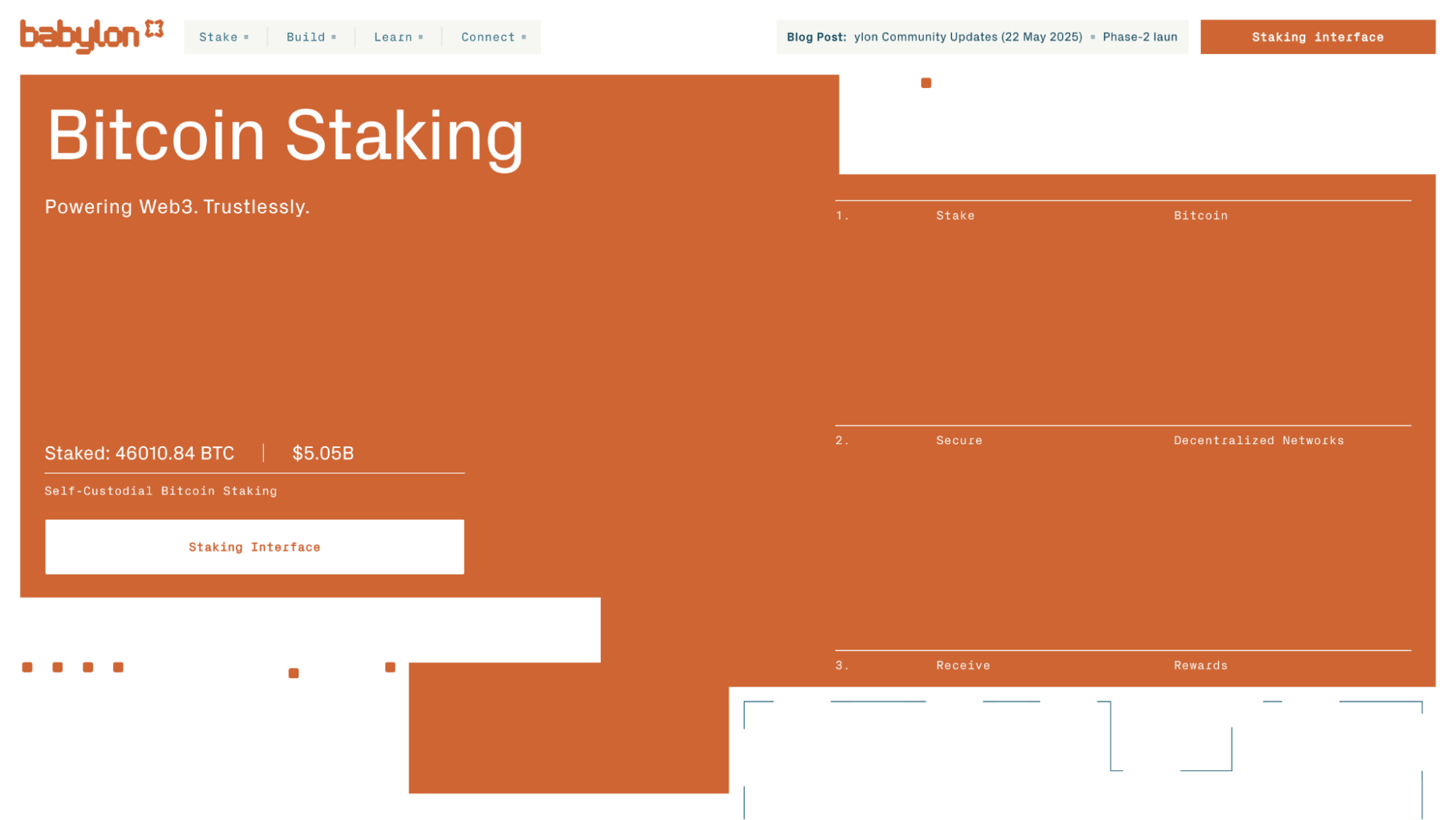
Babylon is a Layer-1 blockchain designed specifically to leverage Bitcoin as a source of security. It operates through a dual-token model that includes:
- BTC as the restaked asset,
- BABY as the governance and utility token.
BTC is staked through time-locked outputs directly on the Bitcoin blockchain. The user commits their BTC for a specific duration and, in return, earns rewards from services secured by Babylon. These could include rollups, bridges, oracles, or other decentralized applications that require economic guarantees.
The protocol includes a proof-of-stake finality layer, where AVS operators validate off-chain logic and can be slashed based on Babylon’s dispute framework. Importantly, slashing BTC is enforced by invalidating time-lock commitments – making restaked BTC temporarily inaccessible or economically penalized if misbehavior is proven.
Babylon launched its Genesis L1 chain in April 2025, marking the beginning of BTC restaking as a composable primitive. Within months, integrations with Cosmos IBC and oracle services like Pyth Network have allowed Babylon to extend Bitcoin’s security guarantees to a growing range of decentralized services.
Advantages Over Wrapped Bitcoin Models
Wrapped BTC (such as WBTC on Ethereum) requires centralized custodians and exposes users to custodial risk. Babylon eliminates this risk by allowing BTC to remain under user control at all times, removing the need to trust third-party intermediaries. This design aligns with Bitcoin’s ethos while unlocking its latent utility.
Furthermore, Babylon does not require changes to the Bitcoin protocol. It operates entirely as an overlay using Bitcoin’s existing time-lock and signature infrastructure. This makes it compatible with Bitcoin’s security assumptions and keeps the base chain untouched, an important consideration for Bitcoin core developers and maximalists.
The result is a framework that allows Bitcoin holders to participate in securing decentralized infrastructure without compromising custody or requiring token wrapping. In doing so, Babylon expands the definition of what staking can be and introduces Bitcoin as a serious contender in the restaking economy.
Restaking and Shared Security in Other Ecosystems
Beyond Bitcoin, restaking and shared security are also advancing in Cosmos, Polkadot, and NEAR.
Cosmos
In Cosmos, the concept of shared validator sets has existed for several years under models like Interchain Security (ICS). In ICS v1, a consumer chain uses the Cosmos Hub’s validator set to secure its operations. With ICS v2 and ongoing upgrades in 2025, chains can share subsets of validators and customize slashing and governance mechanisms. This modular design brings flexibility while maintaining economic security through coordinated staking.
Polkadot
Polkadot’s shared security model is built into its architecture. All parachains are secured by the central Relay Chain’s validator set. However, Polkadot is now experimenting with more flexible Shared Security v2 frameworks, where collator sets and execution logic are decoupled from Relay Chain consensus. This introduces elements of restaking, where different parachains can negotiate validator relationships dynamically, based on their needs and available incentives.
NEAR Protocol
NEAR Protocol, known for its sharded architecture, is exploring FastAuth and smart contract-based validator delegation systems. These innovations aim to allow service chains or app chains to lease security from the NEAR validator pool without maintaining full independent consensus. Although not described explicitly as restaking, this model reflects similar principles of validator reuse and modular trust.
These multichain approaches differ technically but share a common goal: to make economic security more accessible, composable, and efficient across multiple applications and chains.
Risks and Limitations
Restaking outside Ethereum introduces unique risks. In Babylon’s case, slashing BTC is technically complex and irreversible. Mistakes in time-lock logic or misconfigured AVS parameters can result in capital loss without recourse. Moreover, dispute resolution on a separate chain (like Babylon’s L1) may take longer to finalize, depending on the trust model and validator uptime.
For Cosmos and Polkadot, shared validator sets increase the risk of correlated downtime or performance bottlenecks. If multiple consumer chains rely on the same set of validators and one service misbehaves, it can drag others down by overloading operators or triggering multi-chain slashing events.
Governance and trust assumptions also vary. Babylon is still in its early phases of governance decentralization, while Polkadot and Cosmos have more mature on-chain governance but face scaling challenges when customizing slashing or operator sets across many consumer chains.