As the Decentralized Finance (DeFi) ecosystem matures, on-chain asset trading has evolved from basic token swaps into a sophisticated system requiring efficient liquidity aggregation, smart routing, and unified trading interfaces. For Wallets, aggregators, and decentralized trading platforms, relying on a single liquidity pool is no longer sufficient to meet users’ demands for price efficiency and a seamless trading experience. This has driven the need for more robust modularity in underlying trading protocols.
0x Protocol was purpose-built as decentralized trading infrastructure to address these needs. By leveraging Relayer, Mesh, API, and Smart Contract components, it separates order propagation, liquidity aggregation, and trade settlement—enabling Developers to efficiently tap into on-chain liquidity and build applications with integrated trading capabilities. This modular architecture not only enhances scalability but also positions 0x as a critical component of DeFi trading infrastructure.
What are the core components of 0x Protocol?
The core architecture of 0x Protocol is comprised of Relayer, Mesh network, 0x API, and Exchange Proxy. Each handles order relay, order sharing, offer aggregation, and on-chain trade execution, collectively enabling a fully decentralized trading workflow.
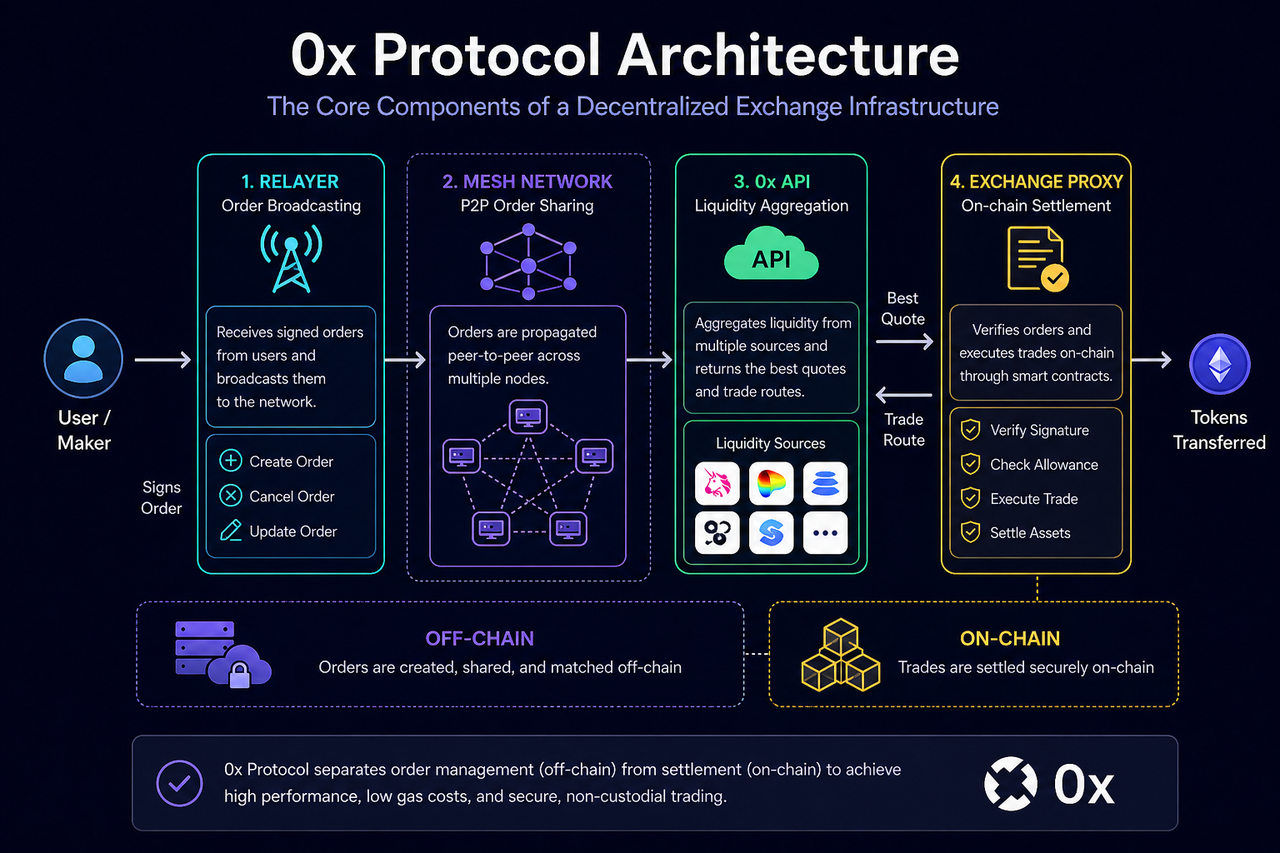
When a user initiates a trade request, orders are propagated and matched via off-chain components and then settled through on-chain Smart Contracts. This modular separation boosts trading efficiency and provides Developers with a unified integration pathway, supporting advanced liquidity aggregation scenarios.
What is the role of Relayer in 0x Protocol?
Relayer is the 0x Protocol component responsible for order relay, broadcasting and managing user-created orders off-chain. Once users sign their orders, they are not immediately sent to the blockchain but are distributed by Relayer to potential counterparties or liquidity networks.
This approach reduces reliance on on-chain Order History, allowing Makers, cancellations, and updates to be handled off-chain, which lowers transaction costs. Relayer does not custody user Assets or execute trades; its sole function is order propagation.
Think of Relayer as a decentralized “order information hub”—it facilitates market participants’ discovery of orders, while Asset settlement remains the domain of on-chain Smart Contracts.
How does the Mesh network enable order sharing?
0x Mesh is a peer-to-peer order sharing network within 0x Protocol, synchronizing and propagating order data among different Nodes. It enables multiple Relayers and Makers to share Order Book information, ensuring liquidity flows throughout the network.
Mesh solves the liquidity fragmentation problem of single Relayers. If orders are siloed within independent systems, liquidity is scattered. Mesh’s peer-to-peer synchronization lets orders be shared across Nodes, dramatically improving matching efficiency.
For cross-platform trading scenarios, Mesh delivers a unified order propagation layer and is an essential part of the 0x liquidity network.
Why is 0x API crucial for liquidity aggregation?
0x API is the unified liquidity interface for Developers, provided by 0x Protocol. It sources offers from multiple on-chain and off-chain liquidity pools and automatically computes the optimal trading route, delivering high-efficiency pricing for Wallets and DEX aggregators.
For Developers, 0x API abstracts away the complexity of liquidity routing, allowing applications to access the best prices without direct integration with multiple trading protocols. When users initiate Swap requests, the API analyzes offers from various sources and returns the optimal execution plan.
This makes 0x API the protocol’s most vital Developer interface and the primary gateway for Wallets and aggregators integrating 0x.
How does Exchange Proxy execute on-chain trades?
Exchange Proxy is the core on-chain Smart Contract component of 0x Protocol, responsible for executing trades and settling Assets. After API routing and off-chain order matching, Exchange Proxy performs the final on-chain execution.
The component handles:
- Order Signature verification
- Asset Approval checks
- Asset Swap execution
- Liquidity routing completion
With a unified execution entry point, Exchange Proxy consolidates multiple liquidity sources and completes final settlement on-chain. This design standardizes trade execution logic and enhances scalability across the protocol.
How do these components work together to complete the trading process?
Within 0x Protocol, each component operates in a coordinated workflow:
First, users create orders and broadcast them via Relayer; then, orders are shared across Nodes through the Mesh network; next, 0x API calculates optimal offers and routes from various liquidity sources; finally, Exchange Proxy executes trades and settles Assets on-chain.
This collaborative architecture separates off-chain propagation from on-chain execution, maintaining decentralized trading security while maximizing efficiency and Utilization Rate.
Why is modular architecture critical for 0x Protocol?
Modular architecture allows 0x Protocol to break out order propagation, offer routing, and trade execution into separate, independent components. This increases system flexibility and reduces integration complexity for Developers.
For example, Wallet applications can simply call 0x API to access aggregated liquidity, without building their own order network or routing logic. This design enhances composability, making it easier for DeFi applications to leverage 0x’s trading capabilities.
Modular architecture is a key reason why 0x has become foundational on-chain liquidity infrastructure.
Summary
0x Protocol’s core components—Relayer, Mesh network, 0x API, and Exchange Proxy—handle order broadcasting, order sharing, liquidity aggregation, and on-chain trade execution, forming the backbone of decentralized trading infrastructure.
By adopting a modular architecture, 0x breaks down complex trading workflows into independent components, improving liquidity Utilization Rate and lowering the Developer barrier to entry. Understanding how these elements interact provides deeper insight into how 0x Protocol empowers Wallets, DEX, and DeFi applications to deliver efficient on-chain trading.
FAQs
What is the primary function of 0x Mesh?
Mesh shares order data across different Nodes, improving the efficiency of liquidity propagation.
Why is 0x API important?
Because it gives Developers a unified offer interface, automatically aggregates multiple liquidity sources, and computes the optimal trading route.
What is the role of Exchange Proxy?
Exchange Proxy executes trades on-chain, including order verification, liquidity sourcing, and Asset settlement.
Why does 0x Protocol use modular architecture?
Modular architecture enhances protocol flexibility, reduces development complexity, and strengthens liquidity aggregation.







