# JusticeDepartmentSellsBitcoin

14.25K
The U.S. DOJ sold seized BTC via Coinbase Prime, sparking debate over government Bitcoin policy. Markets stayed calm. Do government sales matter for long-term confidence?
#JusticeDepartmentSellsBitcoin
Understanding the Situation Beyond the Headlines
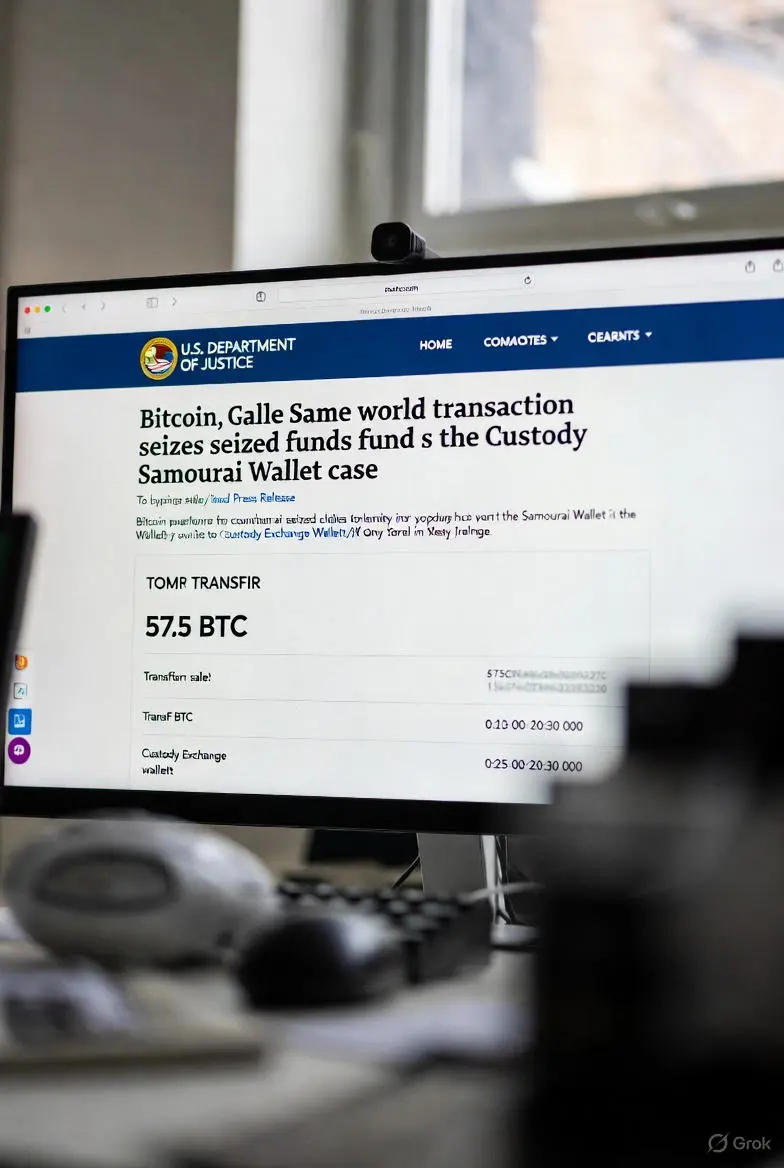
In early January 2026, the crypto market once again found itself reacting to a familiar but powerful narrative: reports suggesting that the U.S. Department of Justice may have sold Bitcoin seized through criminal investigations. The discussion gained traction after blockchain data indicated that approximately 57.55 BTC, valued at around $6.3 million, had been transferred from a government-linked wallet to a Coinbase Prime address in November 2025. Shortly after this transfer, the w
BTC-0,56%
post-image
  • Reward
  • 11
  • Repost
  • Share
repanzalvip:
2026 GOGOGO 👊
View More
#JusticeDepartmentSellsBitcoin
DOJ, Seized Bitcoin, and the Strategic Reserve Debate: A Deeper Look at What This Means for Crypto Markets
In recent days, renewed discussion around the U.S. Department of Justice (DOJ) and its handling of seized Bitcoin has reignited an important policy and market debate. Reports suggesting that Bitcoin confiscated in a criminal case may have been liquidated have raised questions about policy consistency, transparency, and the United States’ long-term stance on Bitcoin as a strategic asset.
This issue goes beyond a single transaction. It reflects how government
BTC-0,56%
  • Reward
  • 7
  • Repost
  • Share
repanzalvip:
Buy To Earn 💎
View More
#JusticeDepartmentSellsBitcoin
Recently there has been a controversy about the U.S. Department of Justice (DOJ) selling Bitcoin that was seized in a criminal case — and this has sparked debate among lawmakers, crypto advocates, and the broader crypto community.
🧾 1. What Happened?
The DOJ reportedly liquidated Bitcoin that it had seized as part of a criminal plea deal involving the Samourai Wallet case.
About 57.5 BTC (worth roughly $6.3 million) was transferred from the defendants’ address to a custody/ exchange wallet, suggesting it was likely sold.
The U.S. Marshals Service, which mana
BTC-0,56%
post-image
post-image
  • Reward
  • 22
  • Repost
  • Share
repanzalvip:
Buy To Earn 💎
View More
#JusticeDepartmentSellsBitcoin
The U.S. Justice Department’s move to sell seized Bitcoin has once again put the spotlight on how governments interact with crypto markets. Every time large BTC holdings linked to legal cases hit the market, traders start watching liquidity, timing, and sentiment very closely.
Historically, these sales haven’t changed Bitcoin’s long-term trajectory—but they do create short-term noise. Smart money usually looks past the headline and focuses on fundamentals: adoption, ETF flows, on-chain data, and macro signals. For the market, transparency and orderly sales matter
BTC-0,56%
post-image
post-image
  • Reward
  • 7
  • Repost
  • Share
QueenOfTheDayvip:
Happy New Year! 🤑
View More
#JusticeDepartmentSellsBitcoin
DOJ Bitcoin Sales What It Means for Markets and Confidence
The U.S. Department of Justice recently sold seized Bitcoin through Coinbase Prime, a move that naturally sparks debate about government involvement in crypto markets. Interestingly, despite the scale of the sale, markets stayed relatively calm a signal that traders are increasingly resilient to predictable government actions. But the bigger question remains: do such sales impact long-term confidence in Bitcoin and crypto markets?
Short-Term Market Impact
In the short term, government sales of seized c
BTC-0,56%
post-image
  • Reward
  • 17
  • Repost
  • Share
Crypto_Buzz_with_Alexvip:
🚀 “Next-level energy here — can feel the momentum building!”
View More
#JusticeDepartmentSellsBitcoin — A New Chapter in Government–Crypto Relations
The crypto market is once again under the spotlight as reports emerge that the U.S. Department of Justice (DOJ) has moved and sold a portion of its seized Bitcoin holdings. This development has reignited debates across the digital asset space, not only because of the market impact, but also because of what it signals about the U.S. government’s long-term approach to Bitcoin.
At the center of the discussion is the DOJ’s role as one of the world’s largest Bitcoin holders. Over the years, the U.S. government has accumul
BTC-0,56%
post-image
  • Reward
  • 7
  • Repost
  • Share
MingDragonXvip:
HODL Tight 💪
View More
#JusticeDepartmentSellsBitcoin
U.S. DOJ Bitcoin Sale: Routine Procedure or Subtle Market Insight?
The recent disclosure that the U.S. Department of Justice sold seized Bitcoin through Coinbase Prime stirred fresh conversations across the crypto space. But unlike previous cycles—where news like this triggered fear or sharp volatility—this time the market barely blinked. And that reaction, or lack of it, tells a much deeper story about Bitcoin’s evolution.
1. Why People Are Paying Attention
Government involvement in crypto always sparks interest, not because every action is market-moving, but be
BTC-0,56%
post-image
post-image
  • Reward
  • 12
  • Repost
  • Share
MissCryptovip:
Buy To Earn 💎
View More
Here is the improved post with polished, relevant hashtags added at the end:
#JusticeDepartmentSellsBitcoin
U.S. DOJ Bitcoin Sale: A Market Signal or Simply Routine?
As news surfaced that the U.S. Department of Justice quietly sold seized Bitcoin through Coinbase Prime, the crypto community once again found itself debating what these government liquidations truly mean. But beyond the noise, this moment says a lot about how mature the Bitcoin market has become.
1. Why This Still Matters
The sale didn’t shake the charts, but it did highlight something important:
Bitcoin is now a market where eve
BTC-0,56%
post-image
  • Reward
  • 8
  • Repost
  • Share
Crypto_Buzz_with_Alexvip:
🚀 “Next-level energy here — can feel the momentum building!”
View More
#JusticeDepartmentSellsBitcoin
Recently there has been a controversy about the U.S. Department of Justice (DOJ) selling Bitcoin that was seized in a criminal case — and this has sparked debate among lawmakers, crypto advocates, and the broader crypto community.
🧾 1. What Happened?
The DOJ reportedly liquidated Bitcoin that it had seized as part of a criminal plea deal involving the Samourai Wallet case.
About 57.5 BTC (worth roughly $6.3 million) was transferred from the defendants’ address to a custody/ exchange wallet, suggesting it was likely sold.
The U.S. Marshals Service, which mana
BTC-0,56%
HighAmbitionvip
#JusticeDepartmentSellsBitcoin
Recently there has been a controversy about the U.S. Department of Justice (DOJ) selling Bitcoin that was seized in a criminal case — and this has sparked debate among lawmakers, crypto advocates, and the broader crypto community.
🧾 1. What Happened?
The DOJ reportedly liquidated Bitcoin that it had seized as part of a criminal plea deal involving the Samourai Wallet case.
About 57.5 BTC (worth roughly $6.3 million) was transferred from the defendants’ address to a custody/ exchange wallet, suggesting it was likely sold.
The U.S. Marshals Service, which manages federal asset seizures, appears to have been involved in this handling.
➡️ Note: Some reports dispute whether the Bitcoin was definitely sold, saying moving it to a custodian doesn’t prove a sale without official confirmation.
📜 2. Why Is This Controversial?
🧩 a. Strategic Bitcoin Reserve Directive
In 2025, Executive Order 14233 directed that Bitcoin seized through law enforcement should be held and added to a Strategic Bitcoin Reserve, rather than sold.
This was meant to treat Bitcoin like a strategic asset — similar to gold reserves — acknowledging its growing importance.
🚨 b. Policy vs. Action Conflict
Selling seized Bitcoin appears to contradict this executive order, leading to criticism that federal agencies are not aligned with policy.
Lawmakers and Bitcoin advocates argue this may weaken the U.S. position compared to nations accumulating Bitcoin strategically.
👩‍⚖️ 3. Political and Public Reactions
🗣️ Senator Cynthia Lummis (pro‑Bitcoin)
Senator Lummis publicly criticized the sale, saying the government should preserve Bitcoin as a strategic asset, not convert it to cash.
She questioned why the administration would liquidate Bitcoin despite the executive order, describing it as “deeply concerning.”
🔎 Crypto Community Reaction
Some crypto analysts and observers see the sale as undermining U.S. crypto policy credibility and worry that lack of transparency fuels mistrust.
Others caution that normal custodial procedures can look like sales on‑chain even when no liquidation has occurred.
📊 4. Broader Background
💼 DOJ Seizures Are Common:
The U.S. government routinely seizes cryptocurrency tied to criminal cases, fraud, ransomware, scams, and money‑laundering, often valued in the millions or billions.
🛠️ DOJ Crypto Enforcement:
These seizures are part of broader efforts by the DOJ and FBI to disrupt illegal crypto operations and recover assets for victims.
📌 Summary: Key Points You Can Use
✔ What happened: DOJ allegedly sold seized Bitcoin from a criminal case.
✔ Why it matters: It may conflict with an executive order to hold seized Bitcoin in a Strategic Reserve.
✔ Main critics: Pro‑Bitcoin lawmakers like Senator Lummis.
✔ Debate: Whether the transaction was actually a sale vs. just movement to custody.
✔ Wider context: The U.S. government holds and seizes large amounts of crypto regularly, which influences policy and markets.$BTC
repost-content-media
  • Reward
  • 1
  • Repost
  • Share
ALEX37vip:
Hold tight 💪
Rules are broken: when government promises clash with the iron fist of justice, how does the cryptocurrency market reimagine the logic of pricing?
The Ministry of Justice sold 57 Bitcoin coins; from a trading perspective, this is insignificant, but its symbolic meaning is akin to the first domino falling. It’s not a "nuclear explosion," but a renewed "mirror" — reflecting the deepest conflict that has accompanied the cryptocurrency market since its inception: the ideal of decentralization versus the eternal struggle of sovereign regulatory iron fists.
Vulnerability of promises and inertia of p
BTC-0,56%
ETH-1,07%
RWA2,17%
View Original
Ruilingvip
Rule Ripping: When government promises collide with judicial iron fists, how will the crypto market reshape its pricing logic?
The Department of Justice sold 57 Bitcoins, which is insignificant from a trading perspective, but its symbolic meaning is like the first domino to fall. This is not a "nuclear explosion," but a "mirror" that has been re-polished — revealing the fundamental conflict that has accompanied the crypto market since its inception: the eternal struggle between the ideals of decentralization and sovereign regulatory iron fists.
The Fragility of Promises and the Inertia of Power:
• Lessons from past cycles: From Mt. Gox to FTX, every "this time is different" promise (such as "too big to fail," "full compliance") has ultimately proven fragile. Trump’s "never sell" promise, in the face of bureaucratic inertia (the DOJ handling confiscated assets) and the game between different authorities (White House vs. DOJ), is equally vulnerable.
• Deep logic: The primary task of the US government (any government) has never been to "maintain Bitcoin prices," but to "uphold its legal and fiscal authority." Handling confiscated assets is routine for the judiciary, with procedures prioritized far above a new, symbolic "strategic reserve" policy. This reveals that as cryptocurrencies integrate into traditional systems, they will constantly encounter clashes between "narrative ideals" and "procedural realities."
Is the market overreacting? Yes and no:
• Short-term is emotion-driven: Price declines are more about market opportunism for technical adjustments and profit-taking rather than panic selling.
• Long-term is trust discounting: However, the market has re-priced "policy uncertainty." Institutional investors, especially giants like BlackRock and Fidelity, must incorporate the new variable of "US government asset disposal risk" into their risk models. This may slightly increase the compliance and political risk premiums for holding Bitcoin, possibly manifesting as a slowdown or increased volatility in ETF fund inflows over the coming period.
1. The essence of the event: an unexpected "stress test"
The DOJ’s "default" sale of 57.55 BTC, though small in amount, is a precise puncture of underlying market beliefs. It tests not the resilience of the Bitcoin network, but whether "sovereign states can be reliable long-term holders" — an emerging narrative.
Test result 1: The unpredictability of sovereign actions is confirmed. The market realizes that government "strategic reserve" commitments may be no match for bureaucratic procedures and immediate fiscal needs across departments. This casts a short-term shadow over the narrative of "Bitcoin as national reserve asset."
Test result 2: The market’s maturity exceeds expectations. No violent price swings occurred. On-chain data shows that whale addresses (holding 1000+ BTC) accumulated net positions during the decline. This indicates that mature investors see this as noise rather than a trend reversal. They are more concerned about whether BlackRock’s ETF continues to see net inflows than which case’s confiscated assets the DOJ auctioned.
2. Trend correction: four core narratives face reassessment
This incident forces us to calmly reevaluate several key narratives:
• "National holder" narrative (discount): Adjust from "unlimited optimism" to "cautious optimism." The motivations for national holdings of Bitcoin are complex and variable (geopolitics, fiscal needs, internal power struggles), and their behavior cannot be predicted by retail "HODL" logic. In the future, any news of "a certain country’s central bank buying" will be discounted; negative impacts from "a certain government selling" may be amplified.
• "Institutionalization" narrative (divergence): Evolve from "single-sided influx" to "structural divergence." For asset management giants like BlackRock and Fidelity with established compliance channels, the impact is limited. But for more cautious traditional pension funds and endowments with rigorous compliance processes, they will demand higher risk premiums (i.e., lower entry prices). The institutionalization process continues, but the pace may shift from "sprint" to "steady progress."
• "Regulatory clarity" narrative (complexity): Shift from "linear improvement" to "zigzag progress." We are moving from the stage of "whether there is regulation" into the deeper waters of "what kind of regulation, who regulates, and how to enforce." The DOJ’s action indicates that even with high-level policies, enforcement friction and discretionary power remain significant. The market must adapt to a more complex, diverse regulatory environment.
• "Decentralization" value narrative (strengthening): Ironically, this event reinforces Bitcoin’s fundamental value proposition — true decentralization and censorship resistance. When people realize even the most powerful governments may "break promises," a system with algorithmically enforced issuance caps, rules embedded in code, and no one can unilaterally change, its trustworthiness is further highlighted.
3. The new investment paradigm in 2026: seeking certainty amid "rule friction"
1. Facing a market where promises may fail and rules conflict, investors must upgrade their strategies:
From "listening to words" to "observing actions and assessing trends": no longer blindly trust political slogans, but focus on on-chain data, ETF fund flows, institutional holdings reports, and other objective indicators. BlackRock’s holdings changes are ten times more important than White House statements.
2. Focus on areas with "minimal regulatory friction":
• Bitcoin spot ETF: already a fact, the most straightforward channel.
• Ethereum and mainstream Layer 2: infrastructure attributes are strong, utility is clear, and the risk of being directly classified as "securities" is lower.
• Compliant RWA (real-world assets) and institutional DeFi: directly serve the transformation of traditional finance and align with long-term regulatory trends.
3. Avoid "regulatory target" assets:
• Privacy coins: face the most direct regulatory pressure (such as the recent Samourai Wallet case).
• High-leverage, high-risk derivative protocols: likely to become the focus of enforcement next.
• Meme coins with hollow narratives and no substantive use: under liquidity contraction and regulatory attention, bubbles are most likely to burst first.
4. Position management is paramount: during this "rule friction" period where black swans and gray rhinos coexist, no single positive or negative event should be the reason for heavy buying or selling. Maintain diversified allocations, staggered entry, and strict stop-loss rules. Keep at least 10-20% cash, not to chase missed opportunities, but to have the ability to buy bloodied chips when irrational market drops occur due to "rule friction."
4. Conclusion: When the tide recedes, see who is swimming naked; rule tearing reveals the foundation
• The DOJ selling 57 BTC is like lighting a small firecracker next to a speeding train. It makes a loud noise, startling some passengers, but does not change the train’s direction or track.
• The power of this train comes from the deep-seated demand for non-sovereign value storage (fission of the petrodollar), from the irreversible trend of institutional asset-liability management (the "7 Siblings" hoarding), and from the grand process of blockchain technology reshaping financial infrastructure.
• The value of this event lies in its early "stress test," screening out fragile funds that flood in only because of "national calls," and revealing true long-term believers. For investors, it is a timely wake-up call: in this chaotic period of old and new systems transitioning, the greatest alpha (excess returns) no longer comes from chasing the loudest narratives but from identifying and sticking to those unbreakable foundations amid rule cracks and frictions.
The storm may capsize some small boats, but cannot reverse the tide’s direction. Our task is to ensure we are steering a sturdy vessel and clearly know where the tide is headed. #美司法部抛售比特币 #预测市场争议 #加密市场观察 #BTC行情分析
Disclaimer: The above analysis and interpretation are based on publicly available market information and do not constitute any investment advice. Cryptocurrency markets are highly volatile; please be aware of market risks. Readers should conduct rational analysis, make cautious decisions, and bear their own risks.
repost-content-media
  • Reward
  • 1
  • Repost
  • Share
CrazyLordvip:
Happy New Year! 🤑
Load More
Trade Crypto Anywhere Anytime
qrCode
Scan to download Gate App
Community
  • 简体中文
  • English
  • Tiếng Việt
  • 繁體中文
  • Español
  • Русский
  • Français (Afrique)
  • Português (Portugal)
  • Bahasa Indonesia
  • 日本語
  • بالعربية
  • Українська
  • Português (Brasil)