As data emerges as a core asset, users are increasingly concerned with how data generates value, how it is traded, and how it delivers returns. JASMY serves as a pivotal connector between data providers and consumers in this ecosystem.
Addressing this topic typically involves analyzing token attributes, functional design, circulation mechanisms, payment and incentive structures, and the impact of total supply and distribution on ecosystem dynamics.
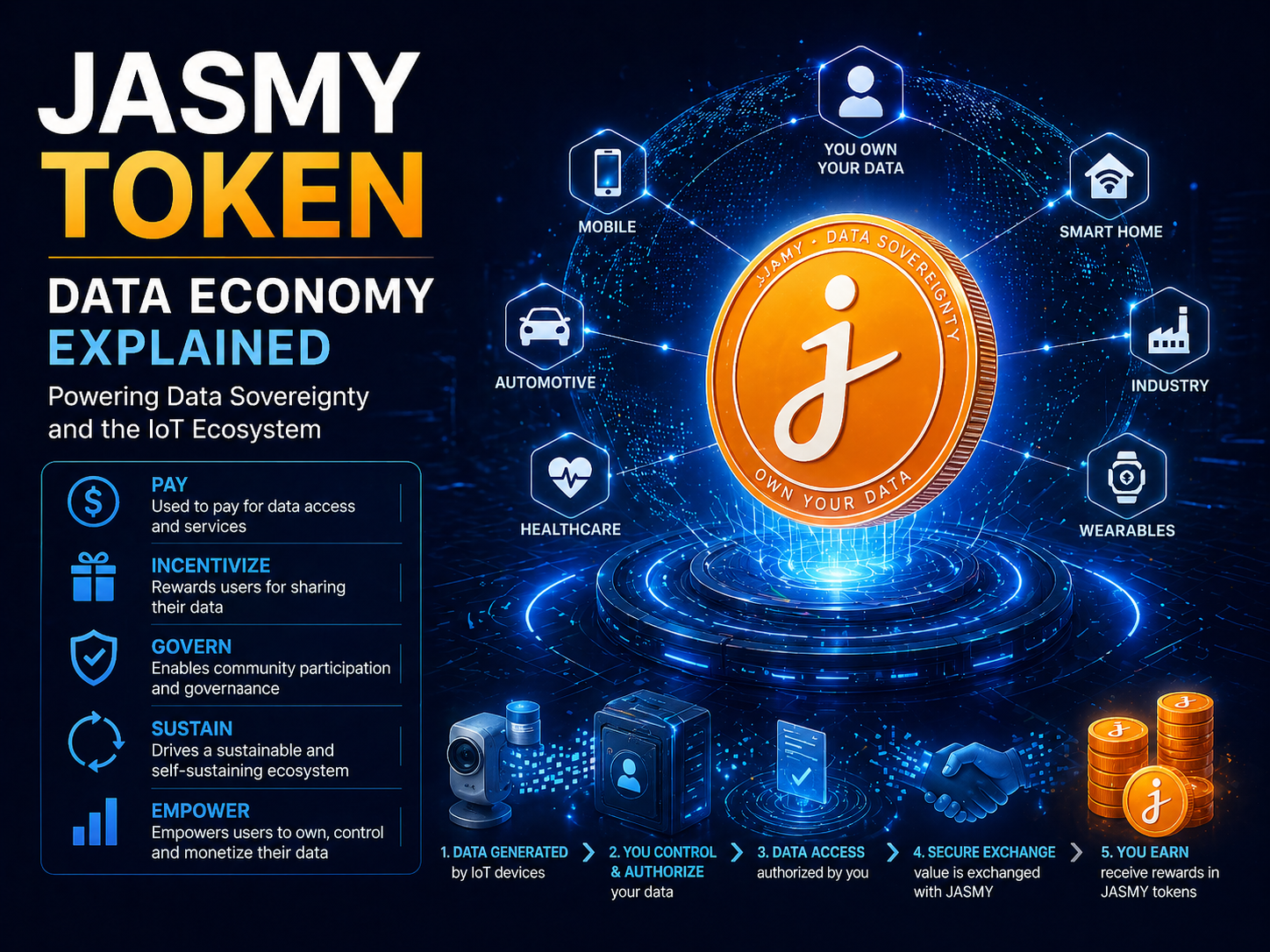
What Is the JASMY Token
The JASMY token is a blockchain asset designed around data sovereignty and data transactions. Its primary function is to provide a value measurement and exchange mechanism for data circulation.
In practice, JASMY transforms data access into quantifiable economic activity, allowing users to earn rewards when they authorize their data, while enterprises pay tokens to access it.
JASMY leverages blockchain technology to record all transaction activity, ensuring transparency and traceability in data usage. Data access is decentralized and completed through authorization and token settlement.
This design converts data from a passive resource into a manageable, tradable digital asset.
Core Functions of JASMY
JASMY’s functions revolve around the data trading system, with a focus on payments, incentives, and ecosystem integration.
Structurally, JASMY fulfills these key roles:
| Function Type |
Specific Role |
Ecosystem Impact |
| Data Payment |
Enterprises pay for data access |
Supports the data trading marketplace |
| User Incentive |
Rewards data providers |
Increases data supply |
| Value Circulation |
Connects supply and demand |
Builds the data economy |
| Access Control |
Integrates with authorization mechanisms |
Restricts scope of data usage |
JASMY functions as both a medium of exchange and a vital connector within the data circulation mechanism, enabling a closed-loop data economy.
How JASMY Circulates in Data Transactions
JASMY’s circulation in data transactions centers on matching data supply and demand, using authorization mechanisms and token settlements to facilitate value exchange.
In practice, users generate and manage their personal data. When enterprises request data, the system matches available data based on authorization rules. Upon receiving access rights, enterprises pay JASMY as a fee for data usage.
This process includes data generation, authorization, usage, and token settlement, all recorded on the blockchain to ensure transparency and traceability.
This approach provides clear pathways for data transactions and establishes a closed value loop through the token.
JASMY in Data Access and Settlement
JASMY enables data usage to be converted into monetizable transactions.
During the access phase, enterprises must obtain user authorization before using data. Authorization alone does not constitute a value exchange; pricing is finalized through JASMY payments.
During settlement, the blockchain records data access and completes token transfers, ensuring full transparency and trust throughout the process.
JASMY elevates data access from a technical process to a market-driven activity, establishing a tangible execution path for data sovereignty.
Incentives and Governance with JASMY
JASMY’s incentive mechanism drives data supply, while its governance function sustains ecosystem operations.
On the incentive side, users are rewarded with tokens for sharing data, increasing participation. Enterprises pay tokens to acquire data resources, creating demand-driven momentum.
On the governance side, JASMY supports ecosystem decision-making and rule modifications, empowering participants to shape the system’s future.
This structure ensures JASMY is used for both transactional purposes and relationship management among ecosystem participants.
Impact of JASMY’s Total Supply and Distribution Structure
JASMY’s total supply stands at approximately 50 billion (50,000,000,000 JASMY), and its distribution structure determines both incentive strategies and the long-term sustainability of the data economy.
Tokens are primarily allocated as follows:
| Distribution Category |
Approximate Share |
Purpose |
| Ecosystem Incentives |
~48% |
Rewards for users and data participants |
| Investors & Partners |
~27% |
Project development and resource integration |
| Team & Operations |
~20% |
Long-term growth and maintenance |
| Foundation & Reserves |
~5% |
Ecosystem stability and future expansion |
A high proportion of ecosystem incentives is designed to encourage user participation and data sharing, increasing supply. Investor and team allocations support ongoing project development.
This distribution approach uses token release mechanisms to balance supply and demand, supporting sustained operation of the data economy. Insufficient incentives reduce user participation; excessive incentives may impact token stability.
Thus, total supply and distribution directly influence Jasmy’s ecosystem growth and data circulation efficiency.
Summary
The JASMY token is the backbone of the Jasmy data economy, supporting data payments, user incentives, and ecosystem governance. By linking data access with token settlement, JASMY grants personal data tradable attributes. The token’s total supply and distribution structure underpin supply-demand relationships and shape ecosystem efficiency and growth.
FAQ
What Is the Total Supply of JASMY
JASMY’s total supply is approximately 50 billion tokens, engineered to sustain long-term data economy operations.
What Are the Main Functions of JASMY
JASMY is primarily used for data access payments, user incentives, and ecosystem value circulation.
How Does JASMY Enable Data Transactions
Enterprises pay JASMY for data usage rights, while users earn tokens by authorizing their data.
What Is the Significance of JASMY’s Distribution Structure
Distribution determines incentive mechanisms and ecosystem development, directly impacting user participation and data supply scale.
Is JASMY Used for Gas Fees
JASMY is intended for data economy applications, not for gas fees in standard blockchain networks.







